

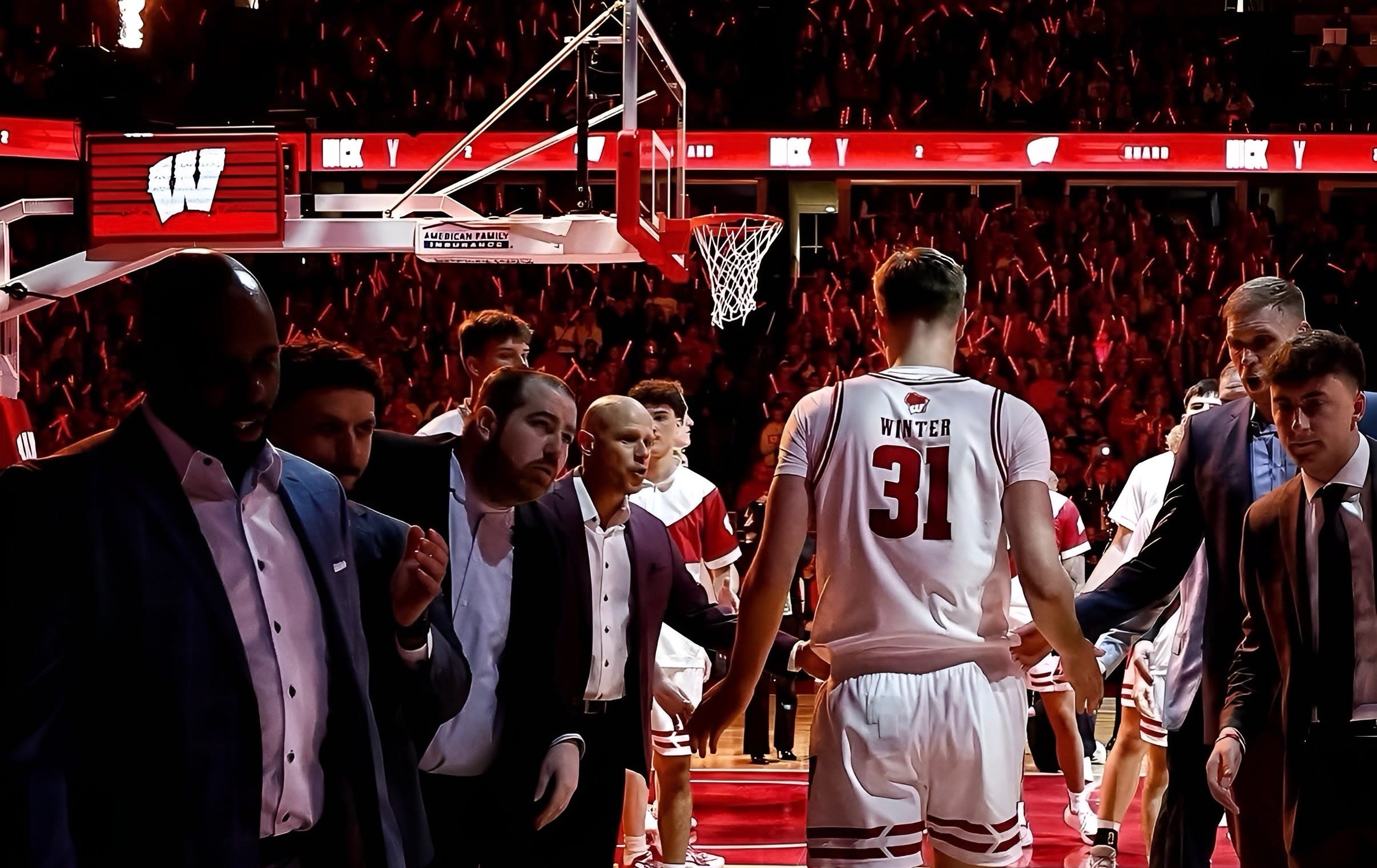
The University of Wisconsin men’s basketball program officially retained its top priority in the frontcourt this offseason.
Nolan Winter announced that he is returning to Madison for the 2026–27 season, giving Greg Gard a cornerstone piece to build around as Wisconsin reshapes the roster. Winter’s decision to remain a Badger for life carries more weight than anything else they’ve done thus far.
“BADGER NATION, I’M BACK,” Winter wrote. “At the end of the day, I couldn’t picture myself anywhere other than with the Wisconsin Badgers. From the moment I stepped on campus, this program has pushed me to grow not only as a player, but as a person. The coaching staff believes in me, my teammates have become family, and the fans show up every night.
“There’s a standard here, a pride in wearing “Wisconsin” across your chest, and that means everything to me. I’m grateful for this place and excited to keep building, keep competing, and give everything I have for this team and city.”


In an era where loyalty is often defined by doing what’s best for you and your family financially, Winter took a slightly different path, staying the course for all four years at Wisconsin while steadily developing his game. It’s a reflection of a program and player who’ve invested in one another.
That context makes what Wisconsin is navigating this offseason worth paying attention to, especially with Winter positioned to provide continuity in the locker room and help carry the program’s culture forward.
The Badgers entered the offseason with plenty of turnover to navigate, starting with the graduation of senior starters Nick Boyd, an All-Big Ten selection, Andrew Rohde, and Braeden Carrington, who served as an important piece off the bench. From there, star combo guard John Blackwell chose to go through the NBA Draft process, enter the transfer portal, and ultimately signed with Duke, further reshaping the roster.
If the Wisconsin Badgers had lost Winter too, they wouldn’t have been building around much of anything. They would have been starting from scratch. Instead, the 7-foot big man stands as the lone returning starter from a team that earned a No. 5 seed in the NCAA Tournament.
That said, Winter didn’t just take a step forward last season. He became one of the most efficient frontcourt players in the Big Ten, and the progression didn’t happen overnight. As a freshman, his PRPG sat at 0.6 before climbing to 3.5 as a sophomore and 4.6 as a junior, according to BartTorvik, reflecting a steady rise in Winter’s impact and usage within the Badgers offense.
The production followed that same trajectory. After averaging 9.4 points and 5.8 rebounds as a sophomore on 56.3% shooting from the field and 35.8% from beyond the arc, the Minnesota native jumped to 13.1 points, 8.5 rebounds, and 1.2 blocks while shooting 56.9% from the field across 31 appearances, cementing himself as a dependable frontcourt presence.
Efficiency wasn’t just a part of his game. It defined it.
He posted a 133.4 offensive rating, per T-rank. The Lakeville North standout finished with 12 double-doubles, the third-most by a Wisconsin player since 2000. And then there’s the number that really makes you pause.
Winter shot 70.1% on two-point attempts. In a league like the Big Ten, where a lot of possessions feel like they’re being played in a phone booth, that kind of efficiency is almost unheard of. In fact, no qualifying Big Ten player had hit that mark inside the arc since the 1986–87 season.
That’s not just productive. That’s remarkably efficient. And in Gard’s offense, which is built around pace, high-percentage looks at the rim, and floor spacing, it’s hard to imagine a better fit. He can run the floor, finish inside, and has already proven he can stretch the defense when needed.
So when you talk about roster construction, you’re not just talking about bringing back a high-quality starter. You’re talking about keeping a foundational piece — especially at a time when proven big men are commanding a premium on the open market.
Winter is a player that Gard can point to when recruiting in the transfer portal as someone to build around and an example of the program’s player development.
Which is exactly what they’ve done.
The Badgers had no choice but to be aggressive in the portal, and it’s not hard to see why. There’s a significant amount of production walking out the door, with as many as four starting spots being replaced heading into next season. That kind of turnover forced their hand. The frontcourt still needs another plug-and-play option following the departures of Aleksas Bieliauskas, Riccardo Greppi, and Jack Robison, all of whom transferred.
But the cupboards aren’t bare.
With Winter back in the fold, along with Austin Rapp — who has already announced his return — and Will Garlock, Wisconsin is expected to retain three rotational forwards. When you factor in the expected return of Jack Janicki, Hayden Jones, and Zach Kinziger on the perimeter and add in two incoming freshmen in the 2026 class, Jackson Ball and in-state forward LaTrevion Fenderson, along with international point guard Owen Foxwell, you can start to see the vision for next season’s team coming together.
From there, the staff has worked to supplement that group through the portal to fill gaps, adding Hofstra big man Victory Onuetu, Miami (OH) wing Eian Elmer, and George Washington guard Trey Autry to round out the roster and provide experienced depth across multiple spots.
It’s not a finished product. Not even close. But it’s a good start. And in today’s college basketball landscape, Winter’s retention might be the difference between simply reworking the roster with a few targeted players who fit your system and having to tear it down and start over.
Keeping Winter doesn’t solve everything. It doesn’t replace all of the production the Badgers lost. But it keeps Wisconsin from drifting into uncertainty without a compass. As the saying goes, sometimes the most important additions you make in the offseason are the players you keep.
Winter’s decision to spend his entire career in one place is becoming increasingly rare. It’s a reminder of what college basketball used to look like — and a chance to appreciate a player and a program that chose to see it through together.
We appreciate you taking the time to read our work at BadgerNotes.com. Your support means the world to us and has helped us become a leading independent source for Wisconsin Badgers coverage.
You can also follow Site Publisher Dillon Graff at @DillonGraff on X.