

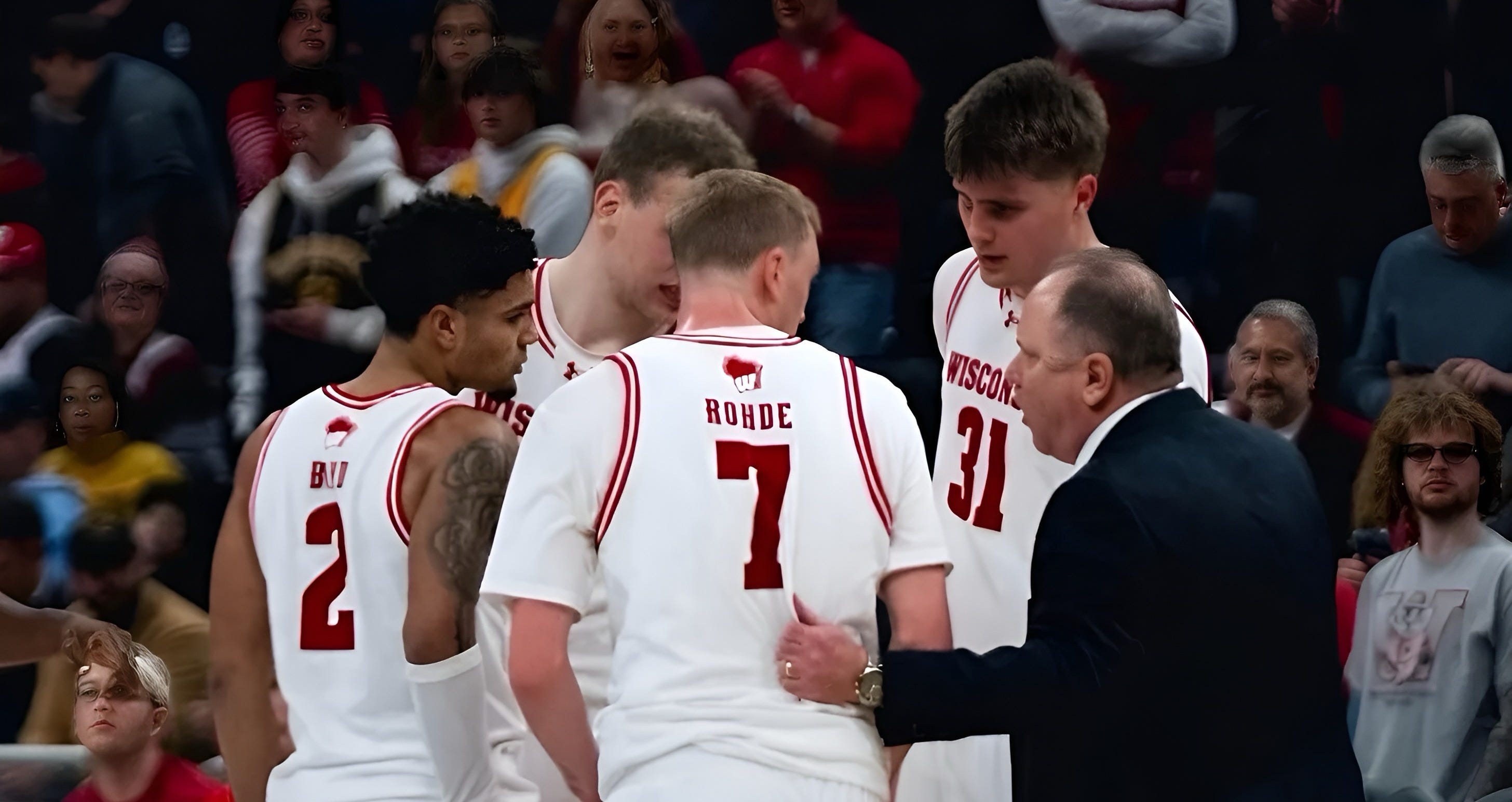
Greg Gard didn’t need a whiteboard or a lengthy explanation to tell you where the Wisconsin men’s basketball team (7-4, 1-1 Big Ten) stands.
Following the Badgers’ 76–66 overtime loss to Villanova, Gard didn’t shy away from what he saw. After Wisconsin clawed back from a 15-point deficit and forced overtime with a strong second-half push, the two-time Big Ten Coach of the Year spoke about the standard he expects to see and the reality that comes with it. Those who meet it will play. Those who don’t will have to earn their way back onto the floor and into the rotation.
“I thought the second half showed who we can be — who we need to be,” Gard said. “It’s what we’ve been asking for in terms of effort and commitment on the defensive end. Those five or six guys showed me who I need to have on the floor, and other guys have to continue to rise to that expectation. I thought the first half we weren’t aggressive enough — one offensive rebound, no free throws, and not good enough defensively.
“The second half is what I’ll hold on to and build upon, and these guys will as well, as we talked about in the locker room. But the solace I’ll take is those 20 minutes in the middle — that’s the type of team we need to be defensively, and we’ve got to get more guys playing to that level. We’ll learn a lot from this. Nobody’s feeling sorry for you. We have to continue to get better. I’ve seen teams come through way harder challenges.”
Gard said it without frustration or panic, but with clarity. He believes this group is capable of playing the right way consistently, and when it does, the path forward is clear. The responsibility now sits with the players to prove they can sustain that level together, possession after possession.
From there, the message shifted from reaction to alignment, with the film, analytics, and personnel all needing to point in the same direction.
Gard is not searching for answers as much as he is waiting for the buy-in to become habitual. The staff has already seen proof of concept. In the second half against Villanova, Wisconsin defended with purpose, holding the Wildcats to 8-of-29 shooting (27.6%), running them off the 3-point line (1-for-10), and limiting them to an impressive 0.778 points per possession.
That stretch showed what this group looks like when it’s connected defensively instead of defending as individuals. The challenge now is making that level the standard and finding out how many guys are willing to commit to the connective work it takes to sustain it over 40 minutes.
That connective tissue, more than any single schematic issue, has defined Wisconsin’s uneven start. Offensively, the Badgers have drifted into isolation far too often, especially when possessions stall or adversity hits.
When the ball sticks, spacing shrinks. When spacing shrinks, reads get rushed. And when the offense loses its rhythm, the defense tends to follow suit. Gard has been consistent in pointing this out, not as a criticism of effort but as a reminder that the two ends of the floor are inseparable.
“When you’re not aggressive defensively, then you’re kind of wishy-washy offensively too, and you’re not in attack mode,” Gard explained. “You’re not playing with an aggressive mindset. Second half, we played with a more aggressive mindset. And we got shots to go in. We got better shots. We were at the rim more. We’ve got to get more than 10 free throws.”
There are players on this roster capable of scoring in bunches. Wisconsin, currently sitting at No. 48 in KenPom’s adjusted offensive efficiency, has several players who can manufacture a basket when needed. Look no further than the backcourt pairing of Nick Boyd and John Blackwell, who are averaging 20.1 and 19.1 points per game for the Badgers, respectively.
“They were the first two guys in my office,” Gard said after the Nebraska loss. “It was about understanding the analytics behind it, breaking down the science behind the shooting percentages, them individually, and how their individual play can improve to help the team. They’re obviously two leaders. But the younger, less experienced guys follow their example.
“If we’re taking shots that are out of character, if we’re not guarding like we should, they’re setting examples... When those guys help follow that plan, everybody else falls in line and has the same discipline offensively.”
But Gard has been clear that reaching the team’s full potential will require a lot more than microwave offense. It demands consistently moving without the basketball, defensive engagement that does not waver from possession to possession, and a willingness to impact the game even when shots are not falling. Those details, not box scores, dictate trust.
And that circle of trust has become increasingly concentrated as of late. Against Villanova, Wisconsin leaned heavily on a small core of players that defended, rebounded, and communicated at the expected level.
The minutes reflected it. The “iron five,” as Gard described them: Boyd, Blackwell, Nolan Winter, Andrew Rohde, and Aleksas Bieliauskas, did the heavy lifting when the game tightened up, with freshman guard Hayden Jones earning an extended look with senior Braeden Carrington sidelined by injury. Jones made the most of those limited minutes by staying connected & engaged defensively, competing on the glass, and playing within himself.
It was not an indictment of the rest of the Badgers roster so much as an acknowledgment of who met the standard in real time. Austin Rapp, Jack Janicki, and Will Garlock were part of the rotation early, but as Wisconsin made its push in the second half, that group tightened up in a major way.
Gard has already proven that he is not afraid to make changes, regardless of preseason expectations or financial investment. That has been most evident in his willingness to remove Rapp from the starting five and scale back his role in favor of Bieliauskas after a stretch where the consistency on both ends simply wasn’t there. The areas that matter most to Wisconsin’s functionality have driven that decision: defending ball screens, rebounding, and staying engaged offensively when the ball isn’t in your hands. Those small details determine the quality of a possession.
In Bieliauskas, Gard has found a player who may not yet offer the offensive upside of others but provides stability. His ability to defend ball-screen actions, rebound in traffic, and remain disciplined within the scheme has, for the most part, helped, especially as Wisconsin tries to establish an identity it can trust. Carrington’s injury has further opened the door for Jones, whose professional experience and willingness to compete defensively could help steady a rotation that remains in flux.
None of this feels punitive. It feels deliberate.
Gard and his staff have not lowered expectations to meet the roster’s inconsistency. Instead, he has held the line and made it clear that roles will be determined by dependability. That’s been well communicated.
Wisconsin is capable of playing winning basketball. The Badgers have already shown it. The question is whether that can become the norm.
But the margins tell a revealing story. In Wisconsin’s four losses, the average margin of defeat is 19.75 points, with the 10-point overtime loss to Villanova serving as the lone game that remained competitive into the final minutes. In contrast, the Badgers’ seven wins have come by an average of 23.7 points. That disparity underscores a prominent issue: when the Badgers don’t jump out early or have shots falling, they have struggled to steady themselves and fight their way back into games.
Closing that gap is critical, especially with a defense currently rated No. 55 nationally in adjusted efficiency by KenPom. For this team to take the next step, that number and the consistency behind it have to improve.
That commitment, as Gard framed it, does not rest with the staff drawing up a ton of new solutions. It rests with the players holding themselves and each other accountable. Playing together, defending together, and committing to the dirty work that allows talent to matter in the first place.
Wisconsin Badgers associate head coach Joe Krabbenhoft and special assistant Brad Davison, both products of that exact standard, stand as reminders inside the basketball program that those details win games.
A shortened rotation like this is not sustainable across a full Big Ten season, particularly in the frontcourt. Gard does not currently have a lot of trust in his bench, and some of the players he has leaned on simply are not producing at a level that consistently supports winning basketball.
Wisconsin is going to need complementary scoring and dependable offensive minutes beyond the big three of Blackwell, Boyd, and Winter. Defending the right way will always be the price of admission, but the offense still has to show up from somewhere else. How and where that support comes from will go a long way in determining whether this team is still playing in March or watching the NCAA Tournament from home.
There is still enough talent in this locker room for the season to regain its footing. Gard believes that. The second half against Villanova reinforced it. But belief alone will not close the gap. Consistency will. And until that consistency becomes collective rather than situational, Wisconsin will continue to operate on thin margins against teams that are further along.
The standard is clear. The path is there. The rest is up to them.
We appreciate you taking the time to read our work at BadgerNotes.com. Your support means the world to us and has helped us become a leading independent source for Wisconsin Badgers coverage.
You can also follow Site Publisher Dillon Graff at @DillonGraff on X.
Good explanaton of what we have seen so far--disappointing, but you have to know the problem before you can fix it.