

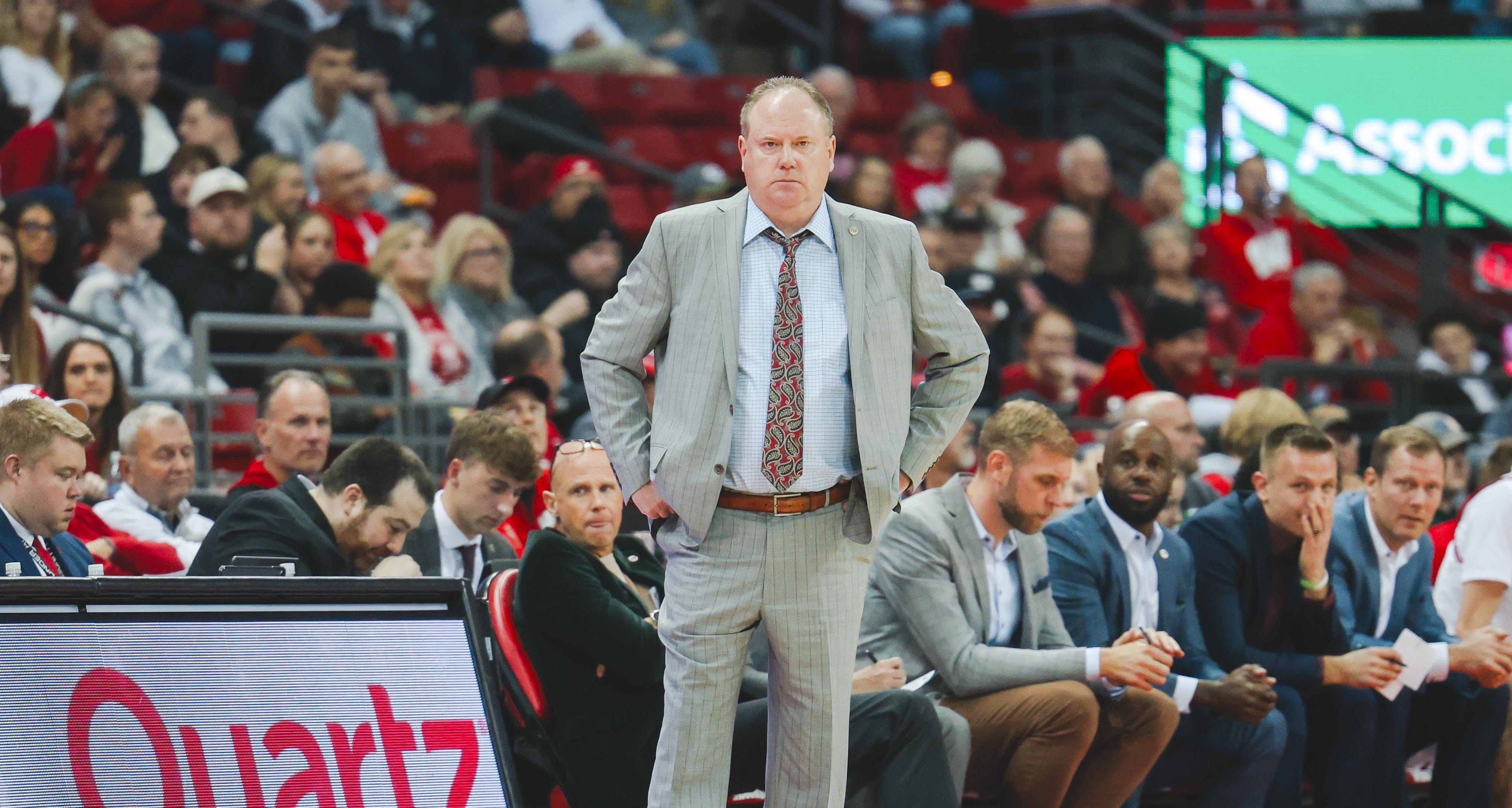
The Wisconsin men’s basketball team didn’t spend the days after its blowout loss at Nebraska pretending it was an anomaly that would fix itself with time. Greg Gard made that clear before the Badgers’ matchup against Villanova, framing the week as more of a gut check than a reset.
The numbers paint a team caught between identities. Wisconsin sits at 7-3 overall, rated No. 41 nationally in adjusted offensive efficiency and No. 49 in adjusted defensive efficiency, according to KenPom. That profile is solid, but it is not close to the version that Gard outlined back at Big Ten Media Day, when he spoke openly about chasing a top-10 ceiling on both ends. The Nebraska loss simply forced the conversation into the open.
“A lot of work on the defensive side of the ball,” Gard said when describing Wisconsin’s focus in the days following the loss.
“A lot of film work when we got back. Took the time to really peel that apart and sit and talk the guys through everything with it. Quite frankly, we’ve just got to play harder. You can solve a lot of problems and cover a lot of warts if you play harder, and that’s something I didn’t think we did when I watched it in person and going through the film. I felt that we needed to just play with more fight to us. We got way out of character.”
Gard did not frame the issue as being about scheme or toughness. He framed it as engagement. When the Badgers play hard, he believes the physicality shows up naturally. When they don’t, everything erodes fast.
“When you don’t play hard, it looks like you’re not physical,” Gard said. “And when you play hard, your physicality comes out. You’re just engaged more. The biggest thing is playing harder will cure a lot of the ills.”
He acknowledged that effort has been better since returning to practice, but stressed that improvement has to show up when the lights are on.
“They’ve come back and practiced pretty well. And then you’ve got to make sure you take the steps forward,” Gard said. “For whatever reason, we didn’t bring it like we needed to bring it. It better be an anomaly. And then you shuffle guys in that understand how important that is.
“But we also got disconnected. Do we not handle adversity well? If they make a run on us, we don’t punch back. So we’ve got to mature and grow in those areas, and it starts with just playing hard.”
That lack of connectivity, Gard explained, is often what shows up first when effort dips — and it’s something opponents are quick to exploit.
While the defensive performance at Nebraska lacked consistency across the board, Gard did point to a few players who have largely done what has been asked on that end of the floor. Jack Janicki and Andrew Rohde, in particular, were singled out as players who have been reliable defensively for much of the season by his evaluation.
At the same time, Gard made it clear that nothing is set in stone. If defensive urgency doesn’t improve, rotation tweaks and playing-time adjustments remain on the table as Wisconsin searches for the right combinations to fix its identity and improve the quality of shots it’s generating on both ends.
The Badgers have looked dominant at home, flowing offensively and feeding off rhythm. On the road and on neutral floors, that edge has vanished. Against Nebraska, the breakdown was evident at every level.
Late rotations. Overextended closeouts. A defense guarding individuals instead of guarding space. Simply put, they’re not playing team defense.
“We got way out of character from who we need to be and how hard we need to play,” Gard said. “Because when we play hard, we’re a pretty good team.”
Gard acknowledged that Nebraska exploited Wisconsin’s impatience offensively just as much as its defensive disconnection. Of the 32 3-point attempts the Badgers took in Lincoln, 15 were internally graded out as bad shots, the highest percentage they have had all season. Those quick misses fed Nebraska’s transition game and left the Badgers scrambling.
“When you’re quick shooting and taking bad threes, now you’re caught in transition, and then we get scattered,” Gard said. “I told the team, not less threes. Better threes. If we take better ones, the results will be better. It’ll help set our defense and keep us from playing in scramble mode.”
“Just in general, the whole theory is: make sure we’re back. Make sure the offense is really good,” Gard explained. “We want stuff at the rim. I told the team not less threes. Better threes. If we take better ones, the results will be better. It’ll help set our defense, get to the free-throw line more by playing through the paint more, then get back and get our defense set so we’re not playing in scramble mode as much as we were that night.”
The data helps support that emphasis. Wisconsin is currently attempting 32.9 3-pointers per game, the 10th-most in the country, but is converting just 33.1% of those looks, a mark that ranks 208th nationally.
That message has been delivered directly to Wisconsin’s leaders. Gard met individually with John Blackwell and Nick Boyd before addressing the whole team, leaning heavily on film and data points rather than emotion.
“They were the first two guys in my office,” Gard said. “It was about understanding the analytics behind it, breaking down the science behind the shooting percentages, them individually, and how their individual play can improve to help the team. They’re obviously two leaders. But the younger guys and less experienced guys follow their example.
“If we’re taking shots that are out of character, if we’re not guarding like we should, they’re setting examples... When those guys follow that plan, everybody else falls in line and has the same discipline offensively.”
Gard was especially candid when talking about Blackwell, coming off a rough night after earning Big Ten Player of the Week honors. The issue, Gard stressed, was not shot-making, but overall impact on the game.
“It’s not because you’re 1-for-11,” Gard said. “It’s because you weren’t engaged in impacting the game in ways that you have your whole career. You’ve got to continue to have that same DNA in your game that you had as a freshman and what got you on the floor as a freshman.
“Don’t forget those things that made you who you were as a freshman. Keep those things. When he’s really good, he’s making all those other plays too. It’s not just scoring 30 a game. It’s all the other ways he impacts our team.”
All of that context makes Friday night’s game against Villanova feel less like a non-conference showcase and more like a litmus test.
The Wildcats, now led by head coach Kevin Willard, bring an offense ranked No. 29 nationally in adjusted efficiency and a team identity built on physicality, offensive rebounding, and disciplined half-court execution rather than creating defensive pressure. That profile will test Wisconsin’s attention to detail more than its ability to handle defensive pressure.
Gard is not pretending one game will solve everything.
“No matter who you’re playing, the next game is the most important thing,” Gard said. “We’ll get better. Because we have to. And regardless of the outcome on Friday, we’ll have to get better as we go through the rest of the non-conference and then back into the Big Ten play.”
Nebraska exposed the gap between who Wisconsin wants to be and who it currently is. Villanova now provides the next measuring stick. The Badgers do not need perfection. They need to demonstrate resilience and an ability to withstand adversity. They need connectivity. Most of all, they need to rediscover the defensive urgency that once defined the program.
If that does not show up in Milwaukee, some of the questions raised in Lincoln will only get louder as the season progresses. Wisconsin will get its chance to respond Friday night, tipping off against Villanova at Fiserv Forum on December 19 at 7 p.m. CT. The game will be broadcast on Fox.
We appreciate you taking the time to read our work at BadgerNotes.com. Your support means the world to us and has helped us become a leading independent source for Wisconsin Badgers coverage.
You can also follow Site Publisher Dillon Graff at @DillonGraff on X.