

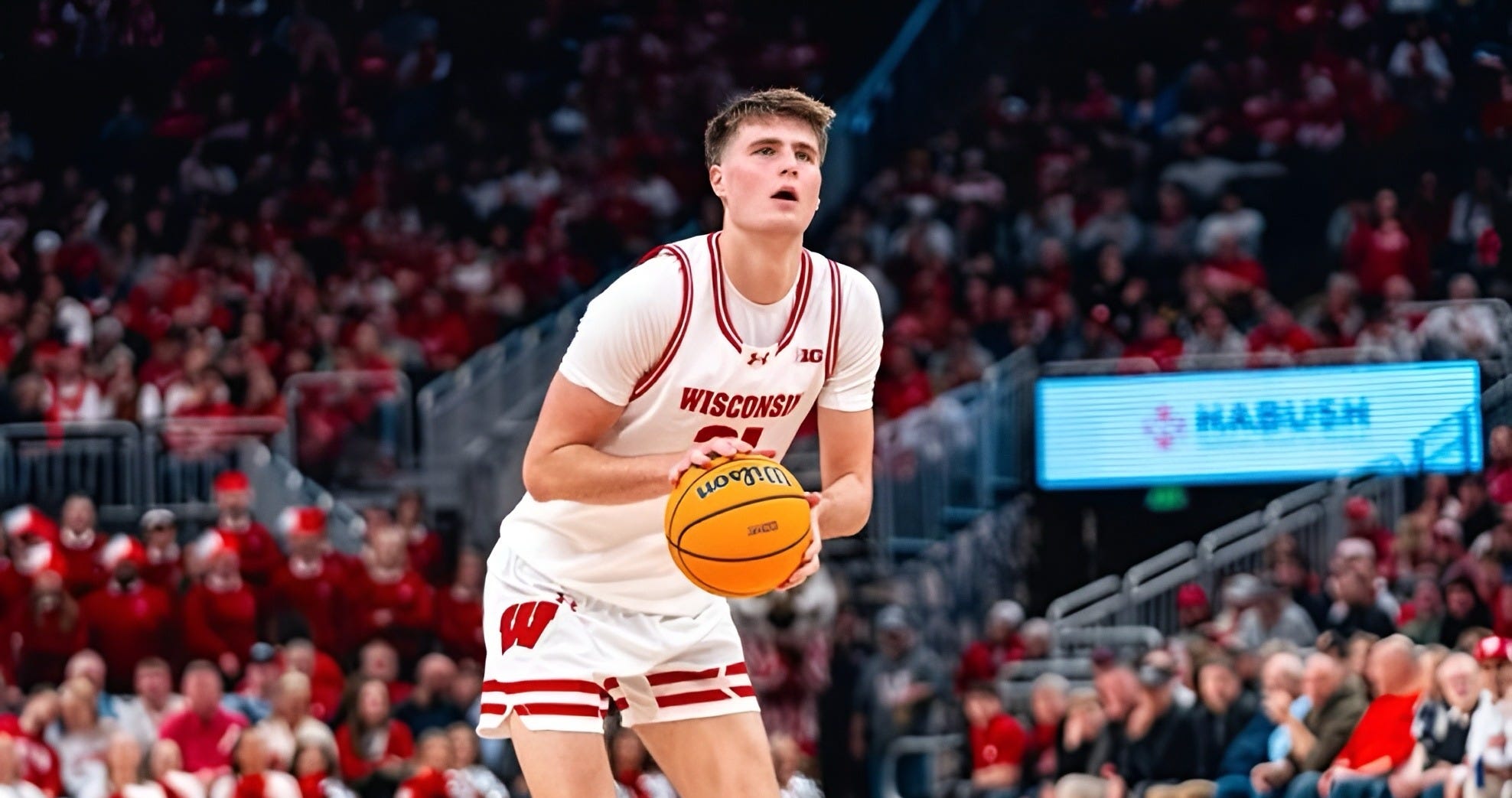
The Wisconsin men’s basketball team walked off the floor at Fiserv Forum knowing it had let a meaningful opportunity slip away in a game that mattered, a realization sharpened by the fact that the Badgers now sit at 7–4 overall and have dropped four of their last seven contests.
What began as a sluggish, disjointed evening on both ends of the court eventually turned into a gritty, workmanlike comeback, only to end with the Badgers running out of answers in overtime as Kevin Willard and the Villanova Wildcats (9-2) pulled away for a 76–66 win in Milwaukee.
Wisconsin did manage to claw its way back, erasing a 15-point second-half deficit by finally attacking the paint and moving with purpose away from the ball. The Badgers closed regulation on an 18–6 run to force overtime, but on a night that required sustained precision and composure from the jump, too many of those traits showed up too late or not at all.
“For us, I thought the second half showed who we can be, who we need to be,” head coach Greg Gard said postgame. “It’s what we’ve been asking for in terms of that effort and commitment on the defensive end, and then you claw yourself back from down 15. Those guys who did that were a part of it. Those five or six guys showed me who I need to have on the floor, and other guys got to continue to rise to the expectations.
“The solace I’ll take is that 20 minutes in the middle that we have to build upon. That’s the type of team we need to be from a defensive standpoint. We’ve got to get more guys playing to that level. We’ll learn a lot from this. As I told them, nobody’s feeling sorry for you. We have to continue to get better. I’ve seen teams come through way harder challenges.”
Here’s what stood out from Wisconsin’s loss to Villanova.
Ball security and offensive cohesion were issues
For as much as the conversation around this team has centered on defense, rightfully so, the biggest reason Wisconsin lost this game to Villanova was offensive issues, particularly early on and in overtime.
The Badgers scored just 22 points in the first half, failed to attempt a single free throw, grabbed only one offensive rebound, and committed eight turnovers that short-circuited any chance to establish rhythm. By the time Wisconsin settled into the game, it was already climbing uphill.
Villanova’s approach wasn’t complicated. The Wildcats applied pressure at the point of attack, crowded driving lanes, and dared Wisconsin’s secondary options to make quick decisions. Too often, they didn’t. Players passed up clean looks, hesitated on drives, or forced passes that weren’t there. The result was a season-high 16 turnovers, double Villanova’s total, and a decisive 15–3 disadvantage in points scored off those mistakes.
Even as Wisconsin finished the game shooting a respectable 44.6% overall and 43.5% on 3-pointers, the damage had already been done. The Badgers averaged just 0.985 points per possession, struggled to generate paint touches consistently, and attempted only 10 free throws all night.
“When you’re not aggressive defensively, then you’re kind of wishy-washy offensively too, and you’re not in attack mode,” Gard explained. “You’re not playing with an aggressive mindset. Second half, we played with a more aggressive mindset. And we got shots to go in. We got better shots. We were at the rim more. We’ve got to get more than 10 free throws. We shot none in the first half, which told me about our lack of aggression.”
In overtime, the offense unraveled again. Wisconsin went 3-for-12 from the field, launched eight 3-point attempts in five minutes, and never was able to reestablish the downhill mindset that fueled the comeback.
The finish also showed just how thin the margin was for this group.
Wisconsin received just two points from its bench (Hayden Jones) on a night when Braeden Carrington was unavailable, leaving little room for error. Nolan Winter delivered a career night with 23 points, 11 rebounds, three assists, and two blocks, and Nick Boyd provided steady production with 19 points, four rebounds, four assists, and two steals. John Blackwell scored 14 points but was inconsistent and fouled out, while Andrew Rohde added six points, four rebounds, and three assists.
The top-end production was there, but it was uneven, and without supplemental scoring, it wasn’t enough to carry the Badger through the final stretch.
With so many new pieces still learning how to play together, some of this was to be expected. But that doesn’t make the loss any less costly. With the nonconference slate nearly complete, the margin for error is shrinking.
Nolan Winter delivered a performance worth building around
If Wisconsin’s coaching staff was searching for proof of tangible growth coming off its blowout loss to Nebraska, Nolan Winter provided it.
The junior forward authored arguably the best game of his career, finishing with 23 points, 11 rebounds, three assists, and two blocks on an efficient 9-of-11 shooting, including four 3-pointers. It marked Winter’s sixth double-double of the season and the ninth of his Wisconsin career.
But the box score only captures part of his impact. Winter’s presence brought stability to Wisconsin during its best stretches, especially in the second half when the Badgers finally began defending with purpose. His influence showed up everywhere. He altered shots at the rim, knocked down perimeter looks, and used his length to disrupt Villanova’s spacing.
Emotion poured out afterward. Winter spoke openly about standards, effort, and what it means to wear Wisconsin across his chest. That mattered. Not because of sentiment, but because it reflected leadership in real time. When Winter plays with confidence, his game elevates everyone around him. Wisconsin needs that version of him every night.
“This team is full of winners,” Winter said. “I know I’m a winner. To go through losses and trials like that, it’s not what I hold this team to be. I know that we’ve got more in the tank. I know what it means for us to wear Wisconsin across our chest. To go out there and not show the effort that the state of Wisconsin deserves, the program deserves, it sucks.”
From Gard’s perspective, Winter’s response proved how much he cared.
“He’s a competitor,” Gard said of Winter. “It bothers competitors when you’re not successful because they put a lot of time into their craft, and they have great pride representing a team and playing for and with their teammates. Winning matters to Nolan, and that’s good to see.”
Winter’s night also came with a heavy workload. He logged a team-high and career-high 43 minutes, carrying the brunt of the frontcourt responsibility as Austin Rapp saw 16 total minutes, only six of which came in the first half, and Will Garlock played just one minute. Questions about sustainability will naturally follow, but the minute distribution felt less like an accident and more like a message to the team. Gard trusted Winter to set the standard, leaned into it, and asked the other players to catch up.
“They’ve got to step forward, and they’ve got to mature and grow and improve at a fast rate,” Gard said of his frontcourt. “They see what Nolan’s doing. That’s the example. That’s the standard. Meet the standard.”
Rapp finished the night without a point scored, recording two assists and a block while missing both of his 3-point attempts. Garlock did not register a counting stat, posting a minus-3 plus-minus in limited action as Wisconsin leaned heavily on its starting frontcourt options. Aleksas Bieliauskas added two points on 1-of-4 shooting and six rebounds, three of them on the offensive glass, with an assist and a block in 28 minutes.
40 minutes of consistency continues to elude Wisconsin
Wisconsin showed, unmistakably, that it can play winning basketball. The problem is that the team only did so in stretches.
The Badgers allowed just 21 points in the second half, held Villanova to 8-of-29 shooting over that span (27.6%), including 1-of-10 from beyond the arc, and closed regulation on an 18–6 run to force overtime. That version of Wisconsin defended as a unit, communicated well, moved with purpose offensively, and played with an edge. It looked connected. In many ways, it looked like the Wisconsin Badgers team that Gard has been asking for.
But it did not last.
Villanova opened overtime by scoring the first seven points, including a momentum-swinging 3-pointer on the opening possession. Wisconsin never recovered. The Wildcats scored 20 points in the extra period on a perfect 5-for-5 shooting, while the Badgers drifted back into taking quick perimeter shots, which resulted in stalled possessions. The inability to sustain identity across 40 minutes remains the defining issue of this team.
Until that consistency becomes habitual rather than reactive, Wisconsin will continue to live on narrow margins against quality opponents.
Gard framed the breakdown as being less about scheme and more about emotional discipline between possessions as the underlying issue.
“We can’t allow a defensive miscue or something to force us to do something out of character offensively,” Gard said. “So you say, all right, don’t make defensive mistakes and give up easy baskets or things you’re trying to take away. We’re still in a learning process of not allowing that to affect us emotionally, and that’s a maturity thing. Even though they’re correlated, you can’t let something that goes wrong on one end affect you on the other and get you out of what has made you successful.”
That reality carries weight. Through 11 games, Wisconsin owns just one win against a team ranked inside KenPom’s top 60, a victory over No. 57 Northwestern. The losses have come against quality competition: No. 8 BYU, No. 64 TCU, No. 22 Nebraska, and No. 29 Villanova, but those results still narrow the margin for error moving forward. Big Ten play will bring more chances, but the runway to clean things up is getting shorter.
What’s next
Wisconsin returns to the Kohl Center on Monday night to face Central Michigan, with the tip time set for 7 p.m. on BTN. The opponent matters less than the response. The Badgers have shown flashes of what they can be. Now comes the harder part: turning those flashes into something sustainable before the calendar flips and every error gets magnified.
We appreciate you taking the time to read our work at BadgerNotes.com. Your support means the world to us and has helped us become a leading independent source for Wisconsin Badgers coverage.
You can also follow Site Publisher Dillon Graff at @DillonGraff on X.
My fingers remain crossed. Gard is the best.