

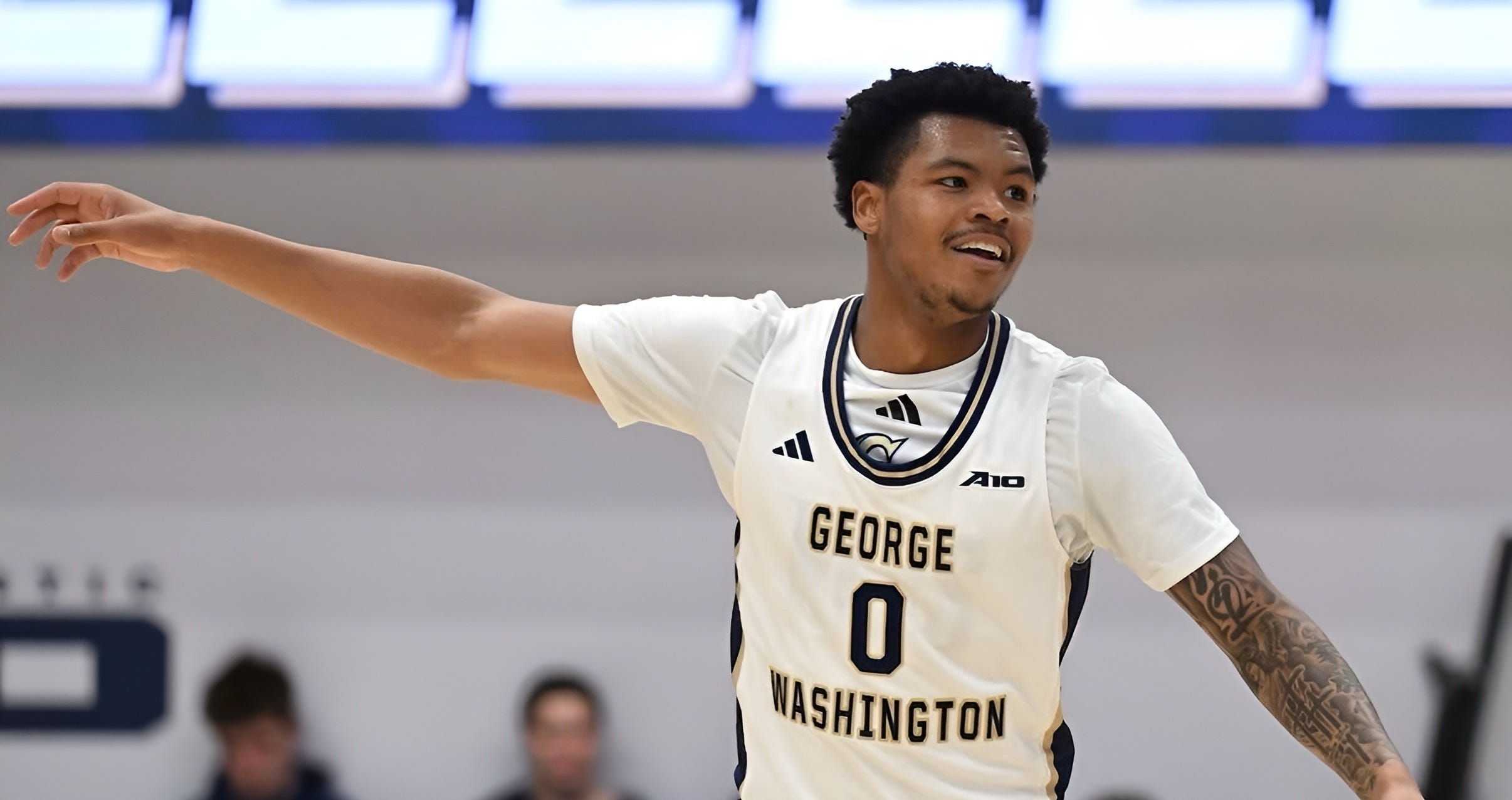
The University of Wisconsin men’s basketball program has added a transfer portal guard from the mid-major ranks.
The Badgers landed a commitment from former George Washington guard Trey Autry. This move gives Greg Gard and his staff another experienced perimeter piece who understands how to play within a role. The news was first reported by Matt Zenitz and confirmed by BadgerNotes.
“We are very excited to have Trey coming to Wisconsin,” Gard said . “He brings some size, physicality, and experience to our backcourt. As a son of a coach, his basketball IQ is high and his ability to stretch defenses from 3 is a great asset to our offensive balance.
“We are looking forward to beginning preparation for next season when he gets to Madison this summer.”


Autry, a 6-foot-4, 210-pound guard, comes to Madison after appearing in 100 career games with 68 starts across three seasons at George Washington. This past year, he started all 34 games, averaging 11.0 points, 3.5 rebounds, and 1.5 assists in just under 29 minutes per game.
The production is solid. The efficiency is what stands out.
Autry shot 43.5% from the field and 38.5% from beyond the arc on high volume, attempting more than six threes per game. He finished fifth in the Atlantic 10 in total made threes with 84, despite taking the second-most attempts in the conference. And the consistency for Autry was there, too, knocking down at least one 3-pointer in 31 of 34 games last season.
This is a player who knows exactly what he is.
"His shot-making numbers are incredible,” George Washington coach Chris Caputo said of Autry. “He’s just not a mistake player, rarely a guy who does something outside of himself, and because of that, just incredibly efficient.”
More than 75% of Autry’s field goal attempts across his college career have come from 3-point range (498 attempts), and he’s converted at a 37.6% clip over that span. Autry is a perimeter-oriented guard who thrives as a spot-up option and has developed into a reliable scoring threat.
According to Barttorvik, Autry posted a 2.8 PRPG with a 125.4 offensive rating while operating at a modest 15.3% usage rate. That combination reinforces what the eye test shows. He’s efficient, he plays within himself, and he doesn’t need the ball to impact winning.
So where does he fit?
There’s a clear parallel to what Wisconsin got from senior guard Braeden Carrington a season ago. An experienced player stepping into a defined role, bringing shooting and stability off the bench, and understanding how to complement the pieces around him. And when you look at George Washington’s roster makeup, with eight players averaging 8.0 points or more per game, it suggests Autry comes from a culture that encouraged operating within a team-first structure rather than isolation basketball.
With players like Nolan Winter and Austin Rapp expected back to anchor Wisconsin’s frontcourt, along with Australian point guard Owen Foxwell facilitating and creating looks, the value of another perimeter shooter becomes obvious. Autry gives the Badgers coaching staff the ability to keep spacing intact and maintain the offensive flow when rotations shift.
He also adds another veteran presence who can lead by example and create more competition for minutes in the backcourt with returning options like Jack Janicki, Hayden Jones, and Zach Kinziger, as well as incoming freshmen LaTrevion Fenderson and Jackson Ball.
And that’s where this addition starts to matter more than it might seem.
In a system that continues to lean into pace, spacing, and shot creation through a European-influenced ball-screen continuity offense, having multiple shooting threats on the floor at all times is critical. Wisconsin finished 10th in KenPom’s adjusted offensive efficiency last season, and if the goal is to maintain that standard, additions like this make a lot of sense.
Autry projects as someone who can come off the bench, provide instant offense, and keep defenses honest without disrupting the group’s rhythm. There’s also value in the experience piece. With over 100 Division I games under his belt, Autry fits what this staff has clearly prioritized: keeping the roster older and more reliable. The less projection involved, the better.
He’s not being brought in to take over games. He’s being brought in to fill a defined role and help finish them. And in an offense that continues to lean more and more into the three-point shot, that role carries real value.
Wisconsin averaged 32 three-point attempts per game last season, ranking seventh nationally, so having another high-volume shooter who can step in and let it fly fits exactly with where this system is headed.
For a roster that’s still taking shape, that kind of addition makes a lot of sense.
We appreciate you taking the time to read our work at BadgerNotes.com. Your support means the world to us and has helped us become a leading independent source for Wisconsin Badgers coverage.
You can also follow Site Publisher Dillon Graff at @DillonGraff on X.
In your opinion, and assuming most 3-point shots are uncontested (which some are not), why aren't there shooters who make more than 40%? Might fatigue be a primary factor?