

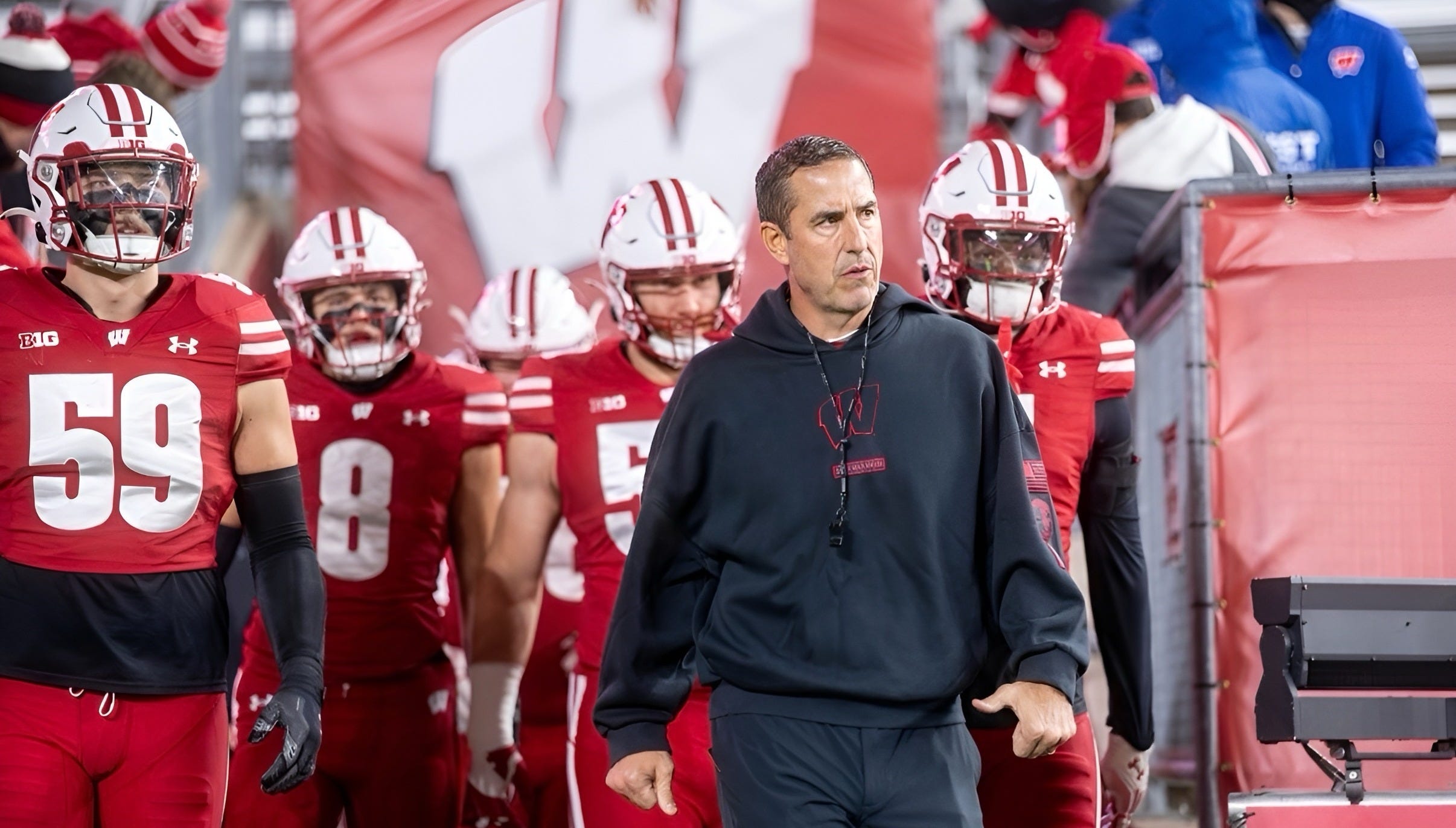
There was no hiding the stakes when Luke Fickell met with local media on Early National Signing Day. The Wisconsin football program is barreling toward a 2026 season that will define how his tenure is remembered, and the head coach spoke with the clarity of someone who knows that the Badgers can’t afford another year trying to tread water on a sinking ship.
Thus far, the Badgers have signed only 13 high school players in the 2026 recruiting cycle, the smallest class the program has taken since 2012, which means the portal will once again be the lifeline that determines whether Wisconsin gets back to playing the brand of football this place used to assume by default. Or whether they continue to fall short.
Fickell didn’t dance around it because there’s no point. He framed Wisconsin’s roster-building approach through an NFL lens, emphasizing the obvious: that premium positions require premium investment. Three areas, in particular, stood out as being top offseason priorities, beginning with the one that has tormented the program for three straight years.
But before General Manager Marcus Sedberry and the recruiting staffers even decide where to spend, it helps to understand why the sport now demands this kind of collective thinking. College football has been forced to operate like a pro franchise, and staffs have had no choice but to study how NFL organizations structure their rosters and allocate their resources.
Everyone is chasing efficiency. Everyone wants to strategically buy wins. The problem is that college football doesn’t function with a true salary cap. It’s closer to the MLB, where spending comes with no guardrails, no ceiling, and no real mechanisms to keep the playing field level. That lack of uniformity in the sport makes it harder than ever to identify the best ways to build and sustain a roster. But it also makes positional investment even more important. That’s the environment Wisconsin is navigating.
Quarterback play has dictated Wisconsin’s ceiling, as well as its floor, more than anything else in the Fickell era, and the head coach didn’t pretend otherwise. He acknowledged its position you cannot underinvest in, pointing out that the Badgers are one of the few programs in the country that have had quarterback instability every year since he arrived.
And the numbers from this fall paint the clearest picture of why. By the end of Wisconsin’s 4–8 season, the Badgers found themselves in a club nobody wants to be a part of: they were the only Big Ten team to start four different quarterbacks who each attempted at least 10 passes, something the program hadn’t experienced since 1956. The production reflected the chaos. Wisconsin quarterbacks combined to complete 57.7% of their throws for 1,637 yards with nine touchdowns and 13 interceptions.
The result was an offense that averaged 12.8 points per game, the lowest mark in the entire Power Four and 135th out of 136 teams nationally.
“I think when you talk about investing in a quarterback position, we might be the only team in the country that has experienced what we’ve experienced in three years,” Fickell told reporters.
“I’m not making excuses. If you don’t invest in a different way in that room — meaning it’s hard to just invest in one — if you don’t invest in that room and have some depth in that room, you can put yourself in a really tough position.”
He acknowledged ongoing conversations with Billy Edwards Jr. about returning in 2026, simply saying “yeah” when asked if those talks had taken place, though his answer made it clear the situation remains fluid.
Beyond Edwards, the picture gets even more complicated. Danny O’Neil suffered a significant lower-body injury late in the season, and his availability for next season is still very much in question. Carter Smith is another name the staff would like to keep in the fold. Smith started a few games down the stretch, showed some real moxie in tough situations, and remains a developmental piece that the program believes has value.
Retaining the current roster and pairing them with incoming freshman Ryan Hopkins could work for Wisconsin on paper, but that’s not the plan.
When asked directly whether he expected to add one or two portal quarterbacks, he didn’t hesitate. He said “yes,” adding that the program has been transparent with its quarterbacks about how critical that room will be to the team’s trajectory next fall. Whether Wisconsin lands a starter, insurance policy, or both, the message was obvious: the portal will shape the future of the position just as much as internal development.
“We know that the QB position is gonna be really key and critical,” Fickell said. “We haven’t shied away from making sure our guys understand that.”
The edge rushers were next on Fickell’s offseason list, and his wording made the priority clear. Pass rushers cost more for a reason. They tilt games, create momentum, and erase offensive drives before they find life. Wisconsin finally enjoyed that advantage in 2025 with a group led by outside backers Mason Reiger, Darryl Peterson, and Sebastian Cheeks.
That trio won’t be easy to replace, but returning players like Tyrese Fearbry, Nicolas Clayton, Micheal Garner, and Ernest Willor give Wisconsin a decent place to start. The Badgers need more than a group to project, though. They need depth, twitch, and players who can win one-on-one in obvious passing situations. Fickell indicated the staff intends to invest heavily again at the position, hoping to reproduce the formula that made the pass rush one of the team’s most reliable traits.
The value of that position showed up all fall. Wisconsin’s pressure package went from a liability to an encouraging storyline, finishing tied for 21st nationally with 32 team sacks after managing only 17 the year before. At one point, the Badgers became the first Big Ten team since 2007 to record five sacks in three straight conference games, and that surge played a major role in securing a pair of victories over top-25 opponents.
It was the clearest example yet of how a real pass rush can change game scripts, and why Fickell views edge defenders as a premium investment.
“The best thing you can do is look at an NFL model,” Fickell said. That’s where a lot of us are shaping things around. Guys that play on edges tend to be guys that maybe the investment is a little bit higher. Guys who sack the quarterback tend to be players that you invest in a little bit higher.”
Then came the offensive line, a group that spent most of the 2025 season held together by duct tape and contingency planning. Injuries to Kevin Heywood and Jake Renfro exposed Wisconsin’s lack of playable depth, and the ripple effects were felt across the entire offense. With Renfro and Riley Mahlman set to graduate, plus uncertainty surrounding Joe Brunner, the Badgers are bracing for a reset. Fickell said plainly that Wisconsin must invest in the offensive line, and the roster math supports that claim.
Before Wisconsin begins reshaping the room, the numbers alone explain why the offensive line became a flashing red light on the offseason priority board. According to Pro Football Focus, the Badgers finished the 2025 season ranked 79th nationally in pass-blocking grade and 105th in run blocking, collectively allowing 19 sacks and 100 total pressures.
That was a sharp regression from the year prior, when AJ Blazek’s room graded out as the No. 4 pass-blocking unit in the country, ranked 38th in run blocking, and surrendered just seven sacks and 65 pressures.
The contrast, especially at a school like Wisconsin, was jarring and showed how thin margins were up front, especially once injuries piled up. It put Wisconsin behind the sticks in almost every meaningful situation.
“I can tell you here that we’re gonna invest in the offensive line, and that’s an area where we gotta continue to get better,” said Fickell. “Some of the injuries and things that happened to us this year, that’s why, as I said, we took five high school kids last year, only taking one right now this year.”
Only one offensive lineman signed in the 2026 class, Brady Bekkenhuis, after earlier commits flipped late in the process. The Badgers brought in 10 total scholarship linemen during the 2024 and 2025 cycles, though in-state product Derek Jensen is no longer with the football program.
The remaining four from the 2024 class have seen the field: Heywood was penciled in as the starting left tackle before injury, Emerson Mandell started every game last fall, playing a team-high 704 snaps and finishing with a 63.9 offensive grade. Ryan Cory logged a start and appeared in five games, playing 100 total snaps, and while he was thrust into some tough situations, there were some clear growing pains. Collin Cubberly made seven starts, appeared in eight games, played 393 snaps, and finished with a 59.6 offensive grade, though he had stretches where he looked solid in pass protection.
It’s a young core with promise, but not enough experience to shoulder the full load of a Big Ten season. Wisconsin will need veteran help to stabilize the room and avoid another year where thin margins for error on the offensive line dictate the outcome of the season.
Fickell didn’t promise splash moves or dramatic overhauls. What he promised was targeted investment in the places where games are won.
And with a more manageable 2026 schedule on the horizon, an influx of resources pouring into the program, and the urgency created by the narrative currently surrounding the staff, this clarity feels overdue. The reality is straightforward: if Fickell and his assistants don’t turn that investment into wins and shift the conversation in their favor, Wisconsin will be looking at a new head coach when the 2027 season begins.
We appreciate you taking the time to read our work at BadgerNotes.com. Your support means the world to us and has helped us become a leading independent source for Wisconsin Badgers coverage.
You can also follow Site Publisher Dillon Graff at @DillonGraff on X.
"New Found Resources" ? Michigan State University just got a $290,000,000 donation for athletics. At 7 % per year that's about $20,000,000 plus $22,000,000 for tv rights = $42,000,000. Is there a story behind "New Found Resources" or are you just trusting Mac and Ted to find $290,000,000 to compete ?