

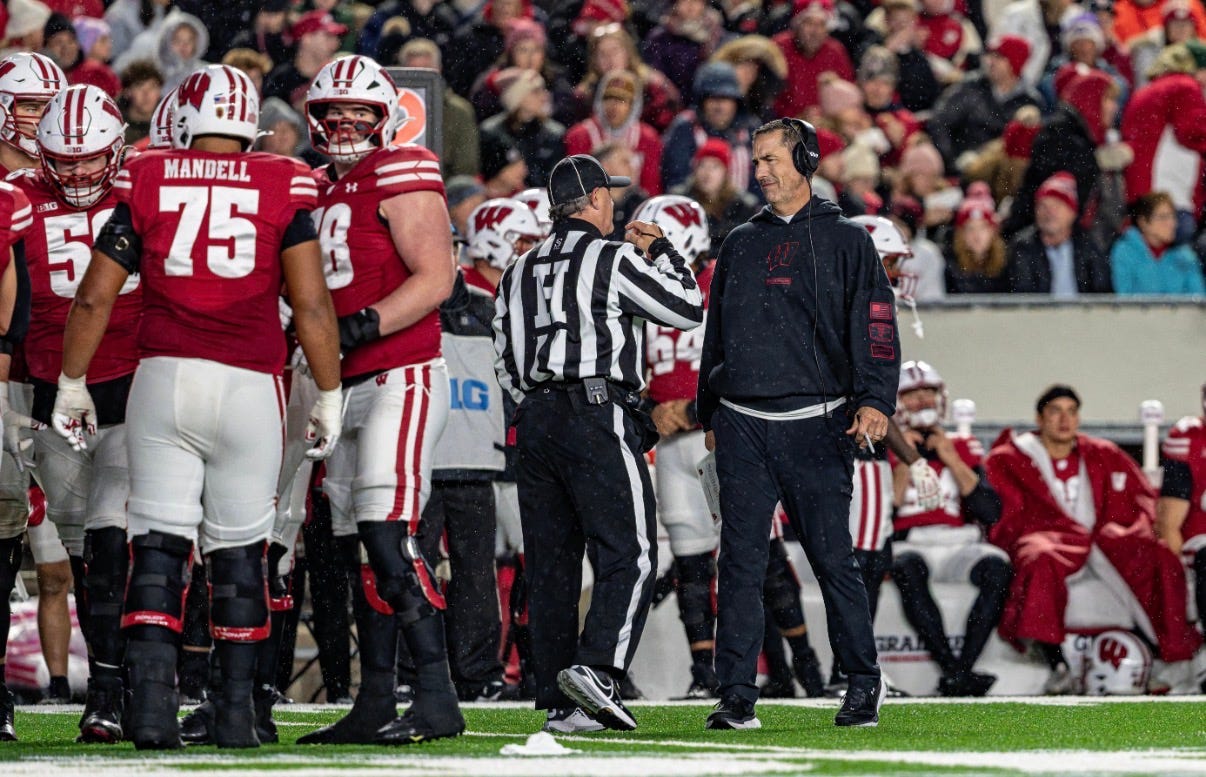
The first projections from Vegas oddsmakers for the Wisconsin football team’s 2026 season are beginning to surface.
FanDuel released its 2026 Big Ten win totals, offering an early glimpse into how the national betting markets view the conference heading into next season. For Wisconsin, the number opened at 6.5 wins — a projection that suggests bowl eligibility is within reach, but far from guaranteed.
And in many ways, that number reflects where Wisconsin football finds itself under head coach Luke Fickell entering Year 4.
Because after stumbling to a 4–8 finish a year ago, the program now faces a different challenge — convincing fans, NIL donors, and decision-makers outside the building that there’s still something worth investing in on the other side of this rebuild.
Through three seasons, Fickell sits at 17–21 overall at Wisconsin and 10–17 in Big Ten play — a far cry from the expectations that accompanied his hiring to elevate the program back into the conference’s upper echelon.
Last season was a difficult one by any measure.
Wisconsin cycled through quarterbacks due to injuries, struggled to find offensive consistency, and finished with one of the least productive offenses the program has fielded in roughly three decades. The Badgers finished No. 134 nationally in scoring offense (12.8 points per game), No. 132 in passing offense, and No. 135 in total offense last season.
At several points during the year, it felt like Fickell’s third season in Madison might be heading toward an inevitable conclusion.
Instead, the administration chose to double down.
There was plenty of outside speculation that Fickell could be on the hot seat after the Badgers missed bowl eligibility for a second straight season. But rather than move on, athletic director Chris McIntosh backed Fickell and promised increased investment in the football program.
“As a department, we must provide our coaches with the tools necessary to succeed,” McIntosh said. “That means more Athletics-funded investments into infrastructure, staffing, and, most importantly, student-athlete recruiting and retention. In this new era of collegiate athletics, the clear reality is that high expectations must be matched with an equal level of support. The results of this elevated support may not be immediate, but we are confident that the impact will be positive and long-term.”
Prominent donor Ted Kellner publicly acknowledged that the University of Wisconsin had been operating in the bottom third of the Big Ten in terms of spending and resources. His message was clear: the goal was to move into the conference’s top third moving forward.
“It changed dramatically in the last two years, and we did fall behind [in the NIL arms race],” Kellner said. “All I can say is… we will be competitive next year in the money. We were in the bottom third of the Big Ten in financial resources. Next year, we will be up in the top third in resources. We were at the lower echelons this last year. We won’t be next year.”
While it’s difficult to measure that claim in real time due to the lack of transparency across the sport, the offseason actions reflected a program attempting to respond.
Wisconsin signed the largest transfer portal class in program history, adding more than 30 players in an effort to improve depth across the roster. The Badgers also moved early to secure their top quarterback target, signing former Old Dominion signal-caller Colton Joseph to a 2-year deal in hopes of stabilizing a position that was in flux a year ago.
“Nobody’s naive to not think that there’s a gap between where we are and where we want to be and where the top of this league is,” Fickell said. “The great thing about last year is we got to experience what the very best looks like. And if I’m being honest, we are not there.
“There’s a gap between where they are and where we are. That gap can be closed with talent. I think we closed some of that gap with talent. But that gap’s not completely closed.”
The bet is simple: build enough talent and depth around the program to produce a strong season now while creating a foundation for sustained improvement later.
Still, the national perception of Wisconsin hasn’t changed overnight.
FanDuel’s early win totals offer a snapshot of how the conference is currently being viewed. The betting markets clearly separate the Big Ten into distinct groups, with Oregon (10.5), Indiana (10.5), Ohio State (9.5), and Penn State (9.5) projected near the top of the conference pecking order. USC and Michigan sit just behind that group at 8.5 wins, while programs like Illinois, Washington, and Iowa (7.5) are expected to remain firmly in the upper half of the league. Wisconsin, meanwhile, finds itself in the middle of the pack — a team the market believes can return to bowl eligibility but hasn’t yet proven it belongs among the actual contenders.
That placement reflects both cautious optimism and lingering skepticism surrounding the Badgers.
On one hand, there were signs late last season that the locker room’s culture and buy-in were still strong. Wisconsin closed the year with ranked wins over Illinois and Washington, victories that mattered for a team trying to prove it still believed in the program’s direction under Fickell.
On the other hand, the gap between where Wisconsin currently sits and the sport’s elite programs was difficult to ignore.
The Badgers faced one of the toughest schedules in the country last season and played four eventual top-nine seeds in the College Football Playoff — Indiana, Ohio State, Oregon, and Alabama. Those matchups exposed the margin Wisconsin still needs to close.
In those four games alone, the Badgers were outscored 124–28. That kind of disparity illustrates just how steep the mountain still is for Wisconsin to climb.
The encouraging part for Wisconsin is that the 2026 schedule appears significantly more manageable. Combined with the influx of portal talent, expanded coaching staff, and improved depth across several position groups, there’s a reasonable argument that the Badgers should take a step forward.
But until the offense proves it can consistently function — something that has eluded the program throughout the first three seasons of the Fickell era — questions will remain.
Defensively, Wisconsin showed signs of progress last season, even if the results still fell short of the standard Badgers fans grew accustomed to before Fickell and Mike Tressel arrived. Offensively, the search for an identity continues, with the hope that Jeff Grimes can be the answer.
So the win total FanDuel posted isn’t just a projection.
It’s a reflection of where Wisconsin football stands right now: a program expected to compete for bowl eligibility again, but one that still has plenty to prove before anyone believes it’s ready to flip the script entirely.
The path toward improvement is undoubtedly there — with a much softer schedule and increased financial investment. Still, until Fickell shows this program can be consistently competitive again, it’s fair to remain skeptical rather than offer “blind faith” without tangible progress on the field.
We appreciate you taking the time to read our work at BadgerNotes.com. Your support means the world to us and has helped us become a leading independent source for Wisconsin Badgers coverage.
You can also follow Site Publisher Dillon Graff at @DillonGraff on X.
6.5 sounds about right. Like you said, it depends on how good the offense is. Plus with an easier schedule, 2.5 more wins sounds about right. If the offense comes together, it could be 8 or 9. On paper they definitely got better. Let's see if they can transfer it to the field. Cautiously Optimistic.