

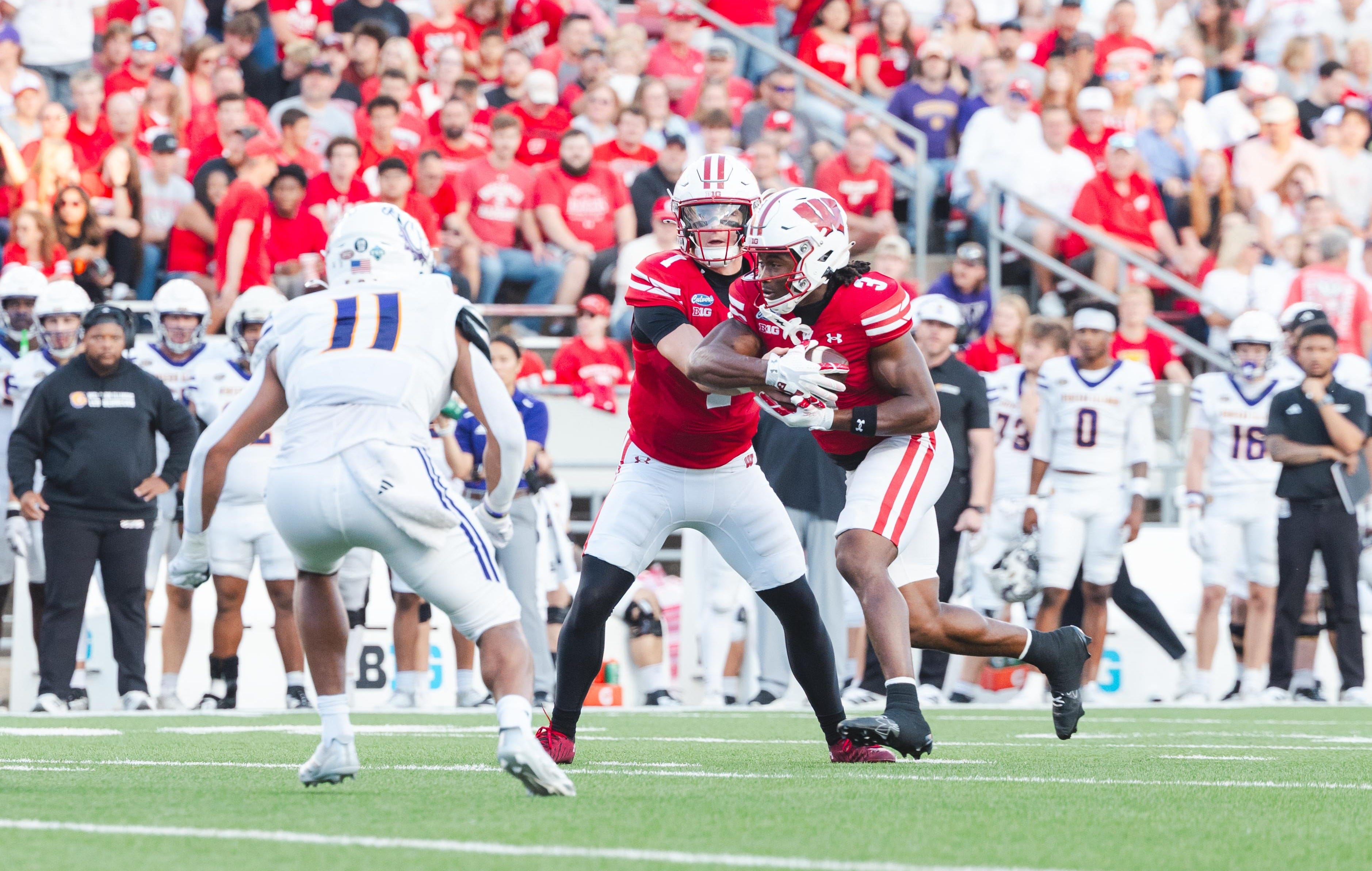
The University of Wisconsin football team got the result it needed against Western Illinois in Week 2. Luke Fickell’s second look at the film left him feeling a little better about how the Badgers got there.
Wisconsin improved to 1-1 with a 36-9 win after racing out to a 17-0 lead in less than eight minutes. The Badgers rushed for 233 yards, averaged 7.7 yards per play, and got another impactful special teams performance.
There was also plenty that looked familiar.
Wisconsin struggled to sustain its early momentum, Western Illinois possessed the ball for nearly 35 minutes, and the Badgers failed to force a turnover for the second consecutive game.
With Eastern Michigan (1-2) providing one final tune-up before Big Ten play begins, Fickell made it clear that Wisconsin’s next step isn’t necessarily finding another gear. It’s sustaining the one it has shown glimpses of.
“We’ve got to be careful of being arrogant and delusional at times,” Fickell told reporters. “I come in and always want more. Winning is what it’s all about, and playing well and getting better is the key to what we do.
“But sometimes you can stymie the growth of it if, all of a sudden, you’re looking for something beyond what you’re asking for.”
Here are three takeaways from Fickell’s media availability entering Week 3.
Wisconsin’s inability to sustain its best football remains the biggest concern
Fickell admitted his initial reaction to Saturday’s performance may have been overly critical.
After reviewing the film, Fickell saw a team that accomplished one of its primary goals coming off the 41-13 loss to Notre Dame. Wisconsin responded immediately, scoring on Abu Sama III’s 72-yard run on its first offensive snap and jumping ahead 17-0 after Carson Van Dinter blocked and recovered a punt for a touchdown.
“I’ve got to recognize there’s some really good things that we did and will continue to grow from,” Fickell said. “Really the only negative, to be honest, is first and foremost as a team is our ability to sustain.
“We got really high really quick, made some big plays both offensively and special teams-wise and defensively as well. And then maybe just the maturity and the ability to sustain that. Obviously, we didn’t do a good enough job. That’s where we’ve got to get better.”
That last part is what matters entering Eastern Michigan.
The circumstances have been different, but Wisconsin’s first two games have produced essentially opposite versions of the same problem.
Against Notre Dame, the Badgers went into halftime trailing 13-10 after holding the Irish to 135 total yards and 29 on the ground. Notre Dame then outscored Wisconsin 28-3 in the second half.
Against Western Illinois, Wisconsin started even faster. But after building its 17-point advantage, the Badgers managed only 63 yards in the second quarter and led 23-9 midway through the third.
Fickell believes handling those emotional swings is part of the maturation process.
“I think it cost us in week one,” Fickell admitted. “It may have cost us a little bit this past week in the idea that, like, it really got really, really high, really, really fast, meaning — the way we came out offensively: a blocked punt. And then do you, by nature, relax a little bit? Do you by nature not have the same focus and energy because of the excitement?”
Eastern Michigan presents another opportunity to find out.
Wisconsin doesn’t need another dominant opening stretch nearly as much as it needs to show that its physicality, focus, and execution can survive beyond one and that it’s disciplined enough to play a full game.
Fickell still wants more from Colton Joseph and Wisconsin’s offense
Colton Joseph’s health provided some important context for an uneven performance against Western Illinois.
Joseph completed 12-of-22 passes for 173 yards and a touchdown, but 84 of those yards came on two fourth-quarter completions: a 51-yarder to Tyrell Henry and a 33-yard touchdown to Chris Brooks Jr.
Fickell revealed after the game that Joseph had been “a little dinged up” following the Notre Dame loss. Monday, he provided more detail about how much that affected the quarterback’s preparation.
“I don’t want to say it held us back,” Fickell said. “I mean, he had something a little bit more in a throwing arm last week. It cost him throwing the ball on Tuesday, and he maybe only threw it a little bit on Wednesday. And we knew even in pregame, he was going to have to probably take a little bit more time to warm up.”
Fickell said he doesn’t anticipate the issue changing Wisconsin’s approach this week. More importantly, he doesn’t want protecting Joseph to prevent the offense from becoming what it ultimately needs to be.
“I don’t want that to hold us back from growing who we are,” Fickell said. “Part of being who we are is still having the option to use his legs, and it doesn’t always have to be called runs. We’re not going to play scared.”
That becomes an important development to watch against Eastern Michigan.
Wisconsin’s running game took a significant step forward Saturday, producing 233 yards on 31 attempts. Joseph hasn’t been much of a factor in that part of the offense, however. Wisconsin has used him sparingly in the designed quarterback run game, and he has just 36 rushing yards through two games. The passing game was considerably less convincing, particularly before Joseph connected on those two late explosives.
Fickell also acknowledged that Wisconsin needs to create more space for Joseph on intermediate throws and continue figuring out when to use his mobility.
There is another encouraging development up front. Wisconsin used the same starting offensive line for its first 47 snaps against Western Illinois, and Fickell came away encouraged by the group’s physicality. He specifically praised Kevin Heywood, Colin Cubberly, Stylz Blackmon, and Austin Kawecki while acknowledging that Wisconsin needs to continue pushing Ole Miss transfer PJ Wilkins.
Emerson Mandell could eventually change that picture. Fickell said Wisconsin planned to begin working him back into the mix as the Badgers approach Big Ten play, although his availability remains uncertain.
For now, Eastern Michigan gives Wisconsin one more opportunity to establish something resembling a complete offensive identity before the competition changes considerably.
Wisconsin’s defense needs to start creating turnovers
For everything Wisconsin has done reasonably well defensively through two games, one number stands out.
Zero.
The Badgers have yet to force a turnover.
Wisconsin generated pressure against Western Illinois, with PFF crediting the defense with 17 total pressures, including six from Sebastian Cheeks. DeNigel Cooper was particularly effective in a rotational role, generating three pressures on 21 snaps and earning an 89.2 PFF pass-rush grade.
Fickell praised Cooper’s energy and believes his combination of size and quickness provides something different inside.
But pressure without takeaways only accomplishes so much.
“It’s two games now that we haven’t created a turnover,” Fickell said. “We’ve had some balls in the air. We’ve had some hands on some balls. There’s been some tips. Those will eventually [break our way]. But our ability to attack the football, be physical enough to dislodge the football, is still where I think we’ve got to do a hell of a lot better job.”
Wisconsin didn’t intercept Notre Dame quarterback CJ Carr or Western Illinois quarterback Kennedy McGill, and the defense hasn’t recovered a fumble.
That hasn’t prevented the unit from producing some encouraging stretches. Wisconsin held Notre Dame to 29 first-half rushing yards and kept Western Illinois out of the end zone entirely despite allowing three red-zone trips.
But creating takeaways is one of the few areas where there has been virtually no production to point toward through two weeks. The run defense has shown some cracks as well. Notably, Wisconsin forced just six turnovers last season, the fewest in the country, so this inability to generate takeaways is hardly a new problem for a Mike Tressel defense.
Eastern Michigan represents Wisconsin’s final opportunity to address that against a nonconference opponent before the Badgers travel to Penn State.
That makes Saturday about more than simply improving to 2-1.
Wisconsin has already shown that it can start fast. It has shown it can play physically in spurts. There have been stretches against both Notre Dame and Western Illinois where the Badgers have looked much closer to the team Fickell spent the offseason describing.
Now comes the part that has proved considerably more difficult: sustaining it for four quarters while playing clean, disciplined, and well-executed football, none of which has consistently been a calling card during Fickell’s tenure.
We appreciate you taking the time to read our work at BadgerNotes.com. Your support means the world to us and has helped us become a leading independent source for Wisconsin Badgers coverage.
You can also follow Site Publisher Dillon Graff at @DillonGraff on X.