

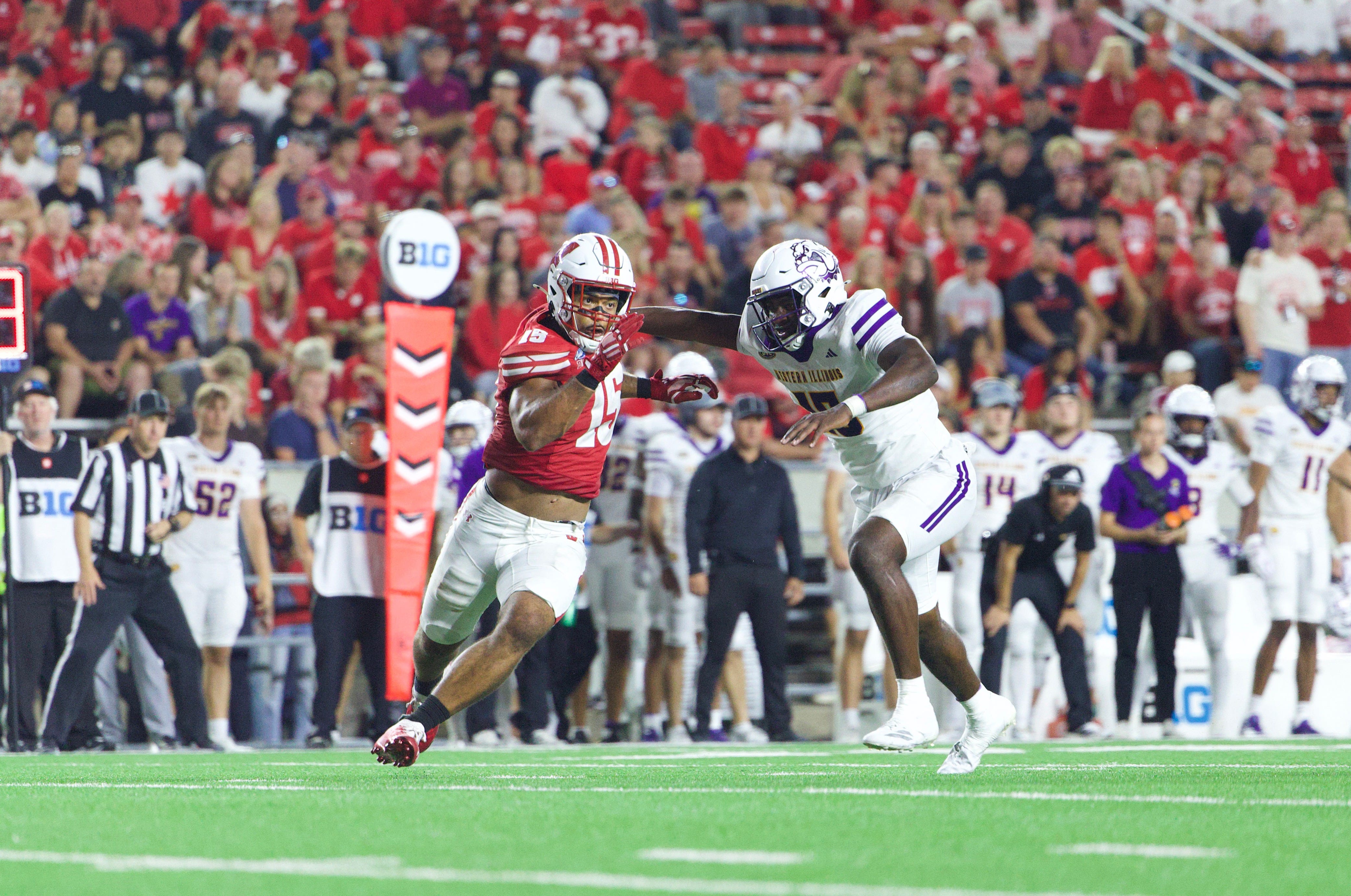
Wisconsin’s 36-9 win over Western Illinois was never really about whether the Badgers could beat an FCS opponent at Camp Randall Stadium.
It was about what they could learn along the way.
After Wisconsin kept several rotations relatively tight against Notre Dame, Western Illinois offered a chance to expand them, get more players involved, and potentially learn something about the depth this staff spent the offseason building. That happened in some places more than others.
The Badgers still leaned heavily on several starters, particularly along the offensive line and at a handful of spots defensively. But Bryan Jackson entered the running back rotation, Thomas Heiberger received a much larger opportunity at linebacker, Carson Van Dinter got his first defensive snaps, and several younger offensive linemen got onto the field late.
Here’s what stood out at every position from Wisconsin’s Week 2 snap counts.
Quarterback
Colton Joseph: 47 snaps
Ryan Hopkins: 8
Unlike Week 1, Wisconsin was eventually able to get its backup quarterback onto the field.
Joseph handled the first 47 offensive snaps and finished 12-of-22 for 173 yards and one touchdown. His accuracy was inconsistent for much of the night, although Fickell revealed afterward that Joseph entered the game “a little dinged up” from the hit he took in Week 1 against Notre Dame.
The Badgers eventually generated a couple of explosive passes late, with Joseph connecting on a 51-yard completion to Tyrell Henry before finding Chris Brooks Jr. for a 33-yard touchdown, the first of his career.
There’s no question Joseph is Wisconsin’s starting quarterback. What was at least notable, however, was who replaced him. The backup quarterback competition was never formally settled, but Ryan Hopkins getting the call ahead of Deuce Adams may have given us our first real answer on where that battle stands.
Hopkins took over for the final eight offensive snaps, carrying three times for 11 yards without attempting a pass.
Running back
Darrion Dupree: 19
Bryan Jackson: 17
Abu Sama III: 16
Nate Palmer: 2
This rotation looked considerably different from Week 1.
Sama played only 16 snaps but made the most of them, carrying eight times for 107 yards and a touchdown. His 72-yard score on Wisconsin’s first offensive snap provided the explosive play that everyone had been waiting to see from the Iowa State transfer.
Interestingly, Dupree actually led the room with 19 snaps despite receiving only four carries. He finished with 38 yards, including a 28-yard touchdown up the middle in the third quarter that capped an eight-play drive where Wisconsin didn’t attempt a pass.
The bigger development was Jackson.
After not playing against Notre Dame while working his way back from an injury, the USC transfer received 17 offensive snaps and carried 10 times for 40 yards. The 6-foot-1, 238-pound tailback forced one missed tackle and gained 26 yards after contact, according to PFF.
That gives Wisconsin another legitimate option in a room that suddenly looks considerably deeper.
Sama remains the most dependable runner, and Dupree continues to have a defined role of his own, but Jackson getting double-digit carries gives Jeff Grimes another physical option to work into the rotation.
Wide receiver
Chris Brooks Jr.: 39
Tyrell Henry: 27
Eugene Hilton Jr.: 26
Shamar Rigby: 20
Malachi Coleman: 9
Kash Brock: 8
Zion Kearney: 8
Jackson McGohan: 6
This was probably the offensive rotation that changed the most because of circumstance.
Coleman, who played 40 snaps against Notre Dame and looked like one of Wisconsin’s potential breakout players, was limited to nine before leaving with an upper body injury. Fickell said afterward that Coleman could not return and didn’t have an immediate update on his status.
That opened considerably more work for the rest of the room.
Brooks led Wisconsin receivers with 39 snaps and caught two passes for 39 yards, including the 33-yard touchdown — the first of his career — that effectively finished the night. Henry had the biggest statistical performance, catching four passes for a career-high 91 yards on nine targets. Hilton added three catches for 32 yards while playing 26 snaps.
Perhaps most notable from a usage standpoint was Rigby increasing from 15 snaps against Notre Dame to 20 against Western Illinois. He still wasn’t targeted, however. Rigby didn’t return to full health until late in fall camp, but it’s clear the coaching staff thinks he can help.
Wisconsin also got Brock, Kearney and McGohan onto the field late.
There still doesn’t appear to be one receiver commanding this passing game. Henry provided the explosive plays Saturday, while Coleman’s health now becomes something worth monitoring entering Week 3.
Tight end
Grant Stec: 34
Emmett Bork: 22
Jacob Harris: 21
Nizyi Davis: 1
Stec remained Wisconsin’s most-used tight end, but the gap behind him narrowed considerably.
After playing 42 snaps against Notre Dame, Stec handled 34 against Western Illinois. Bork increased to 22, while Harris played 21. Ryan Schwendeman, who played five snaps in Week 1, was out due to injury.
That’s probably closer to the kind of rotation Wisconsin envisioned when it rebuilt this room around multiple body types and skill sets.
The usage is also worth noting because Wisconsin leaned heavily on its tight ends as blockers. Stec was used as a run blocker on 22 snaps, Bork on 13 and Harris on eight, according to PFF. They didn’t contribute much in the passing game, with Harris accounting for the group’s only production on two catches for six yards.
Stec still appears to sit atop the pecking order, but this looked much more like a three-man rotation than Week 1 did.
Offensive line
Kevin Heywood: 47
Colin Cubberly: 47
Austin Kawecki: 47
PJ Wilkins: 47
Stylz Blackmon: 47
Lucas Simmons-Johansson: 8
Barrett Nelson: 8
Blake Cherry: 8
Ryan Cory: 8
Hardy Watts: 8
Here’s one of the more interesting developments.
Wisconsin appears to have settled on its starting five, at least for now. Wilkins, Cubberly, Kawecki, Blackmon and Heywood played the first 47 snaps together before the Badgers replaced the entire offensive line for its final eight plays.
That’s particularly noteworthy at right guard.
Blackmon started against Notre Dame but played only 23 snaps while Cherry received 38. Against Western Illinois, Blackmon played all 47 snaps with the first-team offense while Cherry didn’t enter until the backups took over.
Until Emerson Mandell returns, that certainly looks like some separation.
The starting unit also kept Joseph clean. Wisconsin did not allow a sack, and Heywood and Blackmon were particularly strong in pass protection, earning PFF pass-blocking grades of 84.8 and 85.1, respectively. Neither allowed a pressure.
Kawecki had the roughest pass-protection grade of the group at 54.9 and was charged with two pressures, while Wilkins allowed one. Wilkins also drew two penalties and continues to work through some early issues.
More importantly for an offense trying to establish its identity on the ground, Wisconsin rushed for 233 yards and averaged 7.5 yards per carry. That’s a considerably better night for this group.
Defensive line
Hammond Russell IV: 23
DeNigel Cooper: 21
Junior Poyser: 21
Charles Perkins: 17
Nolan Vils: 15
Dillan Johnson: 14
Jacob Anderson: 14
Wisconsin went even deeper into its defensive line rotation than it did against Notre Dame.
Seven defensive linemen played at least 14 snaps, and nobody exceeded Russell’s 23. That is almost exactly what this staff has described wanting from the room.
Cooper was particularly disruptive in his 21 snaps, producing three pressures and two quarterback hits while earning an 89.2 PFF pass-rush grade. Johnson, now in his third year in the program, made the most of an even smaller workload, recording a pressure across 14 snaps and earning an 87.8 overall defensive grade, the highest mark on Wisconsin’s defense.
The problem is that the collective results against the run weren’t nearly as impressive.
Western Illinois rushed for 154 yards on 38 carries. Wisconsin wanted enough size and depth up front to remain fresh and consistently control the line of scrimmage, and allowing an FCS opponent to move the ball that effectively on the ground isn’t what anyone on the staff had in mind.
The rotation is clearly there. Wisconsin still needs better results from it.
Inside linebacker
Cooper Catalano: 57
Mason Posa: 33
Thomas Heiberger: 24
Taylor Schaefer: 7
Aaron Witt: 7
Jon Jon Kamara: 6
This was one of the more revealing defensive rotations.
Catalano remained an every-down fixture, playing 57 snaps and finishing with 13 total tackles. PFF credited Catalano with a pressure, and he earned an 82.4 overall defensive grade with an 81.5 run-defense grade.
The bigger development was behind him.
Posa played only 33 snaps after being limited by an injury, which created an opportunity for Heiberger to get some work. The junior responded with 24 defensive snaps, three tackles, a pressure and two pass breakups.
That’s a substantial change from Week 1, when Heiberger played only four defensive snaps.
Fickell has talked about developing enough linebacker depth that Wisconsin doesn’t need Catalano and Posa playing 60-plus snaps every week. Saturday gave the Badgers their first meaningful look at what that might actually look like if they chose to get Heiberger in the mix.
Heiberger making the most of his opportunity was an encouraging development.
Outside linebacker
Sebastian Cheeks: 49
Tyreese Fearbry: 39
Michael Garner: 23
Nick Clayton: 13
Justus Boone: 10
Two weeks in, Cheeks continues to separate himself.
The senior played 49 snaps and generated six pressures, all hurries, while finishing with five tackles. His 80.6 PFF pass-rush grade led Wisconsin’s primary edge defenders.
Cheeks now has followed an impressive performance against Notre Dame with another disruptive night.
Fearbry also received a substantial workload with 39 snaps and finished with three tackles and a pressure. Clayton generated two pressures in only seven pass-rush opportunities, while Garner added another.
Wisconsin didn’t record a sack, but PFF credited the defense with 17 total pressures, including 11 hurries and six quarterback hits.
The rotation remains deep.
But through two games, Cheeks increasingly looks like the player most capable of becoming the premier pass-rushing presence this defense needs. Who emerges as a difference maker opposite Cheeks is to be determined.
Cornerback
Bryce West: 56
Javan Robinson: 54
Jai’mier Scott: 46
Eric Fletcher Jr.: 25
Cai Bates: 3
The pecking order at cornerback remained mostly intact.
West, Robinson and Scott again handled the overwhelming majority of Wisconsin’s snaps, although Fletcher’s role increased from 16 snaps against Notre Dame to 25.
The results weren’t perfect.
Scott surrendered a 45-yard completion on his only target, while Fletcher was targeted four times and allowed four catches for 55 yards. PFF gave Fletcher a 33.9 coverage grade.
Robinson allowed one reception for seven yards on two targets, while West gave up one six-yard reception and continued to look the part.
Wisconsin held Western Illinois to 148 passing yards overall, so this was hardly a disastrous night for the secondary. But Scott getting beaten vertically and Fletcher allowing four completions are reminders that Wisconsin is still figuring out exactly what it has behind its top options.
Fletcher getting more work was useful. What he does with those opportunities will determine whether that rotation continues expanding.
Safety
Matthew Jung: 57
Marvin Burks Jr.: 41
Cairo Skanes: 22
Carson Van Dinter: 7
Jung remained another fixture in Wisconsin’s defense, playing 57 snaps and finishing with seven total tackles.
But Wisconsin did begin expanding the rotation around him.
Skanes more than doubled his Week 1 workload, increasing from 10 snaps against Notre Dame to 22 against Western Illinois. Burks still handled 41 snaps and finished with three tackles.
And after not playing defensively in Week 1, Van Dinter received seven snaps at safety. Obviously, the in-state product’s biggest contribution came on special teams. Van Dinter blocked a punt, recovered it himself and scored a touchdown while also adding a pass breakup on defense.
His defensive workload remains small, but Fickell said afterward that Van Dinter’s role there could continue growing. Considering what he has already shown on special teams, that’s worth keeping an eye on.
What did we actually learn?
Week 2 gave Wisconsin more information about its roster than the final score probably suggests.
The offensive line rotation appears to have stabilized, with Blackmon taking every first-team snap at right guard. Jackson is healthy enough to give Wisconsin another legitimate running back option. Stec remains the top tight end, although Bork and Harris are both firmly involved.
Defensively, Wisconsin continued rotating heavily along the line and at outside linebacker. Heiberger took advantage of Posa’s limited availability and showed why the staff believes it can develop a legitimate third option at inside linebacker. Skanes received more work at safety, Fletcher got a larger opportunity at cornerback, even if it didn’t go very well, and Van Dinter finally entered the defensive rotation.
Not everything was encouraging.
Wisconsin allowed 154 rushing yards despite rotating seven defensive linemen, the secondary still surrendered a few concerning plays, and several defensive starters remained on the field for a significant portion of a game against an FCS opponent that the Badgers couldn’t force into a turnover.
But this was always supposed to be part of what Western Illinois and Eastern Michigan offered Wisconsin before Big Ten play begins.
Notre Dame showed us who Wisconsin trusts when the opponent demands its best personnel. Western Illinois started showing us who might be able to join them when bumps and bruises take their toll.
One more nonconference game remains to find out.
We appreciate you taking the time to read our work at BadgerNotes.com. Your support means the world to us and has helped us become a leading independent source for Wisconsin Badgers coverage.
You can also follow Site Publisher Dillon Graff at @DillonGraff on X.