

Inside the Donald E. Stephens Convention Center in Rosemont, Illinois, Big Ten media day produced no shortage of talking points. Yet, one question followed Wisconsin men’s basketball everywhere it went.
Could a team built to play faster, shoot more freely, and stretch the floor actually maintain the defensive backbone that has defined the program for decades? Greg Gard didn’t dodge it. He said Wisconsin had the roster size, the mobility, and the versatility to climb toward the top 10 nationally in adjusted defensive efficiency while also pushing the offense closer to that same threshold. That’s the blueprint of a Final Four contender.
The personnel, on paper, looked aligned for that kind of leap.
“Defense is important,” Gard acknowledged at Big Ten Media Day. “They understand that. You can’t have one without the other. We were third in the league defensively last year and like 24th nationally. That needs to climb towards the top 10 and keep the offense towards the top 10.
“Then you’ve got a legit shot to play deep in the March. That’s analytically what a final four team looks like. We’re a little more mobile. We’re bigger across the board, not only at our fours and fives, but at the other places too. So, all of those things can come together to make you better defensively.”
Two months later, the Badgers’ humbling loss at No. 23 Nebraska made the gap between expectation and reality impossible to ignore.
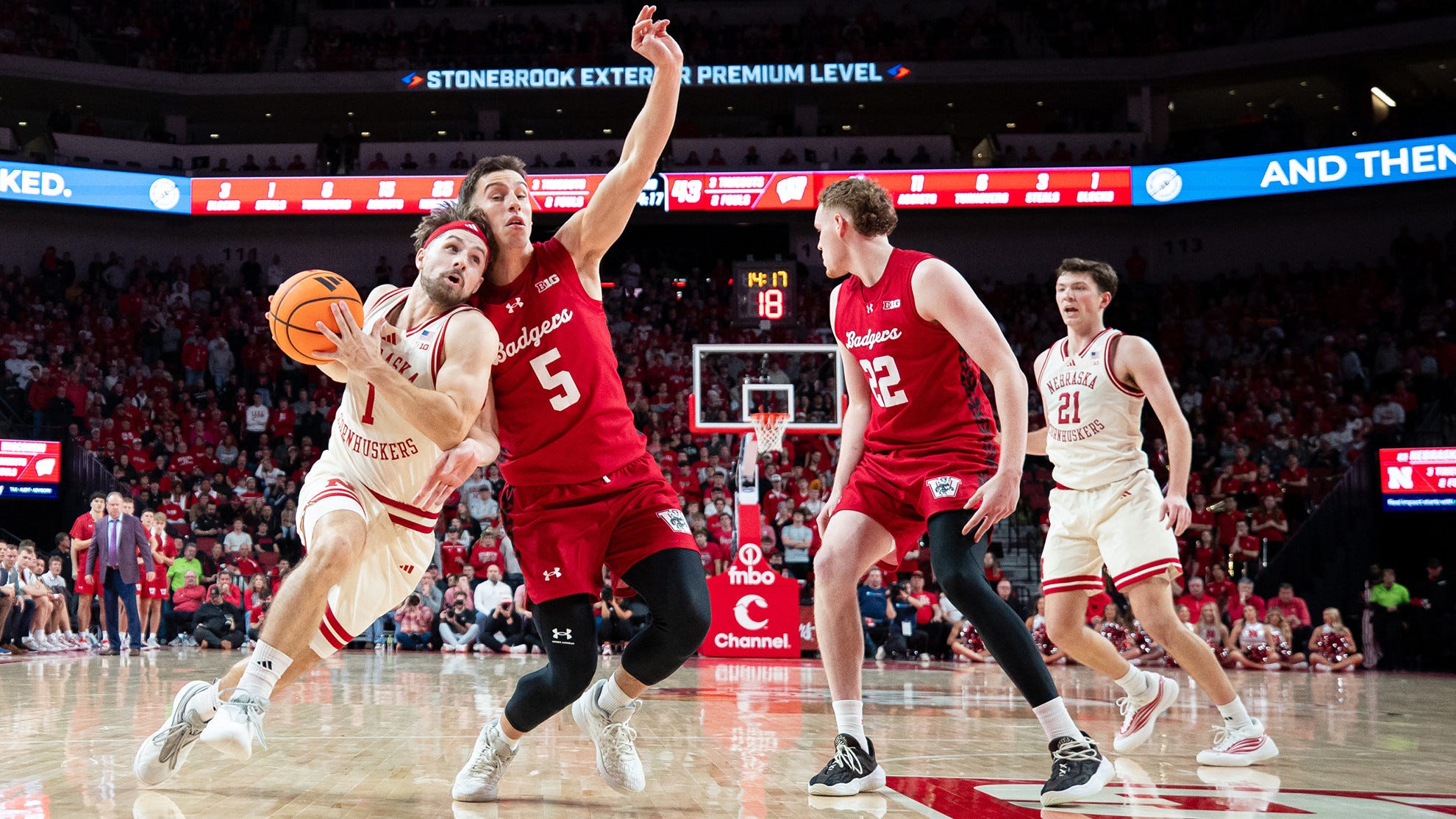
Wisconsin traveled to Lincoln, hoping to announce itself as a Big Ten contender. Instead, it walked out with a 90–60 loss and a coach who had clearly reached his limit with what he was seeing on one end of the floor.
The 30-point loss wasn’t just another bad night. It was Wisconsin’s most lopsided defeat since March 2002, making it the worst of the Gard era.
Wisconsin didn’t just struggle defensively. It offered almost no resistance whatsoever, watching Nebraska stack paint touches, open threes, and easy cuts as if the two teams had prepared under different conditions.
“We don’t have a defensive identity,” Gard said postgame. “Haven’t had one all year, so we’ll search to find one, and I’ll find guys that want to play defense.” Pressed on how he planned to address it, coach Gard didn’t mince words: “Sit guys on the bench.” He added, “We haven’t had a defensive identity all year, and everybody gets all rah-rah about our offense, but it’s the other end of the floor that’s caused us the trouble for the most part.
“Credit to Nebraska. They beat us every way possible.”
That theme has followed the Badgers through every step of the early portion of the 2025-26 season. They’ve been dominant at the Kohl Center, going a perfect 6-0, winning comfortably by an average margin of 25.8 points per game, and feeding off the rhythm their offense creates.
Wisconsin now sits at 7-3 overall and 1-1 in the Big Ten, a record that mirrors the polar opposites they’ve shown at home and on the road.
But the moment this team leaves home, whether it’s a true road game or on a neutral floor, the defensive foundation has cracked. Nebraska put every flaw Wisconsin has on display, the kind of night that forces a program to stop talking about potential and look in the mirror. And the losses all share the same DNA. There’s no counterpunch, no ability to claw back because they can’t get defensive stops when they need them.
Their defeats to BYU, TCU, and Nebraska have come by an average of 23 points, which tells you everything about where this team is right now.
For all of the frustration, Gard credited Fred Hoiberg and the Huskers for taking advantage of that disconnection.
“There’s not another facet in the game of basketball that they couldn’t kick our rear end with,” Gard explained. “They did it all.”
The tape will show plenty of moments to illustrate that point.
Wisconsin wasn’t guarding as a unit. Rotations were late. Closeouts lacked conviction. Nebraska stretched the floor, forced the Badgers to defend in space, and then picked them apart whenever the help was slow or mistimed. Gard pointed to Rienk Mast, who finished with 17 points, 10 rebounds, and two assists on 8-of-15 shooting from the floor, as the fulcrum that made everything harder, noting how much pressure a smart, offensive big man can apply when the defense isn’t playing together.
“When you’re not connected defensively, when you’re guarding individually instead of collectively as a team, they feast on that,” Gard said. “Any good offensive team does.”
This isn’t the first Wisconsin team to need time to build its defensive structure, especially in the portal era, where turnover has become a yearly expectation across college basketball. But with three new starters, six new rotation pieces, and nine total newcomers, this group is trying to learn the Badgers’ defensive language while also learning each other.
That doesn’t absolve the performance, but it explains part of the challenge. Gard made it clear this wasn’t about new faces alone. Veterans have struggled too, and he didn’t believe anyone played particularly well.
“We were individually guarding and not guarding as a team, and when you do that, and the paint’s that wide open,” said Gard. “That’s why you give up those wraps and all of those cuts to the rim, because we’re not connected defensively. We’re too spread out. They got us spread out.”
Gard said repeatedly that Wisconsin strayed from what worked in the opening minutes, and once the bad shots started flying, Nebraska turned the game into a clinic. The Huskers shot 54% from the field, controlled the boards, averaged 1.343 points per possession, hammered Wisconsin for 44 points in the paint, brought 28 more off the bench, and still found eight offensive rebounds along the way. The numbers are quite concerning.
Offensively, Wisconsin drifted away from everything that had worked early in the game. The ball stopped moving, stopped trusting its spacing, and there was no real paint pressure to help settle possessions. Nebraska didn’t exactly have to go hunting for the defensive openings that followed.
And the offensive numbers backed up Gard’s frustration. Wisconsin shot just 34.4% from the floor and 21.9% on 3-point attempts, finishing the night at a measly 0.870 points per possession, which only magnified how quickly they abandoned what had worked early. Gard later expanded on how dramatically the shot profile shifted as the game unraveled.
“I’ll look through the film, but I think we changed the types of shots we were getting, and it was to our undoing,” said Gard. “And to see why we did that, why we chose to take some of the shots we did, we completely got away from what had been treating us well and what had been working the first five, six, seven minutes. And for whatever reason, we thought we were going to solve the puzzle a different way, and it didn’t work.”
Gard didn’t stop there. He doubled down, pointing to the decision-making that unraveled possessions long before the game got out of reach.
“We didn’t do a good job of understanding that and spraying it and kicking it like we have earlier in part of the year,” Gard said. “We got out of sorts. I don’t want to say we lost our mind, but we did. We just got completely out of whack with who we had been, or who we need to be, to be successful.”
And while the team’s defense has deserved most of the criticism, the Badgers’ offense isn’t exactly without its own concerns.
Wisconsin’s calling card this season has been its offense, which currently sits 37th in KenPom’s adjusted offensive efficiency. But even that identity comes with an asterisk. As a group, the Badgers are shooting just 33.1% from beyond the arc, a mark that ranks 190th nationally and puts real pressure on them to squeeze more from the perimeter. Several key rotation pieces are still searching for rhythm: Nick Boyd at 31%, Nolan Winter at 16.7%, Austin Rapp at 29.1%, Andrew Rohde at 32.5%, and Jack Janicki at 29.2%.
If water finds its level, the offense could pop in a meaningful way. But even then, none of it will matter if the Badgers can’t string together defensive stops. Offense may be capable of lifting the ceiling, but defense is what keeps the floor from collapsing beneath them.
This is why the stretch between now and their game against Villanova on Dec. 19 feels significant. Gard didn’t shy away from suggesting that changes are coming. Lineups may shift, rotations may tighten, and playing time will be tied to defense, not to résumé or perceived scoring ability.
It’s the only card Gard has right now.
The offense can be fun. The pace can be modern. The spacing can stretch teams. But if Wisconsin wants to be the version of itself that people projected in the preseason, the defensive identity that once defined the program has to reappear. Right now, the Badgers are sitting 54th in KenPom’s adjusted defensive efficiency, miles away from the standard Gard set for a team he believed could compete deep into March.
Nebraska didn’t end Wisconsin’s season. But it did spotlight the gap between where they are and where they want to go. And judging by Gard’s tone, the runway for excuses has vanished, and whatever patience remained for this coaching staff is gone until this team proves otherwise.
We appreciate you taking the time to read our work at BadgerNotes.com. Your support means the world to us and has helped us become a leading independent source for Wisconsin Badgers coverage.
You can also follow Site Publisher Dillon Graff at @DillonGraff on X.