

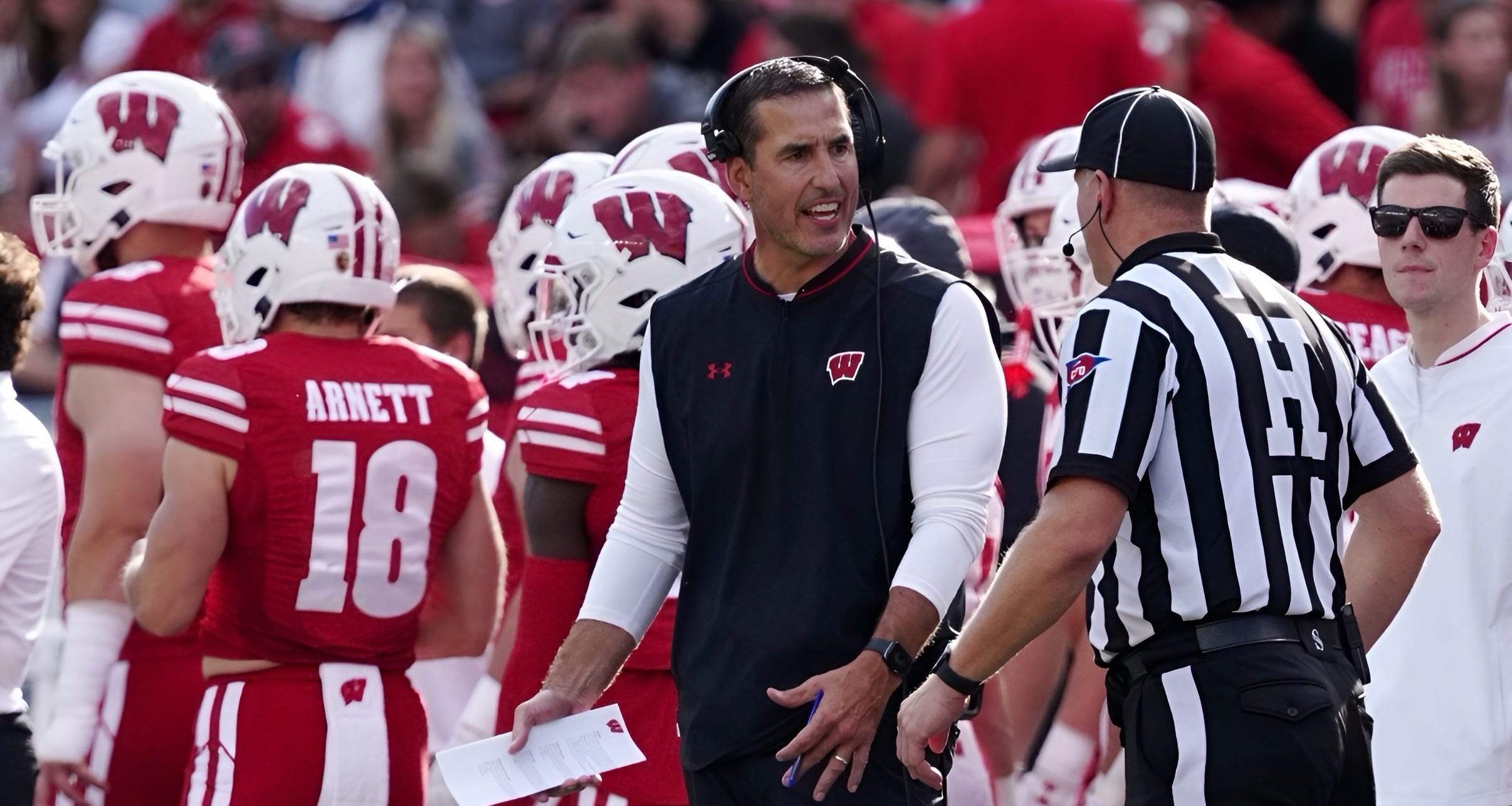
There are stretches in college football when a head coach has to do more than explain a season to his athletic department. He has to convince people investing in the team that there’s something worth building toward on the other side. Wisconsin football just lived through that reality, stumbling to a 4–8 finish that raised every question a program can face at once, and Luke Fickell found himself doing something no coach enjoys: selling the future before the present has made much of a case for itself.
That task gets even harder when your offense spends most of the season looking like it’s running uphill in cement. Wisconsin scored fewer points per game (12.8) than it had in more than 30 years, cycled through quarterbacks until it reached the true freshman at the bottom of the depth chart, and never found much of a rhythm on the ground or up front.
Nothing about that makes a compelling brochure.
Yet this is the world of modern recruiting, where NIL drives the market, but credibility and a chance to compete for a College Football Playoff spot still help determine whether the conversation goes anywhere. And despite everything working against him, Fickell entered the early signing period knowing he had to convince an entire class that what they were watching wasn’t a dead end, that once again, they needed “blind faith.”
Fickell framed it as honesty rather than excuse-making, but anyone who listened to the presser could hear where the conversation was headed:
“You’ve got to have some awareness of what happened to us,” Fickell said on signing day. “We’re not at a point now where we’re making excuses, but there’s a reality behind it. Look at the majority of the college teams that played with a backup quarterback, and just try to evaluate how they did. Then maybe look at some of them that played with their third team.”
Wisconsin didn’t stop at the third team. By November, the Badgers were lining up with Carter Smith, a true freshman who began the year buried on the depth chart and running the scout team. Even that transition wasn’t as simple as injury dictating the move. The situation was disjointed and, in many ways, emblematic of a program that couldn’t form an offensive identity, no matter who was taking snaps.
And while Fickell was fair to point out the difficult realities of life with your fourth quarterback having to lead the team, he also knew that leaning on that explanation alone wasn’t going to convince anyone of note to bet their program’s future.
The ground game wasn’t up to standard. The offensive line had its worst season in decades. The entire unit felt like it was trying to build something without the right tools on hand. It looked as though Wisconsin’s coaching staff was trying to put a square peg in a round hole. That’s a much harder conversation to walk into with recruits than anything quarterback related.
If you want the statistical version of how far the offense fell, the numbers paint the picture. Wisconsin finished last in the Big Ten in passing yards with 1,637, last in passing touchdowns with nine, and first in interceptions thrown with 13. The passing game averaged just 136.4 yards per contest, and the run game didn’t fare much better, checking in at 116.7 yards per game, which ranked 16th in the league. The Badgers were held under 100 passing yards six different times and under 100 rushing yards five times.
Put it all together, and you get an offense that averaged only 253.1 total yards per game, the lowest Wisconsin has produced in decades.
Still, even in a disappointing season defined by offensive frustration, Wisconsin managed to bring in a couple of offensive building blocks. The Badgers signed 13 scholarship players in the 2026 class, which includes a quarterback from Mater Dei, a shifty running back capable of contributing early, two speedy wide receivers, a tight end, and an offensive lineman.
That doesn’t happen if the sales pitch falls totally flat. It also doesn’t happen without some faith from the players who stayed committed to Wisconsin. The flip side, of course, is that plenty of others weren’t as convinced. Amari Latimer, Jayden Petit, Maddox Cochrane, Jack Janda, Tayshon Bardo, and Benjamin Novak all opted to sign elsewhere, and that’s only on the offensive side. Aden Reeder and Zachary Taylor also flipped their commitments.
It’s the smallest recruiting class Wisconsin has taken since 2012, and while the staff insists it was intentional because of a shift toward a more portal-heavy approach, the optics aren’t ideal.
“You’ve got to have some realization,” Fickell said. “We want to throw the ball down the field. We need to throw the ball down the field. We got into a situation where the offense had to manage what we could do. So our guys, whether they’re recruits or within our program, have to have an idea and understanding of that. I’m not saying it’s the easiest thing to sell, but it’s the truth. We’re not making excuses, but there is a reality to the things that we did and how we had to go about them. But we’ve got to fix that.
“That’s one of those things where I know seeing is believing, but there’s some blind faith in the things that some of these guys have to believe in.”
Blind faith is harder to find in the offseason than it used to be. Everyone can go anywhere. Everyone can leave at the first sign of adversity. And every program with deep pockets is waiting to take advantage of a team whose reputation is wobbling. That’s the environment Wisconsin is trying to recruit in. That’s why this recruiting cycle wasn’t just about signing high school prospects. It was about making the case that the Badgers still have a ceiling worth chasing with Fickell as the program’s head coach.
Now comes the next part of the challenge: making that same pitch to high-end transfer portal players who can go anywhere they want.
For all the attention the high school class gets, Wisconsin’s roster foundation for 2026 will largely come from transfer additions. The portal isn’t a complementary piece of roster construction anymore. It’s the lifeline. The Badgers need help across the board, and they need players who aren’t coming in as long-term projects. They need immediate difference makers. They need depth. They need adults in the room.
And the sales job gets tougher in that environment.
Most high school players come for relationships, development, and opportunity. Portal players come for money, role clarity, a path to winning, and a chance to put enough on tape to get to the NFL. Wisconsin has to convince them all of those things exist in Madison, even as the Badgers work through the very issues those players would be brought in to solve.
That’s the balancing act. Sell the vision without pretending the problems don’t exist. Be honest about how bad it looked without letting recruits or transfers think it’s permanent. Show urgency without sounding desperate.
Owning the shortcomings, explaining the why behind them, and pairing that with a clear plan forward might be the only strategy that works when your season ends the way it did, and your offense can’t move the ball.
“It’s been a battle… just the injuries in particular, and then trying to figure out which direction do you go — hoping to get guys back and not getting guys back,” Fickell said after the loss to Minnesota. “It’s created this hesitation offensively… in some ways, it’s not fair. It’s not fair to Coach [Jeff] Grimes, it’s not fair to that group of guys that, Hey, this is what we want to be, this is how we’re going to go. And then when you’ve got to go backwards, and you’ve got to go left, and you’ve got to go right.”
Some years are about building on momentum. This one is about rebuilding trust. Wisconsin doesn’t need to sell perfection. It needs to sell progress, direction, and a belief that 4–8 is not a preview of what’s coming next.
That’s no small task for a program that once made 22 straight bowl games and built its identity on stability, development, and a physical brand of football that never wavered. Three seasons into the Fickell era, that baseline has eroded. The on-field regression is real, and the one calling card this staff carried with absolute certainty was their ability to recruit at a high level, which carried over, but the losing has made that a lot harder.
Wisconsin also got a harsh reminder of how far the climb really is. They faced four of the top nine seeds in the College Football Playoff, including No. 1 Indiana, No. 2 Ohio State, No. 5 Oregon, and No. 9 Alabama. The Badgers were outscored 124–28 in those games. That’s the kind of gap that forces a college football program to speed up its course correction.
It’s much easier to close on big recruiting targets when you’re selling a recent College Football Playoff appearance at Cincinnati and a blueprint you’ve already proven. It’s a different challenge entirely when the product you’re pitching is a program drifting toward the bottom tier of the Big Ten.
And that’s the uncomfortable truth Wisconsin is staring at. They haven’t consistently retained their core players. They haven’t stacked wins or any form of results that suggest the foundation is stable. For all the talk about development and “pounding the rock,” the scoreboard hasn’t backed it up.
Yet despite “fire-Fickell” chants echoing throughout Camp Randall during the month of October, Chris McIntosh hasn’t flinched. He’s doubled down. Prominent donor Ted Kellner even went on something of a media tour, reinforcing that message, pledging resources and alignment because he trusts McIntosh, who trusts Fickell. There’s a lot of belief being extended at a moment when the evidence on the field hasn’t offered much in return.
So we’ll see. That’s where Wisconsin sits right now — a program still trying to sell a future that looks better than its present, hoping this rebuild finally starts moving forward instead of sinking deeper into the mud.
The next few months, as the transfer portal reshapes rosters across the country, will reveal whether the message from Wisconsin’s staff resonated or if the rebuilding effort still has a much steeper climb ahead.
We appreciate you taking the time to read our work at BadgerNotes.com. Your support means the world to us and has helped us become a leading independent source for Wisconsin Badgers coverage.
You can also follow Site Publisher Dillon Graff at @DillonGraff on X.
Very Good Analysis of the Situation, Thanks Dillon. Article could have been titled: "Nothing About That Makes a Compelling Brochure". In creating business plans in my career, we'd always start with a WOTS-UP analysis. That's Weakness, Opportunity, Threats and Strengths. The only Strength in the Badger football NIL world today would be money. Show us the money Mac.