

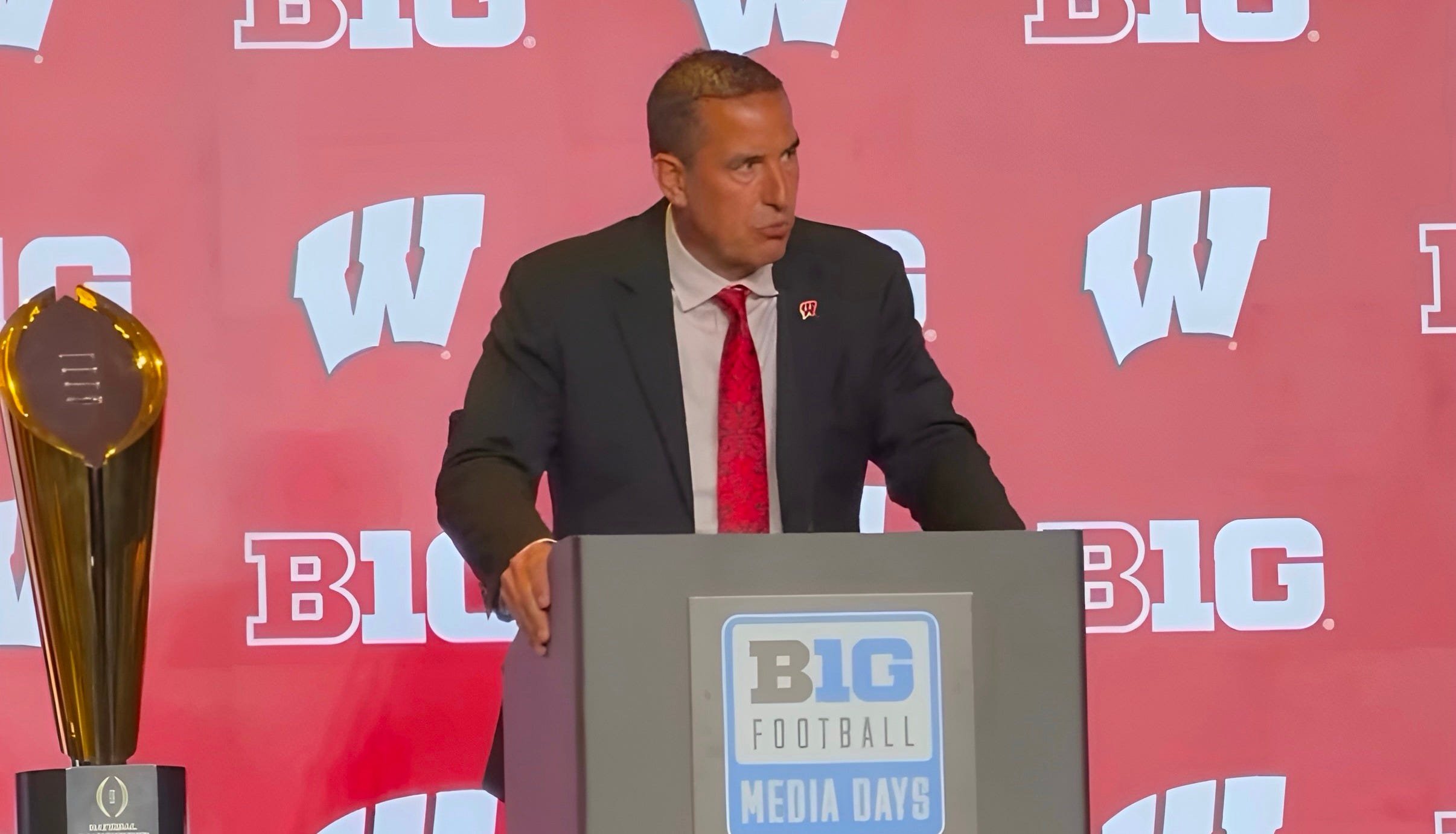
For college football fans, this is when the offseason starts to feel like it’s finally coming to an end.
Big Ten Media Days won’t decide a single game or answer every lingering question from the offseason, but it does mark the unofficial beginning of the season. Coaches step up to the podium, preseason narratives take shape, and the countdown to fall camp shifts from anticipation to reality.
For the Wisconsin football program, this year’s trip to Chicago carries a little more weight than most. Luke Fickell was joined by three veteran leaders in senior safety Matt Jung, senior edge rusher Sebastian Cheeks and senior wide receiver Chris Brooks, each representing the Badgers as the program turns its attention toward the upcoming season.
Fickell enters his fourth season leading the Badgers knowing full well that the conversation has changed. The honeymoon period is over. So are the excuses. After three consecutive seasons that failed to meet expectations, the pressure is squarely on Wisconsin to show meaningful progress in 2026. And the Badgers seem better equipped to do just that.
Now comes the difficult part: proving it.
With that in mind, here are my biggest takeaways from coach Fickell’s appearance at Big Ten Media Days in Chicago.
Wisconsin has fallen short of the standard, promises improvement
Luke Fickell did not attempt to soften the reality of his first three seasons at Wisconsin.
“The last two years for us have not been up to the standard, and I’m not shying away from that,” Fickell said. “The standard of what we have to uphold and where we have to grow as a football program, it hasn’t been there.
“That’s not just in the wins and losses. That’s in a lot of other things as well. The way we play the game, the physicality, the toughness — we’ve got to do a hell of a lot better job at doing. I can promise you that we will and things are obviously moving in that direction.”
That acknowledgment matters because Wisconsin’s problems have extended well beyond a 17-21 record (10-17 Big Ten) during Fickell’s tenure. The Badgers have watched their win total decline in each of the last three seasons, culminating in a 4-8 finish in 2025.
The Badgers have too often lacked the physical identity, discipline and consistency that once defined the program. Fickell knows those shortcomings cannot be explained away by injuries, roster turnover or the changing landscape of college football forever.
There is still plenty of belief inside the building that things will turn around, but Year 4 is no longer about selling a vision. It is about producing evidence that the program is moving in the right direction.
Fickell understands that distinction better than anyone. Now Wisconsin has to show that its promises will translate to Saturdays.
Wisconsin reevaluated nearly every part of the program
One of Fickell’s clearest messages was that Wisconsin did not treat another disappointing season as a reason to make only minor tweaks.
“For us, in the last eight or nine months, we’ve taken a deep dive at all things that we’ve done within our program,” Fickell said.
That review extended to how the Badgers attack the weight room, practice, prepare for fall camp and manage the physical demands of the season. Fickell specifically acknowledged that injuries forced the staff to reconsider some of its long-held training methods.
“We’ve had some critical injuries that have cost us some issues, Fickell acknowledged, “so we’ve taken a really hard look at the way we’ve trained, to the way we’ve practiced all through spring ball, how we’ll practice in fall camp, how we’ll practice as we get into the season.
“We know how to develop and put together a team that can be tough, nasty and disciplined and win in this league. We also have to be aware of some of the evolutions of the things that have continued to happen.”
That does not guarantee better results, but it was necessary.
Wisconsin could not keep approaching every part of the operation the same way while expecting a different outcome. Fickell’s willingness to at least question the program’s processes suggests he recognizes that the Badgers needed more than another offseason of roster additions.
“We’re going in a different direction, and there’s a lot of things that have changed even within the last year in our program,” Fickell said.
They needed to evolve without losing sight of the toughness and physicality they are trying to restore. Now it’s time to find out whether those changes, combined with the school’s increased investment in the program, are enough to move Wisconsin closer to where it expects to be.
Fickell believes Wisconsin’s leadership has changed the trajectory
Entering Year 4 as head coach, Fickell still pronounces Wisconsin as “Wes-con-sin,” and much like previous trips to Big Ten Media Days, he once again pointed to leadership as the biggest reason for optimism.
He believes the most meaningful changes inside the program began midway through last season, when younger players like Mason Posa and Cooper Catalano started assuming greater responsibility. At the same time, Wisconsin’s veterans embraced their development.
Despite finishing the season by losing eight of their final 10 games, the Badgers still knocked off ranked Washington and Illinois teams behind an emerging group of young linebackers, reinforcing the belief in the locker room that the program was moving in the right direction.
“We could have gone one direction or the other, and we were in a really tough situation, but there were some youth within our program that really started to grow and took over in a way that was really, really healthy for us,” Fickell said, “and we had a group of veteran leaders that kind of understood what was happening and saw it and embraced that as well.
“It’s really, over the last nine months, put us in a position that is far, far different than we ever have been since I’ve been here. I can honestly tell you that.”
Fickell also pointed to Chris Brooks, Sebastian Cheeks and Matt Jung as representatives of that veteran group, but his larger point was about what has developed around them.
“These guys, coupled with some youth of this program and this team, have really changed the trajectory,” Fickell said. “I’m going to be honest with you. It has laid some roots within our program that puts us in a much different place right now.”
That is encouraging, particularly for a program that has too often struggled to respond when adversity has hit during Fickell’s tenure. Leadership is easy to praise in July. Its true value will be determined by how Wisconsin responds when the season inevitably tests it.
We appreciate you taking the time to read our work at BadgerNotes.com. Your support means the world to us and has helped us become a leading independent source for Wisconsin Badgers coverage.
You can also follow Site Publisher Dillon Graff at @DillonGraff on X.