

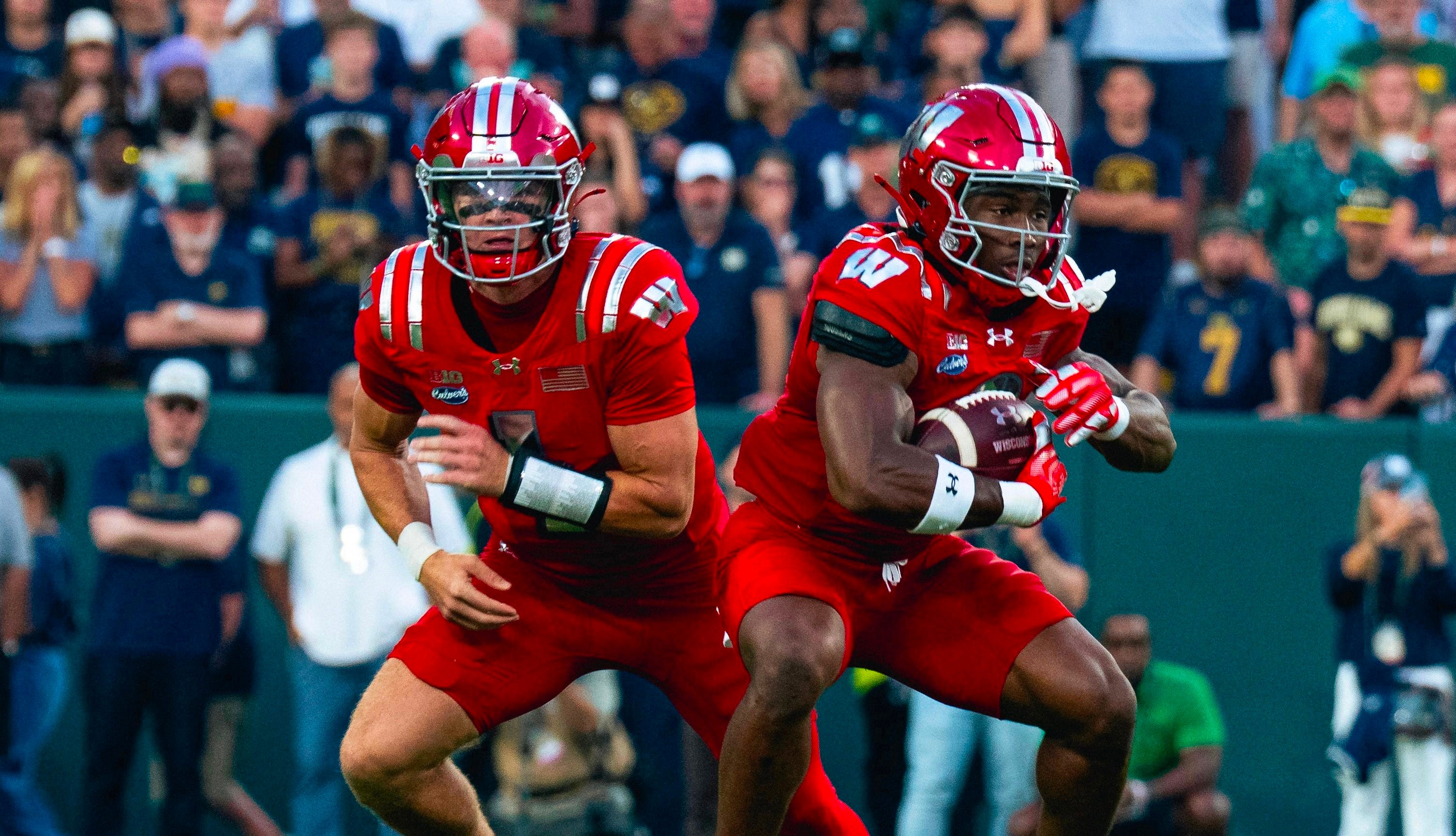
There wasn’t much mystery left in Wisconsin’s 41-13 loss to No. 4 Notre Dame by the time the final seconds ticked off at Lambeau Field.
But the snap counts give us a better idea of how the Badgers actually intend to use this roster.
Some position battles became considerably clearer. Others remain unsettled. And after an offseason built around creating more playable depth, Wisconsin followed through on that plan defensively while keeping several offensive rotations tighter than expected.
Here’s what stood out at every position from Wisconsin’s Week 1 snap counts.
Quarterback
Colton Joseph: 61 snaps
There was never much question about who Wisconsin’s quarterback was going to be, and Joseph took all 61 offensive snaps in his Badgers debut.
The 6-foot-2 signal caller finished 19-of-30 for 217 yards, one touchdown and one interception. The pick-six was costly, but there were enough encouraging moments to feel reasonably good about what Wisconsin has at quarterback — at least relative to the past few seasons.
Joseph also showed some toughness after taking several hits, and Luke Fickell specifically praised his demeanor and response to adversity afterward.
The bigger concern is creating more around him.
Joseph officially carried 12 times for three yards, with a pair of sacks obviously eating into that total, while Wisconsin finished with only 67 rushing yards as a team. If the Badgers are going to maximize what Joseph brings to the table as an athlete, they can’t consistently put him in situations where he has to manufacture offense himself.
Running back
Abu Sama: 31
Darrion Dupree: 25
Nate Palmer: 4
Tyler Jansey: 1
Sama was clearly Wisconsin’s primary runner, taking 15 carries for 49 yards. That’s only 3.3 yards per attempt, and his longest run went for seven. That said, Sama did force five missed tackles.
Dupree’s usage was considerably different. He played 25 snaps but carried the ball only four times for 15 yards, with 19 of those snaps coming either as a receiver or pass protector, according to PFF.
That distinction matters.
This looks less like a traditional 1A/1B backfield and more like Wisconsin already identifying specific roles for their top two tailbacks. Sama is the player Jeff Grimes wants carrying the football, while Dupree’s versatility gives the offense another way to get him onto the field as an asset.
Bryan Jackson did not play after dealing with an injury during camp, and Nate Palmer received only four snaps but didn’t touch the football.
For now, this is Sama’s backfield.
Wide receiver
Chris Brooks Jr.: 47
Tyrell Henry: 45
Malachi Coleman: 40
Eugene Hilton Jr.: 17
Shamar Rigby: 15
This was probably the most revealing offensive rotation.
For all the discussion during camp about Wisconsin potentially spreading snaps across a deep receiver room, the Badgers leaned pretty heavily on Brooks, Henry and Coleman — although Hilton wound up getting hurt.
And Coleman made the most of it.
The Nebraska and Minnesota transfer caught four passes for a team-high 76 yards, including Wisconsin’s lone touchdown on a 28-yard connection with Joseph. Henry added four receptions for 42 yards, Brooks caught three for 38, and Hilton finished with three for 31 despite playing only 17 snaps.
That’s encouraging in one specific respect: Wisconsin didn’t need one receiver to dominate the targets. I’m not sure that kind of offense.
Joseph distributed the football, and four different wideouts finished with at least 30 receiving yards.
The more interesting development is Coleman. After missing some time during fall camp, the 6-foot-5 pass catcher immediately looked like someone capable of becoming a much larger part of this offense than perhaps expected. At the very least, Coleman earned more opportunities.
Rigby played 15 snaps without drawing a target. That’s worth monitoring after the Oklahoma State transfer generated some buzz during camp.
Tight end
Grant Stec: 42
Emmett Bork: 18
Jacob Harris: 17
Ryan Schwendeman: 5
If there was one offensive depth chart that looked slightly different from what I expected entering Week 1, this was probably it.
Stec wasn’t merely the starter. He was Wisconsin’s clear-cut No. 1 tight end, playing 42 snaps and catching three passes for 20 yards.
Bork, an in-state product, actually finished second in the room with 18 snaps, one more than Bowling Green transfer Jacob Harris. Harris caught only one pass for three yards.
That doesn’t mean Harris won’t eventually become a more significant piece of the puzzle. Wisconsin has intentionally built this room around different body types and skill sets, so usage in Nate Letton’s room could change substantially depending on opponent and personnel package.
But Week 1 told us something.
Stec appears to have created meaningful separation at the top.
Offensive line
Kevin Heywood: 61
Colin Cubberly: 61
Austin Kawecki: 61
PJ Wilkins: 53
Blake Cherry: 38
Stylz Blackmon: 23
Lucas Simmons-Johansson: 8
The biggest news here might simply be that Heywood played every snap.
After missing most of fall camp with a lower-body injury and entering Sunday with Heywood’s availability uncertain, Wisconsin’s starting right tackle allowed two pressures while also being flagged for a penalty, but he handled all 61 offensive plays.
So did Cubberly (left guard) and Kawecki (center).
The rotation came primarily at right guard, where Blackmon started but Cherry ultimately played 38 snaps to Blackmon’s 23. With Emerson Mandell unavailable to play, that competition clearly isn’t decided.
Simmons-Johansson’s eight snaps came in relief of Wilkins at left tackle.
The results up front were mixed.
Wisconsin allowed Joseph to throw for 217 yards and largely looked solid in pass protection, but the running game never established itself. The Badgers averaged just 2.2 yards per carry, and Sama averaged 3.3.
Against Notre Dame’s defensive front, that isn’t shocking. But for an offense whose identity is supposed to begin with establishing the run, it’s an obvious area that needs to improve.
Defensive line
Hammond Russell IV: 38
Charles Perkins: 26
Junior Poyser: 20
Nolan Vils: 15
DeNigel Cooper: 13
Dillan Johnson: 11
This looked much closer to what Wisconsin spent the offseason describing.
The Badgers wanted size, depth, and enough bodies to rotate through their defensive front without asking anyone to handle an unreasonable workload. Six defensive linemen played at least 11 snaps, and nobody exceeded Russell’s 38.
For a half, it worked exceptionally well.
Notre Dame entered halftime with only 29 rushing yards on 16 attempts, an average of 1.8 per carry.
The problem was sustaining it.
The Irish eventually finished with 111 rushing yards. Notre Dame’s ability to stay ahead of the chains became a major part of how the game got away from the Badgers. Still, there’s enough here to believe Wisconsin has the rotational depth it wanted up front.
Inside linebacker
Cooper Catalano: 64
Mason Posa: 60
Jon Jon Kamara: 18
Thomas Heiberger: 4
There shouldn’t have been much doubt about who Mike Tressel views as the centerpieces of his defense after what Catalano and Posa showed down the stretch last season. But Week 1 helped reinforce that vision.
Catalano played every defensive snap. Posa missed only four. And both were all over the field, with Posa finishing with a career-high 15 tackles and Catalano adding nine. Wisconsin spent the offseason talking about rotating Kamara and Heiberger into the defense, which they did but against Notre Dame, Tressel leaned pretty heavily on his two starters.
Kamara still received 18 snaps, while Heiberger played only four.
That could change against Western Illinois and Eastern Michigan, when Wisconsin should have considerably more freedom to develop its depth.
But when the Badgers needed their best 11 against Notre Dame, Catalano and Posa weren’t coming off the field much.
Outside linebacker
Sebastian Cheeks: 43
Michael Garner: 33
Tyreese Fearbry: 25
Justus Boone: 21
Nick Clayton: 11
Aaron Witt: 1
Wisconsin actually followed through on its plan to rotate bodies here.
Five true outside linebackers saw the field, with four receiving at least 21 snaps. Aaron Witt, who has primarily been viewed as an inside linebacker, was also credited with one snap on the edge. Cheeks separated himself from the group.
The senior edge rusher recorded two tackles, three pressures, a forced fumble, and a pass breakup, with his strip-sack of CJ Carr on Notre Dame’s opening possession immediately translating the disruption he reportedly showed more often than not during fall camp — into a game.
Garner, who stands at 6-foot-7, 315 pounds, played 33 snaps and contributed four tackles, while Fearbry and Boone both received meaningful work. Boone recorded four tackles and two pressures.
This room was supposed to give Wisconsin multiple ways to attack opposing offenses rather than rely on a single premier pass rusher. One game in, Cheeks looks like he might be capable of becoming that premier option anyway. They need some of the others to continue developing.
Cornerback
Javan Robinson: 62
Jai’mier Scott: 48
Bryce West: 46
Eric Fletcher Jr.: 16
Cai Bates: 2
This was another rotation that told us quite a bit.
Robinson essentially never left the field, while West and Scott handled the overwhelming majority of the remaining cornerback snaps.
Most notably, Scott played three times as many snaps as Fletcher.
After Wisconsin completely rebuilt this room through the transfer portal, we have our first meaningful look at the pecking order under position coach Robert Steeples. Robinson appears firmly established at the top, and Scott and West (starting nickel) have clearly earned significant roles alongside him.
The secondary held up reasonably well early on before Carr and Notre Dame found answers in the second half.
Carr finished 19-of-29 for 239 yards and two touchdowns without an interception, averaging 8.2 yards per attempt. Wisconsin’s softer coverage also allowed him to take easy access throws in the second half.
There were encouraging individual moments, but this remains a group that needs to prove it can hold up when offenses start finding answers.
This room was one of Wisconsin’s biggest problems a year ago. The next two nonconference games should allow the Badgers to iron some things out and figure out how to maximize the talent they’ve added to the room.
Safety
Matthew Jung: 64
Marvin Burks Jr.: 53
Cairo Skanes: 10
Like Catalano, Jung never left the field.
That tracks with everything Wisconsin showed throughout the offseason. Jung represented the football program at Big Ten Media Days and has become one of the veterans Jack Cooper trusts to communicate and organize the defense from the back end. He backed that up against Notre Dame, finishing with nine tackles and a pass breakup.
Burks handled 53 snaps, with Skanes spelling him for 10. Carson Van Dinter didn’t see the field defensively.
Wisconsin wants more depth in the secondary than it had a year ago, but Week 1 showed there are still players this staff views differently when the opponent demands its best personnel.
Jung is clearly one of them.
What did we actually learn?
More than anything, Week 1 gave Wisconsin a baseline.
The Badgers are hoping to have found something in Coleman. Stec has emerged as the clear top tight end. Sama is the primary ball carrier. The right guard competition remains open until Mandell is back. Heywood was healthy enough to play an entire game.
Defensively, Catalano, Posa, Jung and Robinson look like foundational every-down pieces, while Wisconsin has legitimate rotational depth along the defensive front and at outside linebacker.
That’s useful information coming out of a 28-point loss.
Now comes the part that matters.
Western Illinois and Eastern Michigan should give Wisconsin opportunities to expand some of these rotations, get younger players meaningful work and, more importantly, establish the things it couldn’t sustain against Notre Dame. They need proof of concept.
That starts with the running game. It extends to cleaning up the secondary and figuring out which of these rotational pieces deserve larger roles. Notre Dame showed us who Wisconsin trusted when the stakes were highest. Unfortunately, the talent gap is still pretty wide.
The next two weeks should tell us who is capable of earning more.
We appreciate you taking the time to read our work at BadgerNotes.com. Your support means the world to us and has helped us become a leading independent source for Wisconsin Badgers coverage.
You can also follow Site Publisher Dillon Graff at @DillonGraff on X.