

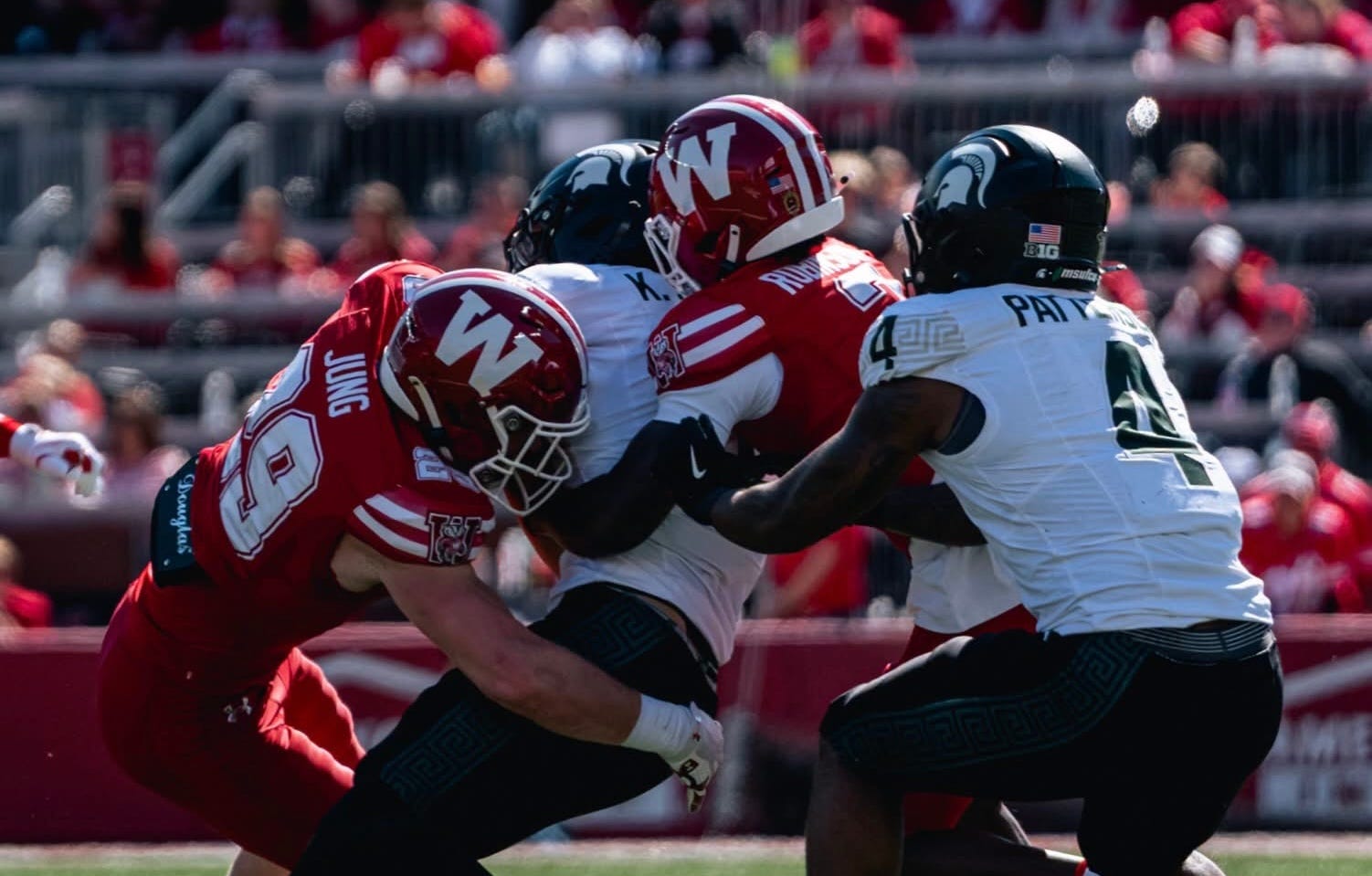
For the first time this season, the Wisconsin football team’s snap counts tell the story of a game played mostly on the Badgers’ terms.
There was no fourth-quarter comeback required. No extended stretch where the offense disappeared — at least not when it mattered. No late defensive stand needed to preserve the result.
Wisconsin scored touchdowns on its first two possessions, took a 17-3 lead into halftime, and eventually pulled away for a 31-3 win over Michigan State. The Badgers finished with 373 yards of offense, including 228 on the ground, while holding the Spartans to 235 total yards and keeping them out of the end zone.
But the personnel usage underneath that performance might be just as interesting.
Wisconsin reshuffled its offensive line before kickoff, had to adjust again when Austin Kawecki left with an injury, leaned heavily on Colton Joseph’s legs, and continued expanding the defensive rotation. The PFF grades also help explain why this felt like Wisconsin’s most complete performance of the season.
Here’s what stood out at every position from Wisconsin’s Week 5 snap counts.
Quarterback
Colton Joseph: 59
Ryan Hopkins: 3
Joseph’s passing line wasn’t particularly efficient.
He completed 9-of-20 passes for 145 yards, but he threw three touchdowns, avoided the turnover problems that plagued him at Penn State, and completely changed the game with his legs.
Joseph rushed for 141 yards and a touchdown, the second-highest single-game total by a quarterback in Wisconsin history. PFF gave him a team-best 87.2 offensive grade and 79.1 rushing grade.
The most revealing number might be where those yards came from.
PFF credited Joseph with only 10 yards after contact. Of his 140 charted rushing yards, 130 came before contact, and he had four runs of at least 10 yards. That’s what the quarterback run game can do when Wisconsin blocks it correctly and Joseph commits to getting downhill.
His 47-yard touchdown in the third quarter was the obvious example.
There is still plenty to clean up as a passer. But this was the version of Joseph that makes Wisconsin difficult to defend. He didn’t need to carry the offense through the air because his legs created an entirely different problem.
Hopkins handled the final three snaps after the game was decided.
Running back
Darrion Dupree: 43
Bryan Jackson II: 16
Nate Palmer: 3
This continues to look like Dupree’s backfield while Sama is sidelined with an injury.
He played 43 of Wisconsin’s 62 offensive snaps and handled 19 carries for 61 yards. Jackson received seven carries for 22 yards on 16 snaps, while Palmer didn’t enter until late.
The raw rushing numbers weren’t especially impressive for either running back. Dupree averaged 3.2 yards per carry, while Jackson averaged 3.1.
But Dupree continues to provide value beyond the box score.
He earned an 88.0 pass-blocking grade, the highest on Wisconsin’s offense, albeit on only two pass-blocking snaps. PFF also credited him with 37 yards after contact on his 61 rushing yards and three missed tackles forced.
That’s worth noting because Joseph’s 141 rushing yards can make Wisconsin’s overall rushing performance look more dominant than it was from the traditional run game. The Badgers still need more efficiency from their backs.
The pecking order, though, isn’t particularly difficult to identify right now. Dupree is getting feature-back usage and will be a big part of the game plan even when Sama is healthy.
Wide receiver
Chris Brooks Jr.: 41
Eugene Hilton Jr.: 38
Malachi Coleman: 28
Tyrell Henry: 28
Shamar Rigby: 8
Kash Brock: 3
Zion Kearney: 3
Jackson McGohan: 2
Mason Kelley: 1
This was probably the most interesting receiver rotation Wisconsin has used this season.
Brooks and Hilton still led the room in snaps, but neither dominated the passing game. Brooks caught one pass for 10 yards on three targets, while Hilton caught his only reception for 17 yards.
Instead, Wisconsin got its biggest play from Coleman.
He played 28 snaps and caught his lone target for a 46-yard touchdown in the fourth quarter. That gave Coleman his second touchdown reception of the season after entering 2026 with one career receiving score.
Henry also played 28 snaps and caught two passes for 32 yards.
The larger takeaway is that Wisconsin doesn’t appear particularly interested in narrowing this room to three receivers. Brooks, Hilton, Coleman, and Henry all played meaningful snaps, and the distribution gives Jeff Grimes different personnel combinations without dramatically changing the offense.
Coleman is the player I’m watching most closely coming out of this one. At 6-foot-4 with legitimate vertical ability, there is an obvious role available if he keeps earning opportunities.
Tight end
Ryan Schwendeman: 27
Grant Stec: 25
Jacob Harris: 23
Emmett Bork: 18
Nizyi Davis: 3
Harris only played 23 snaps.
He also might have made the biggest impact of anyone in the room.
Harris caught two of his three targets for 35 yards and two touchdowns, earning a 90.8 receiving grade, the highest mark on Wisconsin’s offense.
That’s now touchdowns in consecutive games for Harris, making him the first Wisconsin tight end to accomplish that since Jake Ferguson in 2018. His two-touchdown performance was also the first by a Badgers tight end since Clay Cundiff in 2022.
But the snap distribution tells us Wisconsin still isn’t treating Harris like an every-down tight end. To be fair, the game was well in hand and called for more of the ground game to eat clock. That said, Schwendeman led the position with 27 snaps and earned an 84.9 run-blocking grade, the best run-blocking mark on the team. Stec played 25, and Bork added 18.
That’s the tradeoff Wisconsin seems comfortable making. Harris is becoming its most dangerous receiving tight end, while Schwendeman and Stec continue handling substantial work when Wisconsin wants more from the position as blockers.
