

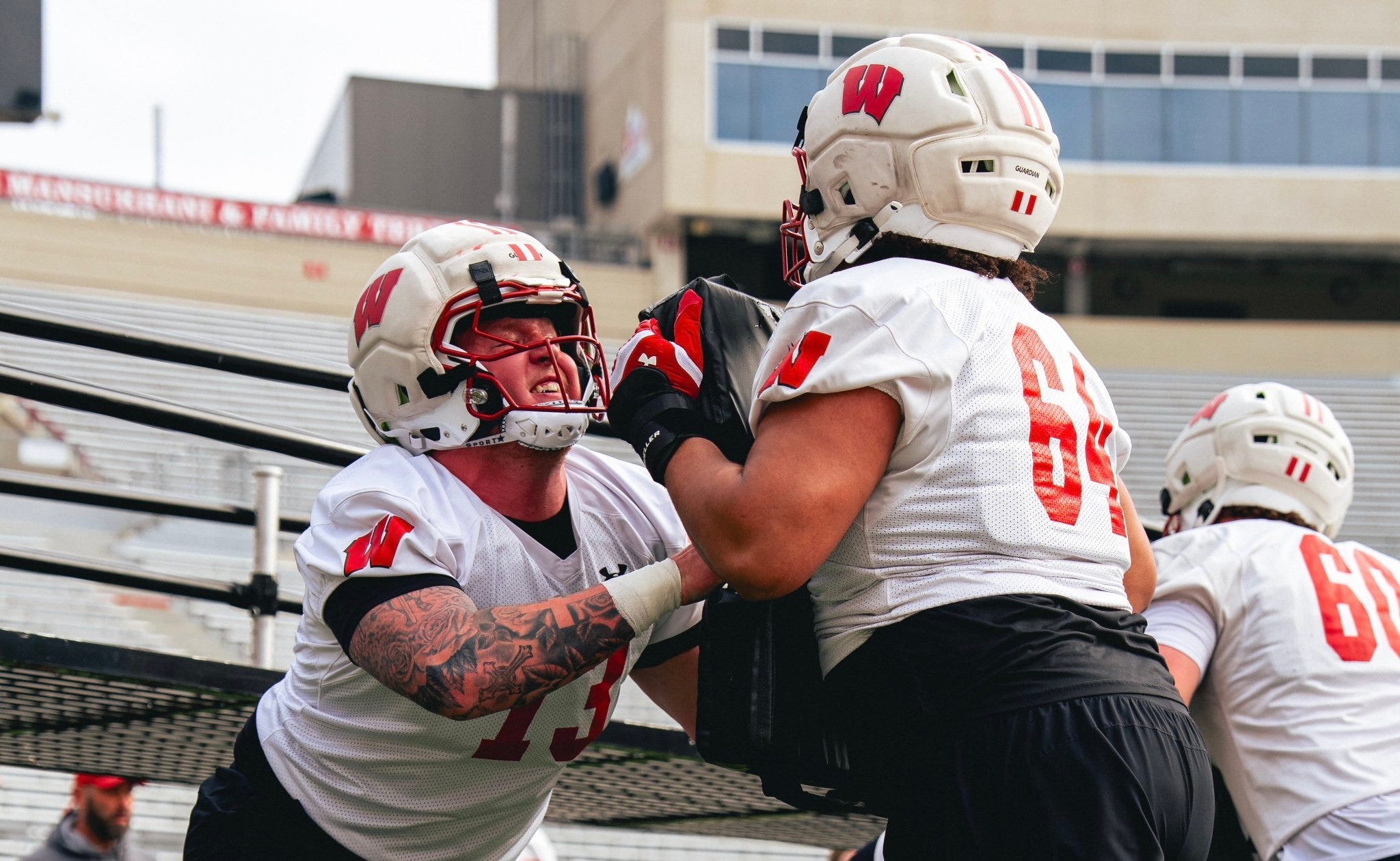
There was no shortage of things that went wrong for Luke Fickell and the University of Wisconsin football team during its 4–8 season in 2025.
You can point to the countless injuries at quarterback. You can point to an inconsistency at the skill positions. You can point to a lack of offensive identity. All of it is fair. But if you really strip it down from an execution standpoint, most of those problems trace back to one place.
Up front.
“That’s the number one thing offensively is the continuity of those guys up front,” Fickell said when asked about the focus for Wisconsin’s offensive line this spring. “I’m not going to dwell upon the past, but if there’s something that has probably not gone in the direction, individually or unit-wise, it has been the O-line. With the history here and what the expectations are here — that’s one of the big things.”
That’s not a throwaway line. That’s an acknowledgment.
Because for as much as the quarterback carousel defined last season, the offensive line never gave the offense a chance to stabilize or improve. There was constant shuffling. Players were asked to play out of position. Others were forced into roles they probably weren’t ready for yet.
And the result showed up in the numbers.
Wisconsin fielded the least productive offense in the Power Four last season, finishing No. 134 nationally in scoring (12.8 points per game) and No. 135 in total offense (253.1 yards per game). The run game — a foundational piece of the program’s identity — never found traction.
Then, after the season, more experience walked out the door.
Starting left guard Joe Brunner transferred to Indiana. Center Jake Renfro left for Illinois. Offensive tackle Riley Mahlman exhausted his eligibility.
Whatever continuity existed up front didn’t last.
So the response was predictable. Wisconsin moved on from A.J. Blazek and hired Eric Mateos as the new offensive line coach, leaning on his prior working relationship with offensive coordinator Jeff Grimes in hopes that familiarity can help this new group get up to speed quickly.
The next step was to go out and add bodies. A lot of them.
Most notably, Austin Kawecki arrives from Oklahoma State as a veteran presence expected to take over the starting center job. Kevin Heywood returns from an ACL injury and is expected to factor in at tackle. And then there’s P.J. Wilkins, an Ole Miss transfer who has primarily played guard in college but is now working at tackle since arriving in Madison.
That last part matters.
Because Mateos didn’t just inherit this group — he’s reshaping it.
“That’s what I really love about it, to be honest with you,” Fickell said about the offensive line. “I love being in that room right now because there are all new guys. There are some guys who played a little bit in [Colin] Cubberly and Emerson Mandell. But the nature of it is it’s a new group.”
It looks like one, too.
Colin Cubberly brings experience after being thrown into the fire last season. Emerson Mandell, who opened last year as the starting right guard, has shown positional flexibility after sliding out to tackle last season, but is now back working on the interior. Arkansas transfer Blake Cherry is competing on the interior, while younger or depth options like Lucas Simmons and Stylz Blackmon add competition behind them.
Even someone like Barrett Nelson, currently working back from another injury, is viewed as a candidate for the two-deep at tackle when healthy. There are more options. The challenge is turning that into answers.
“Look, we’ve got to get back to that group being a group,” said Fickell. “It’s not individuals. There are a lot of things we’ve got to be able to do... Yes, they understand the history. Yes, they understand the past. But it’s time to kind of say, ‘Look.’ This is a group that’s got to kind of reestablish the things that we believe in, and we are.”
And that’s where everything ties together. Because this isn’t just about fixing the offensive line in isolation, this is about supporting a completely reworked offense.
Nobody’s expecting this group to snap back to the gold standard of offensive line play that Wisconsin built its identity on overnight. But this is still a program that wants to run the ball, play with physicality up front, and lean into a system that now includes mobile quarterbacks.
Even if returning to an elite level immediately isn’t realistic, they do have to become a Big Ten-caliber unit — one capable of holding its own, creating movement, and giving the offense a chance to dictate terms instead of constantly reacting. Wisconsin has a new quarterback room led by Old Dominion transfer Colton Joseph. A reshaped running back group featuring Abu Sama and Darrion Dupree. A completely different mix at wide receiver. Changes at tight end. All of it depends on what happens up front.
If the line comes together, the Badgers’ offense has a path toward meaningful improvement after what was one of the least productive units Wisconsin has fielded in decades. If it doesn’t, it’s hard to see much changing, regardless of who’s under center or carrying the ball.
Fickell knows it. The staff knows it. The returning players know it.
Now it’s about proving it.
“I think that’s where a lot of the youth and the newer guys have been really refreshing — a little bit of a changeover,” Fickell said.
Refreshing is one way to put it. Necessary might be a better one. Because for Wisconsin to take a step forward and make it back to a bowl game for the first time since 2023, it starts where it always has. Up front.
We appreciate you taking the time to read our work at BadgerNotes.com. Your support means the world to us and has helped us become a leading independent source for Wisconsin Badgers coverage.
You can also follow Site Publisher Dillon Graff at @DillonGraff on X.
Indeed, the OL is key. Has there been any light on the departures of Renfro and Brunner? Was it $$$, dissatisfation with the new coach, a sense that their starting roles might be in jeapordy?