

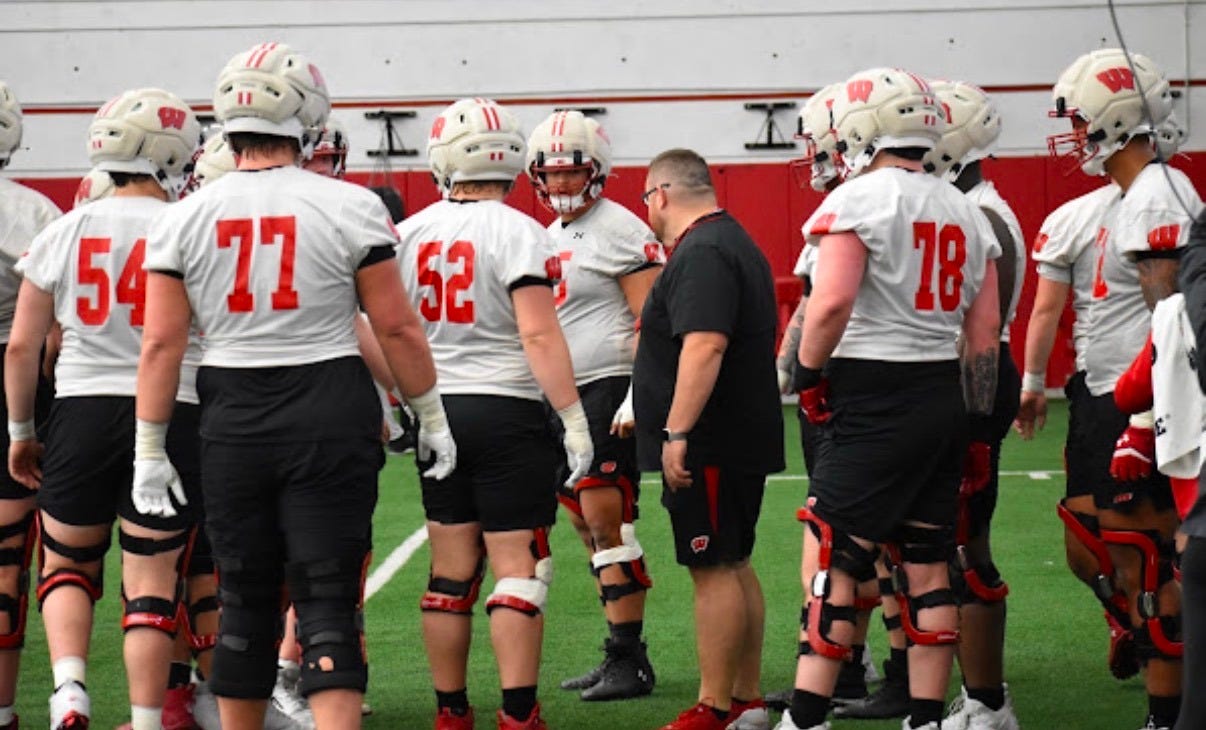
The University of Wisconsin football offensive line isn’t operating under ideal circumstances five practices into fall camp.
Eric Mateos doesn’t particularly care.
With Kevin Heywood and Emerson Mandell unavailable, Wisconsin has been forced to move pieces around earlier than anticipated. Lucas Simmons has shifted to right tackle, while players further down the depth chart are receiving opportunities they otherwise might not have gotten with the first-team offense.
For Mateos, that’s not necessarily a problem.
That was one of several things that stood out from Wisconsin’s offensive line coach when he met with reporters during fall camp.
Wisconsin is using its injuries to build offensive line depth
Wisconsin entered camp expecting to rotate offensive linemen. The absence of Heywood and Mandell has accelerated that process.
“All O-line coaches are grinding out to make number seven, number eight on the roster viable to go win football games,” Mateos said. “This to me gives us an opportunity to do that even earlier and more frequently than we already anticipated.”
Instead of having five established starters take virtually every first-team rep, Wisconsin is getting an extended look at its next wave.
Simmons has been among the most notable examples. The Florida State transfer added 20 pounds after spring practice and is now up to 323, all while adjusting to right tackle despite never playing the position before.
“He’s playing strong,” Mateos said. “He’s getting tougher. He’s never done right tackle in his career. That’s a big change, and some people don’t think it’s a big change, but — try wiping after you go to the bathroom with your opposite hand and tell me how it goes. So he’s working through it.”
There has been competition behind him, too.
Mateos called Hardy Watts his biggest surprise since spring practice, praised Ryan Cory’s improved football IQ and execution, and said Stylz Blackmon has continued adjusting to the speed of the college game.
Not everyone is where Mateos wants them.
“Not all five of the twos are pushing how they need to,” Mateos acknowledged. “But some of them are certainly doing that.”
The goal is making sure Wisconsin isn’t scrambling if and when attrition inevitably arrives during Big Ten play.
Mateos wants Wisconsin’s running game to deliver ‘body blows’
Jeff Grimes’ arrival has brought an obvious philosophical shift to Wisconsin’s offense, and nowhere is that more apparent than up front.
Mateos, who has worked with Grimes in the past, wants the Badgers to become increasingly difficult to deal with as games progress.
“We want to be delivering body blows,” Mateos said. “Those first-quarter runs that are three and four yards, second quarter they become five and six. Second half, fourth quarter they become 9-12 explosive plays. We’re just trying to train that mentality.”
That’s significant for a Wisconsin offense that struggled to establish the run last season, finishing 116th nationally and 16th in the Big Ten in rushing offense.
Mateos has been encouraged by the early returns, particularly when the Badgers have created clean running lanes during fall camp. But installing the scheme is only part of what he’s trying to accomplish right now.
Practices five through eight are intentionally designed to test his group mentally and physically.
“Practice five is all about I’m trying to kill them. I’m trying to break them down like a wild bronco,” Mateos said. “There’s a wall in the mind that they have to understand is built of soft thoughts. We all have it, and we’re attacking that. You’ve got to cut the flowers down a little bit if you want them to grow a little bit bigger and more beautiful, and that’s what I’m trying to do right now.”
That approach isn’t one-size-fits-all, either. Mateos believes part of pushing players that hard is understanding how each individual responds to it.
“I think one of the strengths of a good coach is that he can talk to players in a way that connects with them and what they need in that moment,” Mateos said. “I don’t treat everybody the same. That’s an old football coaching adage, ‘Treat everybody the same.’ I think that’s bogus because not everybody’s the same. My job is to figure out how to connect with each of them and make sure we understand each other on a deeper level. So when I do have my foot up their ass, it’s not personal, it’s business.”
The language is colorful. The objective is pretty straightforward.
When Wisconsin takes the field, Mateos wants five offensive linemen comfortable operating without him.
“On September 6th, I’m not going to be out there,” Mateos said. “It’s going to be five guys versus the world.”
Mateos believes turning Wisconsin around starts up front
There are few position groups facing more pressure to improve in 2026.
Wisconsin’s offense averaged just 12.8 points per game last season, the lowest mark by a Big Ten team this century. The offensive line was rebuilt around Grimes’ vision, and Mateos came to Madison understanding exactly what he was being asked to help fix.
Asked whether turning the program around starts with his position group, Mateos didn’t hesitate.
“That’s how I think about it every day,” Mateos said. “That’s why I took the job.”
Mateos compared the opportunity to his previous stop at Baylor: joining a defensive-minded head coach whose offense needed significant improvement and believing he could directly influence the trajectory of the program.
Now Wisconsin is asking him to do exactly that.
There are still questions about what the starting five will ultimately look like, particularly while Heywood and Mandell work their way back.
Oklahoma State transfer Austin Kawecki appears to have the center job locked down, while Ole Miss transfer PJ Wilkins should be similarly secure at left tackle. Colin Cubberly and Blake Cherry are among the options competing for spots on the interior, with Simmons emerging as the preferred option at right tackle while Heywood is sidelined.
Notably, Heywood is expected back before too long, but his absence has forced Wisconsin to test its depth earlier than anticipated. For Mateos, that’s part of the process rather than something preventing the Badgers from establishing what he wants the group to become.
Build enough depth to survive the Big Ten. Develop a running game capable of wearing teams down. And create an offensive line tough enough to handle what happens when nobody on the sideline can help them. For Mateos, that’s where Wisconsin’s offensive rebuild starts.
We appreciate you taking the time to read our work at BadgerNotes.com. Your support means the world to us and has helped us become a leading independent source for Wisconsin Badgers coverage.
You can also follow Site Publisher Dillon Graff at @DillonGraff on X.