

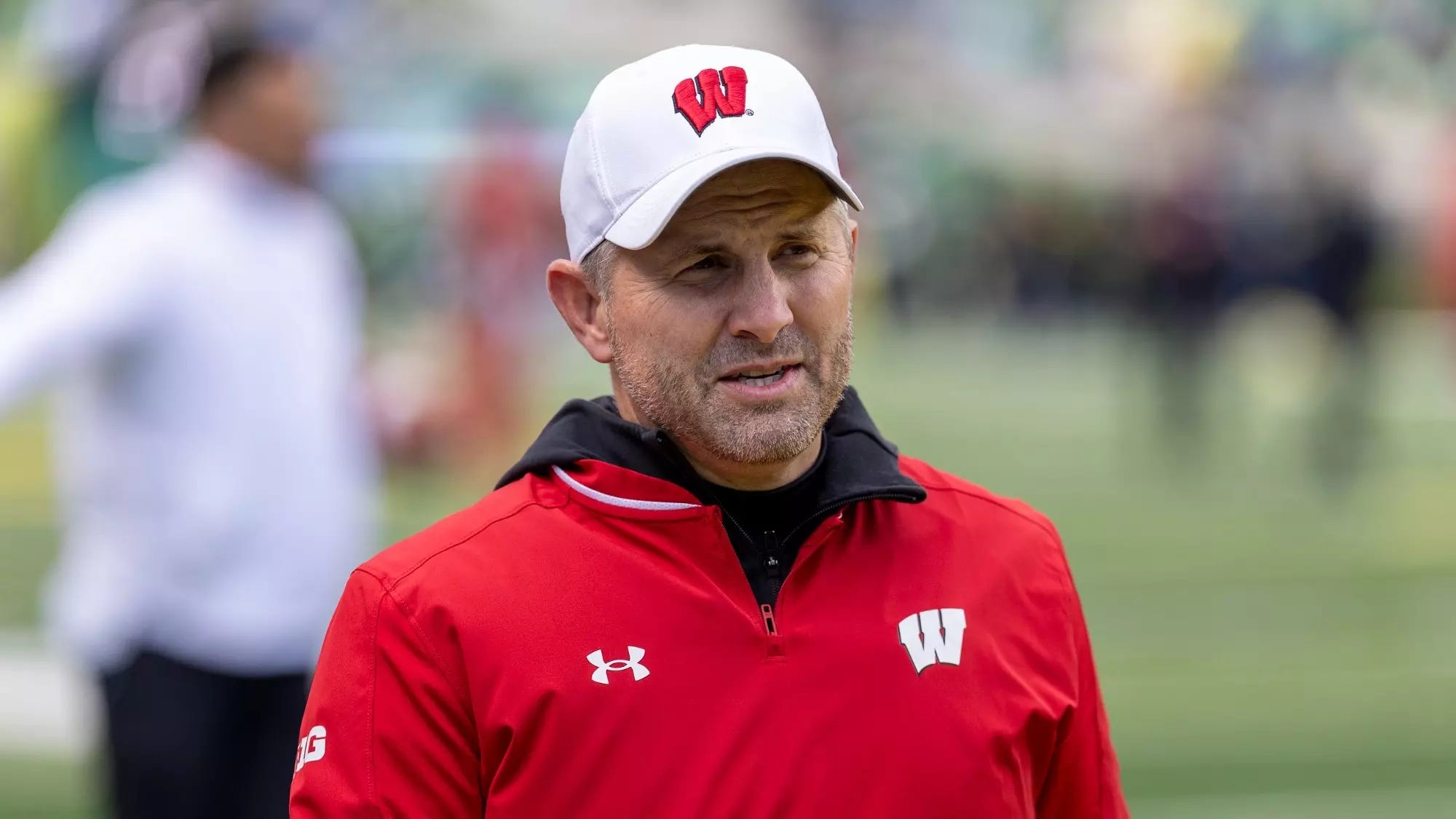
The University of Wisconsin football team’s defense showed signs of progress in Year 3 under Mike Tressel, particularly against the run, where it consistently gave offenses problems and forced games into uncomfortable territory. But zoom out, and the picture still had its flaws.
The secondary lacked consistency, explosive plays slipped through at the wrong times, and as sturdy as the front seven looked, replacing that type of production now becomes part of the challenge. According to Game on Paper, Wisconsin finished the 2025 season ranked 54th nationally in defensive EPA per play, 73rd in EPA per dropback, and 25th in EPA per rush, reflecting a unit that was good against the run but uneven overall.
“I think they’ve got a good beat on what we need to do and how we need to do it,” Luke Fickell said after the season finale. “They played well. The guys up front, in particular, were the strength and consistency of the defense, and they grew throughout the entire season. But the truth is, I think they’re in a good place and moving in a really good direction.”
That’s the reality of where this unit sits entering the spring. There’s something to build on, but also something to prove. Wisconsin attacked the offseason with that in mind, adding new pieces, reshaping the depth chart, and creating competition across multiple levels of the defense.
So when Tressel met with reporters during spring practice, the tone wasn’t about starting over; it was about what comes next.
Takeaways, third downs are areas for growth
If there was one place that Tressel didn’t hesitate to own the Badgers’ shortcomings a season ago, it was here.
“The critical areas are takeaways, and third and long being dominant,” Tressel said. “Those are two areas where you can’t survive and be a great team if you’re just okay in those areas.”
That’s the next step. And it’s not hard to see why.
Wisconsin got after the quarterback at times last season, something that had been a clear point of emphasis, but the production stopped short of turning into game-changing moments. The Badgers finished the year with just five interceptions and four forced fumbles. Of those, only one was recovered. Six total takeaways across an entire season is pretty limiting.
“A lot of focus in terms of takeaways,” Tressel added. “The focus is not just the count every day, but it’s the ball awareness and opportunity awareness. All the time I want to see it. They’re aware exactly where that ball is, and they know exactly when the opportunities are. So ball awareness, opportunity awareness will lead to takeaways, and you can see the confidence in the back end leading to more takeaways as well.”
That’s where the conversation shifts from effort to execution. Wisconsin has built out the roster to give itself a chance. The secondary has been reshaped with new faces and added competition. The defensive line has more veteran bodies to rotate through as pass rushers. And the inside linebacker group remains one of the more dynamic units on the roster.
On paper, the depth is better. The structure is there.
But for a defense that finished 24th nationally in total defense a year ago (323.5 yards per game), this isn’t about holding steady; it’s about finishing drives.
“A simple plan executed violently is always better than a plan where guys are thinking,” Tressel said. “So it’ll build, but the main thing is a simple plan executed violently.”
And that’s the line to watch.
Because if the front seven comes together again and the secondary proves to be better, there’s a path for this group to perform at a more familiar level due to a manageable schedule. But if the takeaways don’t come, if third-and-long continues to be a missed opportunity instead of a strength, it becomes harder to argue this unit is fully back on track.
Not yet, anyway.
Wisconsin likes depth and competition at inside linebacker
For all the attention that’s rightfully gone to Mason Posa and Cooper Catalano in the linebacker room, the more interesting development this spring might be what’s building behind — and alongside of them.
There’s a growing sense that Wisconsin is preparing to lean into more three-linebacker looks, and that only works if you trust the depth.
Right now, the staff does.
Thomas Heiberger is a big part of that. The 6-foot-4 linebacker out of South Dakota was a quiet but important retention win this offseason—someone the staff believes in as a developmental piece with real upside.
He appeared in 11 games a year ago, making three starts, logging 95 defensive snaps, per PFF, and finished with seven total tackles.
Then there’s Jon Jon Kamara, a transfer addition from Kansas who brings a different kind of juice to the room. Kamara played in all 12 games last season under Lance Leipold, totaling 13 tackles, three pressures, 1.5 tackles for loss, and 0.5 sacks across 238 defensive snaps.
Put them together, and you start to see the framework.
“What I like is that there’s a competition amongst a bunch of guys,” said Tressel. “Talking about Catalano and Posa. Of course, of course, they’ve proven they’re really good players. But I see Tommy and Jon certainly being in a position to push them. Because if you just have two, and there’s no one pushing them, how are we going to get better? We ultimately know you’ve got to get your best players on the field and do what they do best.”
That’s the point. This isn’t just about finding two starters; they have those. It’s about building out a room where you’re forced to get your best players on the field, even if that means adjusting the structure to do it.
“I think both of those guys can rush the passer. They have length in coverage. And they can run,” Tressel added. “I don’t feel like we’re losing a whole bunch in coverage other than maybe some man things when we’re out there with three backers.”
And when you pair those traits Heiberger and Kamara possess with what Posa and Catalano already bring to the table, it gives Wisconsin something it hasn’t had at that position in recent years — options.
What that ultimately looks like is still taking shape. But the competition for snaps is real, the depth feels improved, and the ceiling of that room under Tuf Borland will start to come into focus with time. Notably, JUCO transfer Taylor Schaefer and veteran Aaron Witt are still in the mix as well.
New-look secondary has Tressel ‘fired up’
If there was one position group that needed a reset this offseason, it was the secondary. And to their credit, Wisconsin’s staff didn’t tiptoe around those weaknesses; they attacked them in the transfer portal.
After struggling in man coverage and allowing too many chunk plays through the air, the staff made it a priority to upgrade both the talent and competition at corner. The result is a completely reshaped room, headlined by transfer additions like Javan Robinson (Arizona State), Bryce West (Ohio State), Cai Bates (Florida State), and Eric Fletcher (Oklahoma State).
On paper, it’s one of the more intriguing position groups on the roster. And early returns have caught the attention of Tressel and the staff.
“They had me really fired up,” Tressel said. “The competition that you can see between them is all positive. The energy in the corner room is as good as I’ve seen in quite some time. They’re all loving ball, pushing each other, they’re talented, and they can run.”
But as much as anything is, there’s a lot of juice in there where they’re pushing each other. The word “competition” keeps coming up. And it matters.
“There’s a lot of juice in there where they’re pushing each other,” Tressel added.
You can connect the dots here. For all the talk about increased resources and investment behind the scenes, this is where it shows up on the field.
Wisconsin went out and added a mix of proven production and high-upside talent — players who, in some cases, were waiting for the right opportunity to prove themselves on the field. And the Badgers had plenty of snaps to sell to corners on the open market.
There’s no guarantee it all clicks right away. That’s just the reality of rebuilding a room from top to bottom.
But internally, there’s a quiet confidence building, not just in the players themselves, but in what this group allows Wisconsin to be schematically.
More options. More speed. More attitude. And if that translates the way they believe it can, it changes the ceiling of the defense significantly.
We appreciate you taking the time to read our work at BadgerNotes.com. Your support means the world to us and has helped us become a leading independent source for Wisconsin Badgers coverage.
You can also follow Site Publisher Dillon Graff at @DillonGraff on X.