

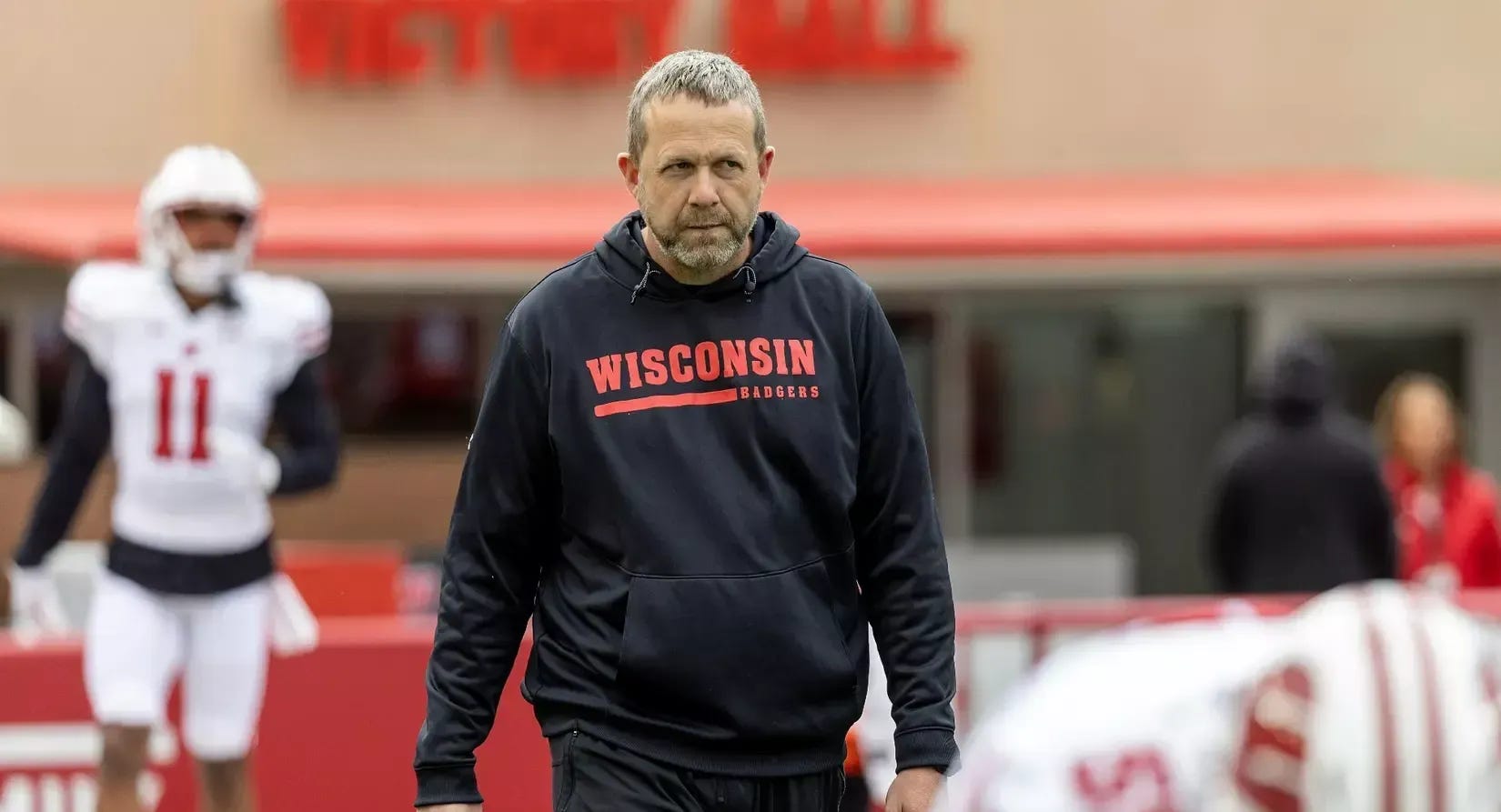
The University of Wisconsin football team's outside linebacker room, like most position groups, enters spring practice with question marks.
For the first time since Mike Tressel became defensive coordinator, the Badgers aren’t asking whether they can rush the passer. That question was answered a season ago. What they’re trying to sort out now is how to replace that production and which players are ready to step up.
The departures of Mason Reiger and Darryl Peterson loom large.
Together, Reiger and Peterson accounted for 68 total tackles, 11.5 sacks, 17.5 tackles for loss, and 72 pressures. That kind of edge production doesn’t quietly disappear. It leaves a void that forces honest evaluation.
And that’s exactly how outside linebackers coach Matt Mitchell sees it.
Speaking recently on ESPN Madison, Mitchell didn’t sugarcoat where things stand. He acknowledged that opportunities existed last season for some players, but circumstances made it hard for them to find snaps.
“I was fortunate last year that a few of these guys I’m going to talk about probably should have played a little bit more,” Mitchell admitted. “But I was pretty injury-free, and it was really hard not to have Mason [Reiger] on the field or not to have Darryl Peterson on the field, especially with how things are going within our team. And you knew that every defensive series was really critical, just based on the way the team was performing.”
That backdrop matters. With the Badgers cycling through starting quarterbacks, finishing 4–8, and ranking near the bottom nationally in scoring (12.8 points per game) and total offense (253.1 yards per game), the depth chart wasn’t just about development — it was about survival.
Now, with those veterans gone — and Corey Walker also exhausting his eligibility while Aaron Witt shifts toward a more inside backer/star role, the room looks different. Bigger in spots. Younger in others. And wide open.
Mitchell was clear about where the evaluation starts.
“To me, it’s got to start with Sebastian Cheeks,” Mitchell said. “He played a lot of snaps for us [368] and was productive. I’m looking at him to take the next step that Darryl Peterson took, just in terms of that production and leadership from his junior to his senior years, no doubt about that.”
Cheeks is the known quantity. He logged 25 total tackles, 5.5 tackles for loss, three sacks, and 27 pressures last season and showed the kind of edge presence that fits Wisconsin’s philosophy. The expectation now is that he becomes more than a contributor — he becomes the standard.
Behind him, the picture gets more complicated.
Tyreese Fearbry, who transferred to Wisconsin ahead of the 2025 season after three years at Kentucky, enters his second year in the program with obvious talent, but Mitchell made it clear that ability alone isn’t enough.
“Fearbry has a lot of talent, and it’s my job to try to get that equated to production on the field,” Mitchell said. “There were some highs and lows last season — and trust is a big deal with me as a position coach, so we’ve got to make sure that we can trust that things are happening right.”
Fearbry played 73 defensive snaps last season, finishing with eight total tackles, a sack, and three pressures. The production didn’t always match the flashes, and spring ball becomes about showing more consistency.
Nicolas Clayton represents the other end of the spectrum.
Clayton, a former blue-chip recruit in the 2025 recruiting class, appeared in all 12 games as a true freshman, largely on special teams, logging just 15 defensive snaps. He recorded two tackles and a pressure. But Mitchell made a deliberate choice not to redshirt him, and that wasn’t accidental.
“Nick Clayton was a true freshman who probably earned the right to play a little bit more,” Mitchell said. “He’s got a high pass-rush upside. He played on every special teams unit. I made the decision not to redshirt him because I wanted him to get Big Ten experience so I could catapult him into the 2026 season. He probably should have played more.”
Mitchell even pointed to examples of players like Cooper Catalano and Mason Posa, who emerged once opportunity met preparation, adding, “I really believe Nick Clayton is in that category of types of players.”
The transfer portal has added layers — and options.
Justus Boone arrives from Arkansas with SEC experience and a build that fits what Wisconsin wants up front. Boone played in 12 games with three starts last season, totaling 28 tackles, 13 pressures, 1.5 tackles for loss, and one sack. Mitchell noted that he felt Boone was used out of position at times and plans to move him back to a five-technique role, where his 6-foot-4, 275-pound frame can ideally impact both the run and the pass.
“Probably the one that intrigues me most right now is Justus Boone, who was down at Arkansas,” Mitchell said. “He can really be on the boundary and do a really good job, kind of like DP did, and try to impact things.”
Liam Danitz brings something entirely different.
The Division III Hope College transfer posted 46 total tackles, 15 sacks, and 21 tackles for loss last season and boasts elite track speed. Mitchell acknowledged the leap in competition but emphasized the physical traits.
“This will be a jump going from Division III to the Big Ten,” Mitchell said of Danitz, who earned Division III First Team All-American honors in both football and track and field, “but he’s got some twitch, and some get off.”
Micheal Garner remains the jumbo option. At 6-foot-6, 302 pounds, he’s built to anchor edges and support the run. He played 38 defensive snaps last season, recording two tackles, a tackle for loss, three pressures, and gives the room a uniquely physical presence that few teams can replicate.
And then there’s the developmental group: Sam Lateju, Jaylen Williams, Tennessee transfer Jayden Loftin, and true freshman Yahya Gaad, all competing for snaps in a room that suddenly feels wide open. Add in redshirt junior Will McDonald, now listed at outside linebacker, who brings size that can help support the run, and the competition only intensifies.
Mitchell didn’t pretend there are answers yet.
“We’ve got a lot of work to do figuring out who the pieces are going to be, and it’s going to be earned,” Mitchell said. “Whether it’s transfers from the SEC, a Division III transfer, or younger players in the room who need to develop, there’s a good group to work with and select from.
“You are what you put on tape, and when these guys go through spring ball, they’ll earn the right to play by the production that they put on tape.”
Spring practice will be the first step in sorting out who can turn potential into production. A lot of it will be Wisconsin’s staff doing installation, teaching, and controlled reps, not always full pads and live bullets, but it’s where you start to see who separates. By the time summer rolls around, the picture of who your top players are should begin to come into focus.
We appreciate you taking the time to read our work at BadgerNotes.com. Your support means the world to us and has helped us become a leading independent source for Wisconsin Badgers coverage.
You can also follow Site Publisher Dillon Graff at @DillonGraff on X.