

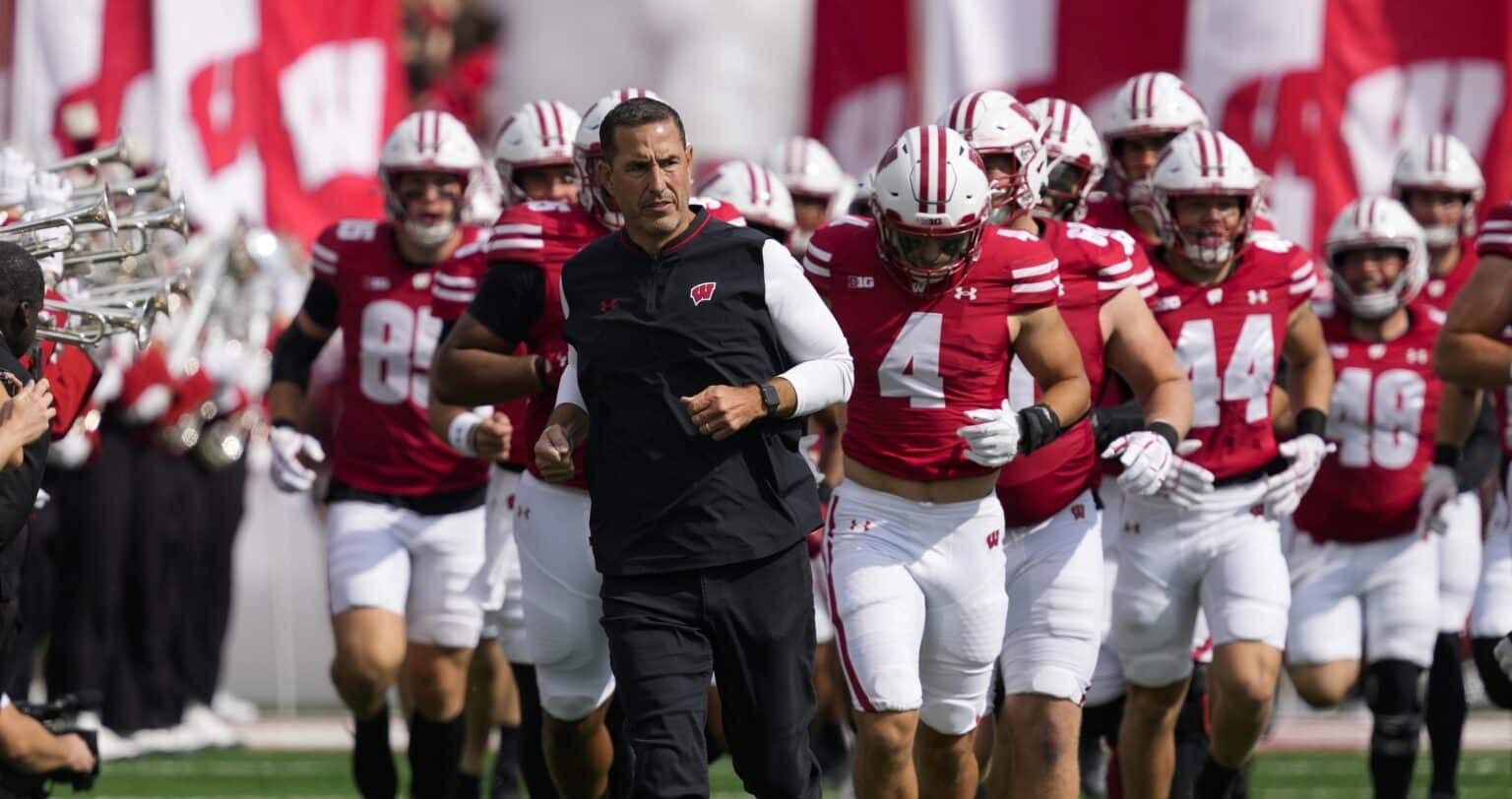
There are a lot of reasons why the Wisconsin football program’s 2026 recruiting class doesn’t jump off the page. Roster math, transfer portal recalibrations, a smaller scholarship pool, you can take your pick. But, the reality is the results mirror the current state of the program.
On paper, there’s been a clear dip.
In 2024, Wisconsin signed the No. 23 class nationally, followed by the No. 27 class in 2025. That momentum helped validate Luke Fickell’s ability to recruit and the coaching staff’s national reach. But in 2026, things look a little different. The Badgers’ current class sits at No. 56 in the 247Sports Composite, and it’s a cycle that’s noticeably lighter on blue-chip talent.
That part matters more than some might think. Recruiting rankings aren’t gospel, but they’re a reflection of a roster’s long-term potential, and history backs that up. As a program, Wisconsin hadn’t reached the 50% blue-chip ratio threshold until Fickell’s 2024 recruiting class signed. And that milestone mattered because no college football team that’s fallen short of that 50% mark as a team has ever gone on to win a national championship. A few have flirted with it, but none have broken through.
When the ceiling lowers in recruiting, it tends to lower the product on the field, too, and that’s the reality Fickell is desperately trying to prevent.
Wisconsin’s smaller 2026 class is somewhat intentional, largely driven by shrinking roster limits and a desire to leave space for proven transfer portal additions. It’s a calculated approach, but in a results-driven sport, perception sometimes outweighs the context, and right now, other programs can smell blood in the water.
That’s the balancing act that every coach faces when recruiting through a rocky season. Winning sells itself. Losing turns every conversation into damage control. Fickell didn’t sugarcoat that reality.
“It’s always been that way, right?” Fickell said. “The world isn’t completely different. You never stop recruiting. You never stop building, you never stop looking at what the future is like. The easiest thing to do is to have success on the football field. There’s no better way of recruiting. But the truth of the matter is, you still have to continue to build the relationships.”
He knows this is the part of the job that never sleeps: the calls, the texts, the constant reassurance to recruits that the vision is still intact.
“You’ve got to recognize the things that are going to be the difference in getting guys, whether that’s high school guys or eventually transfer guys, and this age, it’s a little bit different,” Fickell said. “I’m not saying that the relationships don’t still matter. But you also have to recognize that it’s going to make it a little bit more difficult if you aren’t having success on the football field. They’ve got to be able to believe in what it is that you’re doing, in the direction of what you want. When they can’t see it as well, you’ve got to make sure that you can make them see it in a different way.”
Even with those challenges, Wisconsin’s 2026 class isn’t without a few bright spots. The Badgers staff have had some legitimate wins on the recruiting trail, including four-star wide receiver Jayden Petit out of Florida, a 6-foot-4 playmaker who fits the mold of what this offense wants on the outside to stretch the field. Plus, Amari Latimer, a blue-chip running back from Georgia, whose powerful running style fits like a glove.
Still, as Fickell knows, no verbal commitment is ironclad until the ink dries.
Other programs are circling, and Wisconsin’s top commits continue to draw heavy interest nationally. Latimer, in particular, has been at the center of speculation after taking an official visit to Ohio State and later wearing Buckeyes arm sleeves during a high school game, just days after his father publicly reaffirmed their commitment to Wisconsin.
Latimer addressed the situation publicly in a way that showed maturity. While recruits don’t owe anyone blind loyalty before they sign, it was a moment of accountability from a young athlete navigating a messy, but incredibly high-pressure process. Fans see verbal commitments as promises; players see them as checkpoints in a life-changing decision.
Both perspectives are fair, but at the end of the day, these kids owe it to themselves to leave no stone unturned before putting pen to paper.
“I do understand your point of view,” Latimer wrote on social media. “That wasn’t my intent, but understand how it looks and how it’s disrespectful. Wasn’t my intent, but you are not wrong for feeling how you feel. This was on me. I’m gonna correct this... I didn’t mean for any of this. I am not a thug. I am not an a$$hole, and I am not a dirt bag. But I will restate that I understand everyone’s frustration. I want for this to work more than anyone for Wisconsin’s season. And Coach Fick, he is a great coach.”
It’s a good reminder that, for all the movement in modern recruiting, these are still young athletes caught between loyalty and opportunity, and that Wisconsin’s best shot at keeping them is by showing visible progress on the field.
“When you don’t win football games, it makes it a little bit more of a challenge,” Fickell said. It has always been that way. I don’t think that will change.”
It’s an honest admission in a sport that rewards momentum as much as message. And until Wisconsin starts stacking wins again, that’s the battle: convincing recruits that what’s being built in Madison is worth buying into before the results catch up. Right now, that’s an incredibly tough sell.
It’s crazy how much has changed since the day Fickell was hired as the 30th head coach in program history. The hype surrounding the hire and the seemingly instant results on the recruiting trail and in the portal left the fanbase dreaming of what was possible. So many were hoping to see the ceiling of the program rise, and in that pursuit, the floor crumbled.
Nothing’s real until the ink dries on National Signing Day. The next few months will say a lot about how much belief remains in what Fickell is selling at Wisconsin. Because right now, it feels like a lot of the fanbase has already checked out on the experiment. The question is whether the 2026 commits stay true to their word when it matters most, or ultimately decide they’ve seen enough and go searching for stability elsewhere.
We appreciate you taking the time to read our work at BadgerNotes.com. Your support means the world to us and has helped us become a leading independent source for Wisconsin Badgers coverage.
You can also follow Site Publisher Dillon Graff at @DillonGraff on X.
"The easiest thing to do is to have success on the football field." Oh really? When does that start?