

The Wisconsin men’s basketball program has spent the last few months assembling a roster that looks considerably different from the one that won 24 games and earned a 5-seed in the NCAA Tournament last season.
Now comes the process of figuring out exactly what Greg Gard has.
The Badgers have eight newcomers to integrate, a new point guard in Owen Foxwell, and significant perimeter production to replace. They also return an established frontcourt built around Nolan Winter and Austin Rapp, with more size and lineup flexibility behind them than Wisconsin has had in recent years.
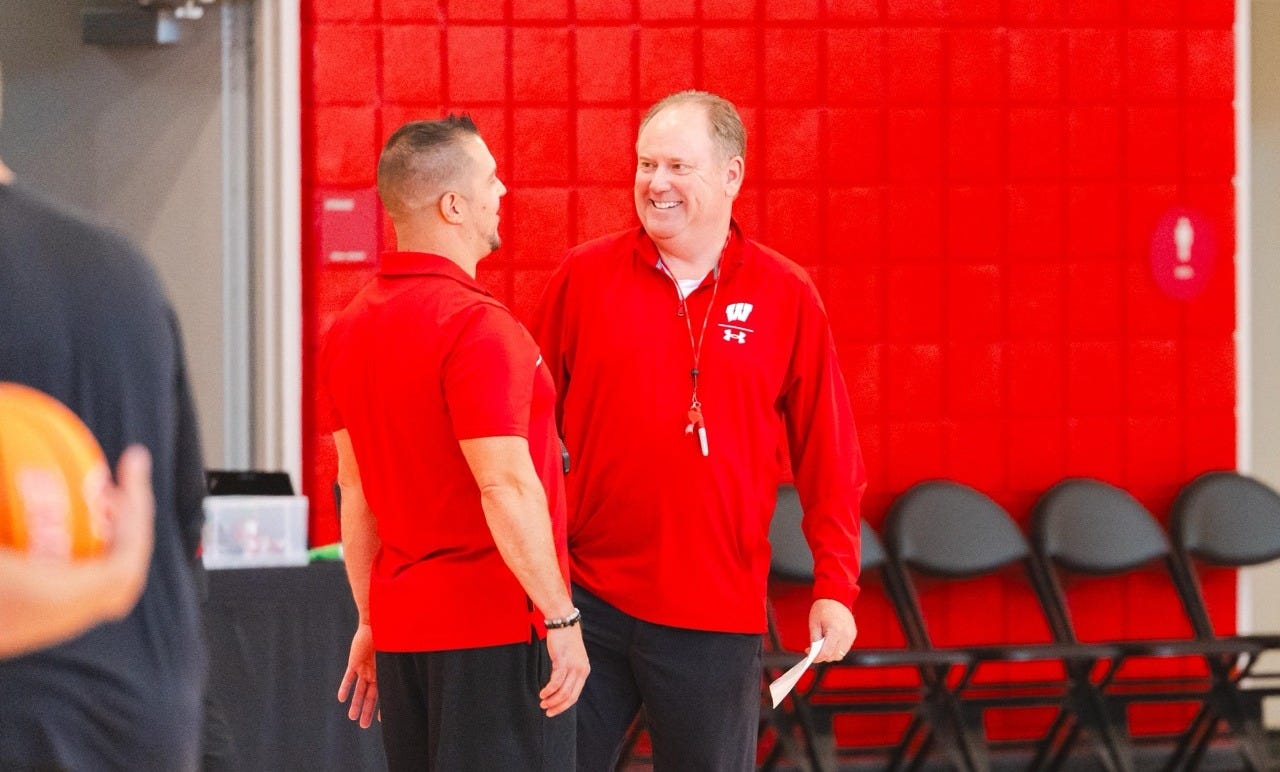
Local media day gave Gard a chance to offer a more detailed assessment of where that process stands as Wisconsin prepares for the 2026-27 season.
Here are the three things that stood out most from what he had to say.
Wisconsin believes its size can change the defense
Gard has spent much of the offseason talking about Wisconsin needing to improve defensively. Local media day provided a clearer picture of how he thinks that can happen.
It starts with size.
Wisconsin finished 56th nationally in KenPom’s adjusted defensive efficiency last season, but this roster gives Gard options he simply didn’t have a year ago. Nolan Winter is back, while Victory Onuetu and Will Garlock give Wisconsin two more legitimate centers who can protect the paint.
“With two guys that are seven feet plus, we can play much differently in ball screens,” Gard said. “And use more drop coverage and more mobile with mobile fives, you can park them in the paint, and they can cover up.”
That matters schematically. Drop coverage allows Wisconsin’s bigs to stay closer to the basket rather than pulling them farther away from the rim while defending ball screens. If Onuetu and Garlock can consistently provide that back-line presence, the Badgers can shrink the floor and make opponents work harder to generate shots around the basket.
Gard still identified transition defense as the top priority. Once Wisconsin gets set, though, the objective is pretty straightforward.
“Once we get settled in the half court, we have to keep people away from the rim,” Gard said.
In theory, the personnel should provide Wisconsin with several ways to accomplish that goal.
Gard has more lineup options than he knows what to do with yet
We knew Wisconsin was deep on paper. Gard made it pretty clear that determining exactly how to use that depth remains one of his biggest preseason puzzles.
“There’s legitimately 12 guys right now that could and probably should be on the floor,” Gard said.
That’s significant because this isn’t necessarily 12 versions of the same thing.
Wisconsin can play Winter alongside another seven-footer in Onuetu or Garlock. Winter and Austin Rapp already give the Badgers a proven shooting frontcourt combination. Gard mentioned Eian Elmer and Hayden Jones as options at the four when Wisconsin wants to play smaller, while Braeden Carrington has experience doing the same.
The frontcourt competition has also produced tangible development. With Winter and Rapp limited during the summer, Onuetu and Garlock spent extended stretches matched up against each other.
“The evolution of those two has been impressive to watch because they’re both much better than where they were when we got back on June 15th,” Gard said.
Eventually, Gard will have to establish a core rotation. Production, health, and matchups will help make some of those decisions for him. But the larger takeaway is that Wisconsin doesn’t have to play one way. Gard has enough size, shooting, and positional flexibility to alter lineups depending on what a game requires.
Figuring out which combinations work best might be one of the defining stories of November.
Wisconsin’s point guard picture is starting to come into focus
There were two meaningful developments at point guard on Tuesday, beginning with the most important.
The NCAA has fully cleared Owen Foxwell.
Wisconsin had been awaiting a ruling after submitting documentation related to Foxwell’s professional career in Australia. The 22-year-old spent the past five seasons with the South East Melbourne Phoenix in the NBL and averaged 10.8 points, 4.5 assists and 3.0 rebounds per game last season after taking over as the team’s starting point guard.
Gard said the Badgers learned roughly a week ago that Foxwell, Wisconsin’s expected starter at the position, had received complete clearance.
That removes one significant preseason unknown. It also sounds increasingly like Zach Kinziger is positioning himself to handle some of the minutes behind him.
Gard acknowledged how far the sophomore has come as a decision-maker after playing sparingly as a freshman.
“A year ago this time, he was throwing it around the gym like he was handing out Halloween candy,” Gard said. “He’s tightened that up. He’s gotten better with the ball in his hands. He’s gotten better at decisions.”
The next step for the in-state product is learning when to attack and when to value the possession. Gard described that balance as becoming “intelligently aggressive,” particularly when Kinziger is navigating ball screens and deciding where the next pass needs to go.
That’s encouraging considering Wisconsin doesn’t necessarily need Kinziger to become another Foxwell. The Badgers have other capable decision-makers and have built an offense that doesn’t require every possession to run through a traditional point guard.
If Kinziger can defend, make shots and reliably initiate the offense when Foxwell rests, Wisconsin may already have its answer behind him.
We appreciate you taking the time to read our work at BadgerNotes.com. Your support means the world to us and has helped us become a leading independent source for Wisconsin Badgers coverage.
You can also follow Site Publisher Dillon Graff at @DillonGraff on X.