

The University of Wisconsin football program enters fall camp with far fewer questions on defense than offense.
That’s not to suggest there aren’t holes to fill. Mason Rieger and Darryl Peterson exhausted their eligibility, leaving Wisconsin to replace two of its most productive edge defenders. The secondary features several new faces, and the Badgers defense needs to create far more takeaways.
But after a season in which Wisconsin quietly emerged as one of the Big Ten’s more improved defenses — finishing 24th nationally in total defense, 15th against the run and 62nd against the pass — there is legitimate belief internally that another step forward is coming.
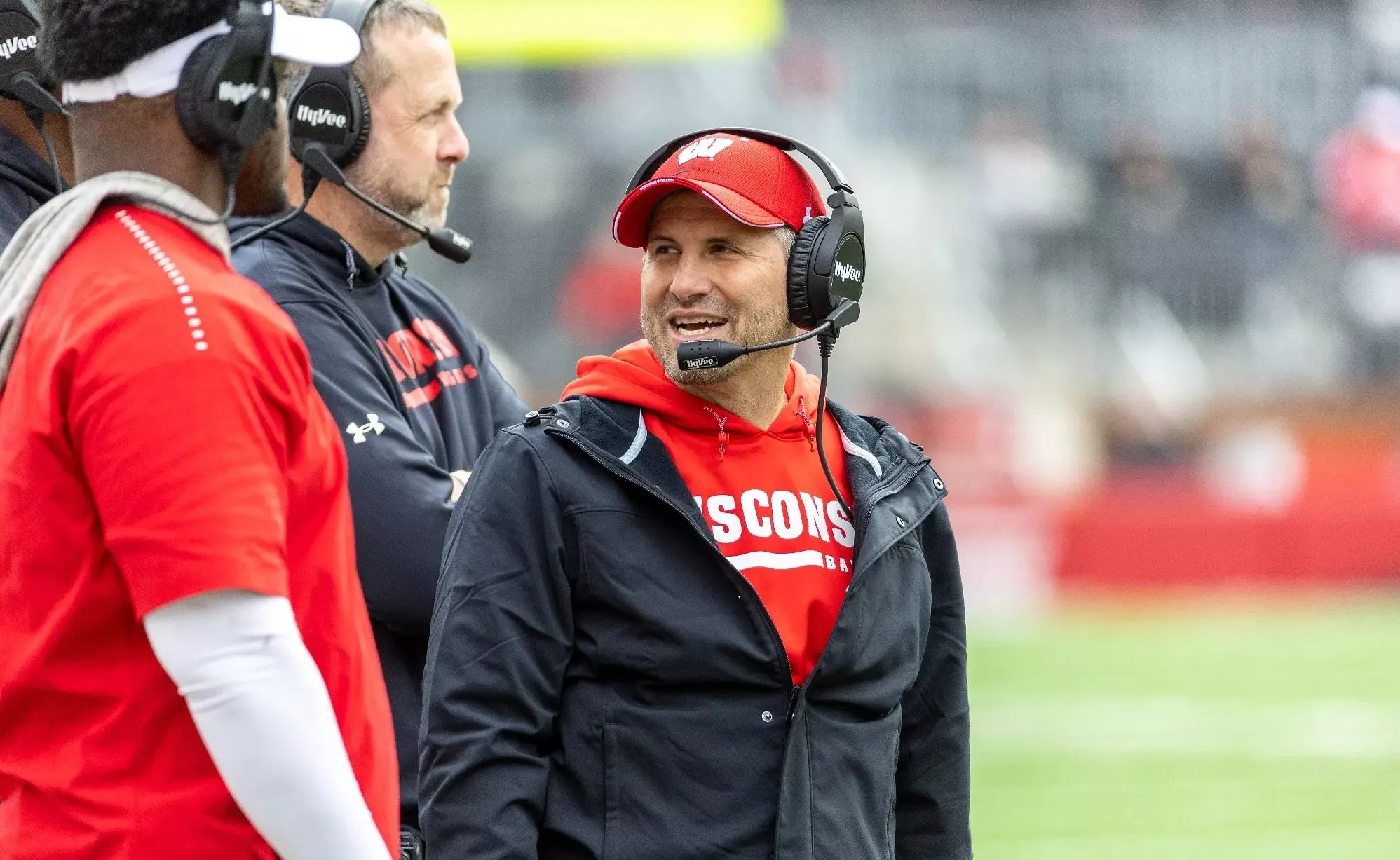
Defensive coordinator Mike Tressel didn’t shy away from that expectation during his local media availability. Here are my biggest takeaways.
Wisconsin believes its young linebackers have become complete players
Luke Fickell has spent much of the offseason talking about leadership, and Tressel offered another glimpse into why the staff believes Mason Posa and Cooper Catalano changed the trajectory of last year’s team.
The growth, however, extends beyond leadership. Tressel believes both linebackers now understand the defense at an entirely different level.
“They made a lot of plays and did a lot of really good things based on just football instincts and the base fundamentals we’re teaching,” Tressel said. “I think they’ve taken huge steps forward in terms of understanding our defense and understanding how to truly defend an offense, not just play.”
That distinction matters.
Posa, who earned third-team All-Big Ten recognition, finished with 61 tackles, 14 pressures, four sacks and two forced fumbles in just 11 games, while Catalano added 56 tackles, 2.0 sacks and 4.5 tackles for loss as a true freshman. They burst onto the scene by trusting their instincts. Now, Tressel believes they’ll begin playing with a much deeper understanding of offensive tendencies, formations and situational football.
He also isn’t worried about either player trying to do too much now that opposing offenses know who they are.
“They aren’t guys that will get frustrated,” Tressel said. “They’re not guys that will go rogue because they need to make plays. They understand team defense.”
If Wisconsin’s defense reaches another level in 2026, it will likely begin with those two linebackers.
Replacing Mason Rieger won’t fall on one player
No one inside the program is pretending Mason Rieger’s production can simply be replaced.
Instead, Wisconsin is betting on depth.
Tressel called Rieger and Darryl Peterson “math changers,” a term the Badgers use for defenders capable of completely altering games.
Now the challenge shifts to Sebastian Cheeks, who appeared in all 12 games last season, made three starts and quietly put together a productive campaign with 25 tackles, 5.5 tackles for loss, three sacks and 27 pressures across 368 defense snaps, according to PFF.
“I am fired up to see what type of year Sebastian Cheeks can have,” Tressel admitted. “I’m really excited for him because he gets to sort of take over as the guy in that room. DP had a huge step between his second-to-last year and his last year. And we’ve challenged Sebastian to have that same type of jump, or even surpass that.”
Cheeks is clearly the headliner, but he wasn’t the only name Tressel mentioned.
Nick Clayton, the former four-star edge rusher from Gainesville (Fla.), drew praise for his motor, length and mentality. At the same time, Arkansas transfer Justus Boone, Micheal Garner and Jaylen Williams were all identified as players expected to compete for larger roles.
Perhaps the most notable takeaway wasn’t about any individual player.
Wisconsin doesn’t want anyone taking on the workload Rieger handled a season ago.
“We don’t want to have guys play the number of snaps that Nick Clayton [15] and Rieger [514] did last year,” Tressel said. “That’s not good for guys and the team playing our best at the end of the year. So we’re excited about lots of guys, and then that pushes you.
“I don’t care if it’s your last year, Sebastian, because Nick Clayton is coming, baby, and we all want to feel that healthy competition.”
That’s another reminder that Wisconsin believes its improved financial resources have translated into legitimate roster depth.
The defensive priorities are clearly defined
Tressel didn’t hesitate when asked where Wisconsin has to improve.
“The two areas… we have to take the big jumps are takeaways… and third-and-long has to be dominant.”
Those weren’t arbitrary answers.
Fickell challenged both Tressel and offensive coordinator Jeff Grimes to study which statistical categories most directly correlate with winning.
Tressel’s conclusion was pretty straightforward.
The Badgers defense wants to average roughly two takeaways per game, which would place them among the nation’s elite after finishing dead last nationally with just six forced turnovers all season. They also want to stop opponents on 75 percent of third-and-long situations.
More interesting was how Wisconsin is trying to improve.
Rather than simply running takeaway circuits again, Tressel said Wisconsin has stressed what he calls “opportunity awareness,” teaching each position group where its turnover opportunities typically come from and training players to recognize those moments before they happen.
“We’re at a point where we could be watching film with a group and not even talking about it, and they’ll say, ‘There’s the opportunity,’” Tressel said.
Now comes the difficult part.
“There’s no more consolation prizes for trying to use the technique or recognizing the opportunity,” Tressel said. “Now it’s about getting the ball.”
That might have been the biggest takeaway.
Wisconsin believes the scheme is in place. The depth is better. The leadership has grown. The understanding of the defense has improved. Now the Badgers simply have to turn those beliefs into production.
The Badgers showed last season they could fix one major problem, transforming into one of the nation’s better run defenses after a year they couldn’t stop a nosebleed. Now comes the tougher challenge. A rebuilt secondary must prove it can eliminate the explosive plays that contributed to a pass defense that finished 62nd nationally.
If Wisconsin can pair last year’s run defense with meaningful improvement through the air, Tressel’s unit has a chance to become one of the Big Ten’s better units. Much like Fickell has said throughout the offseason, the talking portion is over. Fall camp is officially underway.
We appreciate you taking the time to read our work at BadgerNotes.com. Your support means the world to us and has helped us become a leading independent source for Wisconsin Badgers coverage.
You can also follow Site Publisher Dillon Graff at @DillonGraff on X.