

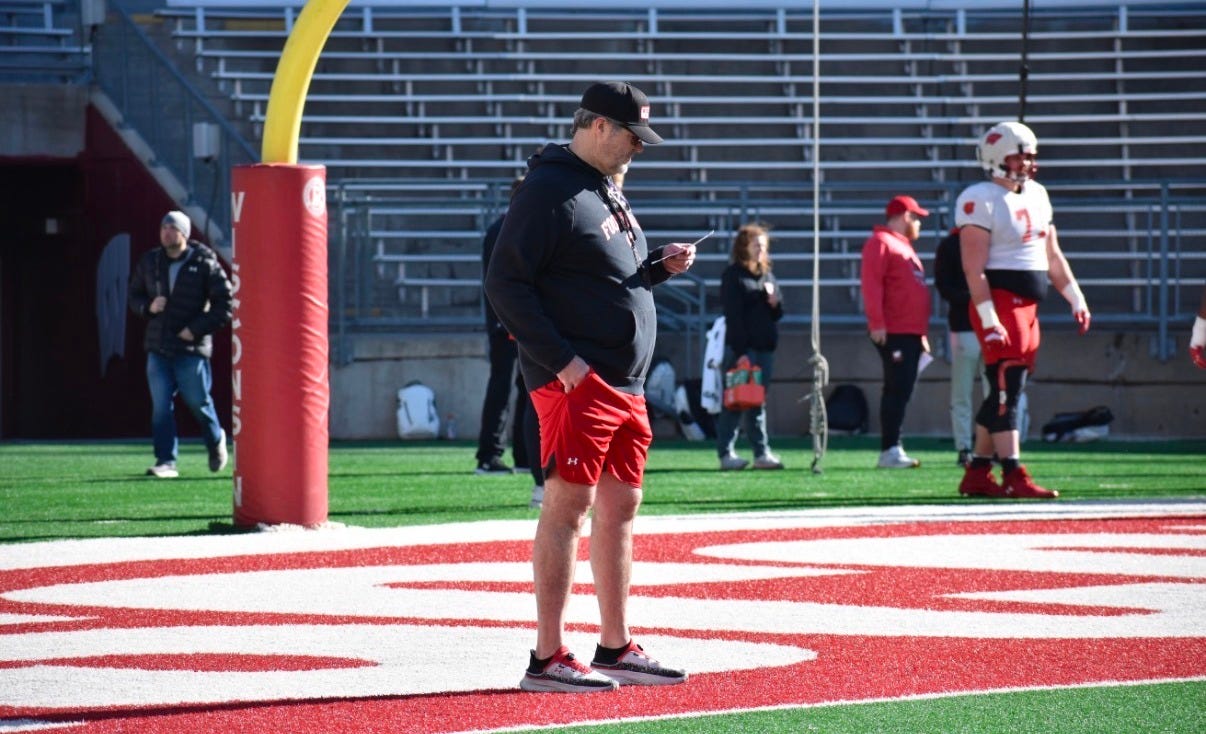
The University of Wisconsin football program has spent much of the offseason explaining why its offense should look different in 2026.
The roster is deeper. The financial investment has increased. Jeff Grimes is entering his second season as offensive coordinator, now reunited with offensive line coach Eric Mateos, and the Badgers finally appear to have a dual-threat quarterback who fits what they want to become.
None of that guarantees meaningful improvement after Wisconsin scored just 154 points in 12 games last season, averaging only 12.8 points per contest while finishing 135th nationally, ahead of only UMass.
But during his local media day availability before fall camp, Grimes made it clear that the expectations have changed. The Badgers believe they are more talented, better equipped and ready to restore some of the physical identity that disappeared during the first three years of the Luke Fickell era.
Here are my biggest takeaways.
Colton Joseph is being trusted to carry a significant load
Wisconsin went into the transfer portal needing more than a starting quarterback. It needed someone capable of changing the complexion of the entire offense.
Grimes believes Old Dominion transfer Colton Joseph can do exactly that. The reigning Sun Belt Offensive Player of the Year accounted for 3,631 total yards and 34 total touchdowns last season after throwing for 2,624 yards and eclipsing the 1,000-yard mark as a runner.
“You see a guy that’s a dual-threat quarterback,” Grimes said. “He’s great with his legs. He’s got a strong arm and, to me, is the total package.”
The physical ability is obvious. Joseph can push the ball downfield, create outside the structure of the offense and punish defenses when protection breaks down. What has impressed Grimes most, however, is Joseph’s ability to handle everything Wisconsin has placed on his shoulders.
“He’s a workhorse, and I’ve never seen the work, whether it’s in the weight room or whether it’s out running on the field when we’re doing gassers during the summer, or in a practice and we’re asking something of him mentally that he hasn’t done before, checking a protection or a play, I’ve never seen the moment too big for him,” Grimes said.
“I’ve never seen the work be too burdensome for him. He’s a workhorse, man. He can handle the load.”
That matters because Joseph will likely determine how high this offense can climb. Wisconsin feels good about the future of the quarterback room with true freshman Ryan Hopkins and Louisville transfer Deuce Adams, but if the Badgers are going to take a substantial step offensively in 2026, they’ll need a healthy QB1 leading the way.
Wisconsin’s roster appears to be a lot better on paper, but it still lacks proven difference-makers at several positions. A healthy Joseph should elevate the unit considerably, even if expecting him to transform one of the nation’s least productive offenses single-handedly may be a little rich.
What he does provide is a quarterback whose skill set can erase mistakes, create explosive plays when structure breaks down, and raise the ceiling of everyone around him.
Wisconsin wants to restore its physical identity
Grimes did not dance around what Wisconsin’s offensive identity needs to become.
The Badgers must protect the football and run it effectively.
After all, Wisconsin finished 135th nationally in total offense, 132nd in passing offense and 116th in rushing offense last season. Advanced metrics painted an equally bleak picture, with the Badgers ranking 132nd nationally in EPA per play, 131st in EPA per dropback and 115th in EPA per rush, according to Game on Paper.
“Teams in the Big Ten that won the rushing-yardage battle, I think, won 82% of those games last year,” Grimes said. “Again, just that stat alone tells you something pretty strong, and we want to be a team that’s going to run the football.”
That message will sound familiar to Wisconsin fans.
For decades, the Badgers built their success around controlling the line of scrimmage, wearing down defenses and making opponents stop the run before anything else mattered. The initial attempt to move away from that identity under Fickell and former offensive coordinator Phil Longo never took hold.
Now Grimes and Mateos are trying to rebuild it.
“We want to be a team that’s going to run the football,” Grimes said. “We had a lot of guys, Coach [Barry] Alvarez and some former players, talk to the team this summer. A couple of things that came up with everybody that talked, whether it was an offensive player or former defensive player, they talked about how the history of running the football here and being physical at the line of scrimmage has been a big part of the formula for success.
“And we need to get that back this season. We have to. We will.”
The return of the fullback, increased investment along the offensive line and a deeper running back room all support that goal.
Regardless, this is another promise that eventually has to show up on Saturdays. Wisconsin has spent much of Fickell’s tenure talking about becoming “tough, nasty and disciplined.” In 2026, the offense finally has to resemble those words.
Fall camp must create separation at the skill positions
Wisconsin undoubtedly has more options than it did a season ago.
Whether those options produce reliable playmakers remains uncertain.
Grimes said the Badgers are “more talented” and “deeper everywhere.” Even so, fall camp still has important questions to answer. How will Wisconsin divide carries in what appears to be one of the deeper running back rooms it has had under Luke Fickell? And perhaps more importantly, who emerges as the offense’s true vertical threat at wide receiver?
“In an ideal world, we have somebody who becomes our primary ball carrier, and then the other three supplement that position,” Grimes said. “For my personal liking, I would like to see us have one guy that becomes our bell cow, that we want to hand the football to more than anyone else.”
Iowa State transfer Abu Sama appears to be the most likely candidate after rushing for 732 yards and five touchdowns on 140 carries last season. But Bryan Jackson, Darrion Dupree and Nate Palmer should all have opportunities to carve out meaningful roles in the rotation.
The receiver room presents an even greater unknown.
Wisconsin added more size and length to the room by bringing in FCS standout Jaylon Domingeaux from Southeastern Louisiana, Oklahoma transfer Zion Kearney, Oklahoma State transfer Shamar Rigby and Minnesota transfer Malachi Coleman. But Grimes acknowledged someone from that group — or returning options like Chris Brooks Jr., Tyrell Henry or Eugene Hilton Jr. — still has to prove capable of stretching the field.
“The biggest thing there is depth and just having more guys that are worthy of playing and more guys that can make plays,” Grimes said. “And then I think the next step is somebody needs to emerge as that deep threat for us.
“I think there are two or three guys that might be that, but we’ve got to see throughout the course of fall camp who really proves to be that primary vertical threat.”
That might be the biggest offensive storyline of camp.
Depth is valuable. Competition is healthy. But at some point, Wisconsin needs clear separation.
The Badgers do not need a room full of interchangeable options, although there is value in that. They need players who force their way onto the field and give Joseph reliable answers when the offense needs a play.
Wisconsin believes it finally has enough talent to make that possible. Fall camp will begin determining whether that belief is justified.
We appreciate you taking the time to read our work at BadgerNotes.com. Your support means the world to us and has helped us become a leading independent source for Wisconsin Badgers coverage.
You can also follow Site Publisher Dillon Graff at @DillonGraff on X.