

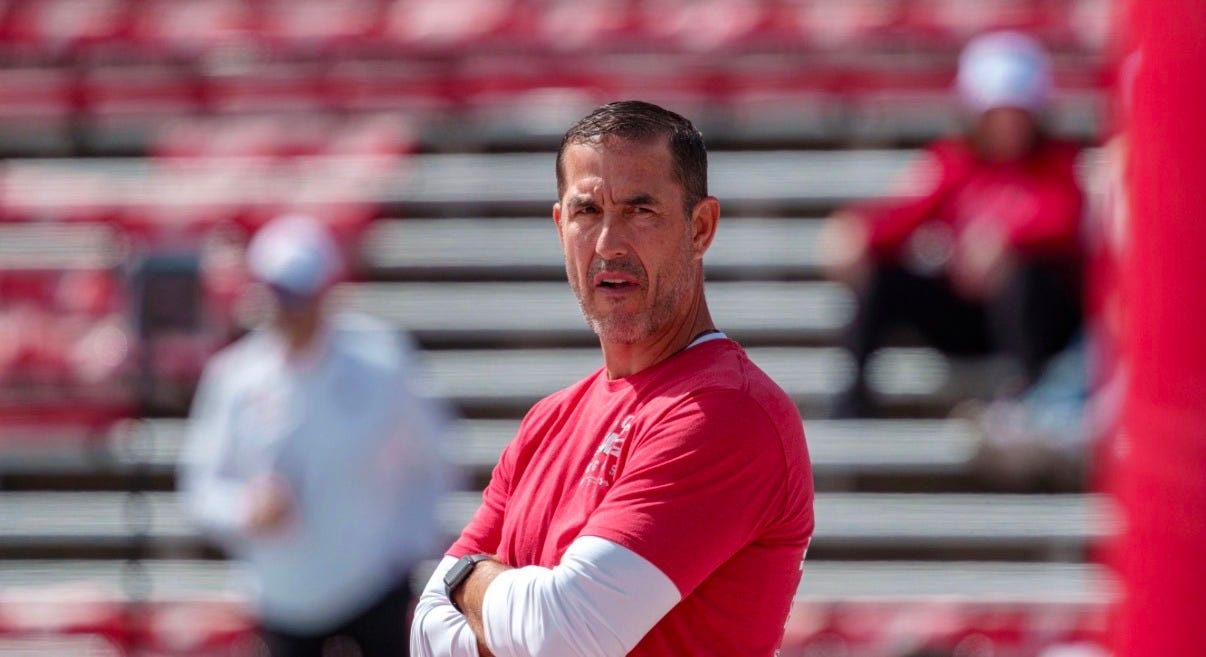
The Board of Regents delivered a reminder that even the most ordinary offseason decisions can help frame where Wisconsin football stands.
Routine extensions at Wisconsin are typically little more than procedural housekeeping, a quiet show of institutional alignment meant to prevent unfavorable recruiting conversations and project long-term confidence.
This time, however, three fall sport coaches saw their deals pushed out through January 2031, while Luke Fickell’s name didn’t appear on the list.
On the surface, it invites interpretation. Dig a little deeper, and the explanation becomes more nuanced. Wisconsin Athletic Director Chris McIntosh clarified that the department didn’t drive the decision.
“In December, shortly after the 2025 season ended, Luke Fickell requested that I not put forward a contract extension for consideration this year,” McIntosh said. “I respect his request and determined that the current terms of Luke’s contract will be maintained.”
McIntosh continued to frame the decision not to extend Fickell through the lens of internal expectations rather than external optics.
“Luke is completely focused on a successful 2026 campaign. There is no one more competitive than Luke, and he holds himself to the highest standards,” McIntosh continued. “He is committed to meeting and exceeding the expectations of everyone connected to Wisconsin — his own, the team’s, the University’s, alumni, supporters, fans, and the entire state.
“He continues to have our full support and, as we shared widely at the end of last year, Luke is making the necessary changes in the program, our department is increasing our investment and we are aligned with campus leadership in our commitment to football success.”
The quotes strike the tone you’d expect from an athletic department determined to project stability. However, the broader context is harder to smooth over. Programs rarely step away from extensions unless there is at least some recognition that results must catch up to the expectations.
Fickell enters Year 4 as the head coach at Wisconsin with a 17–21 overall record and a 10–17 mark in Big Ten play. Those numbers would have felt almost unimaginable inside a building that once measured success by bowl appearances and double-digit win seasons. When the Badgers extended Fickell after a 5–7 finish last offseason, the backlash on social media was fueled by a fanbase unaccustomed to missing the postseason.
Then came a 4–8 campaign that raised the temperature even further.
Camp Randall heard numerous “Fire Fickell” chants roaring through the stadium this past season, a signal less about organized revolt and more about the erosion of the Wisconsin football program’s historical baseline. After 22 consecutive bowl appearances, the Badgers have now finished with losing records in back-to-back seasons.
Against that backdrop, choosing performance over contract optics reads less like a symbolic gesture and more like an acknowledgment of reality.
According to the Milwaukee Journal Sentinel’s John Steppe, Fickell told McIntosh he preferred the conversation focus on improving the team rather than revisiting his deal. It’s an approach that suggests self-awareness — and perhaps an understanding that another extension, absent tangible progress on the field, would have landed poorly.
None of this alters the structural security already built into Fickell’s contract. He remains on a six-year agreement, his compensation still climbing by $100,000 to $7.8 million under the original terms signed in November 2022. A buyout north of $21 million remains firmly in place.
In other words, this isn’t a coach operating week to week. But stability on paper does not erase the pressure of what comes next.
To the staff’s credit, the program and its front office moved with a sense of urgency this offseason. The Badgers leaned hard into the transfer portal, pairing a noticeable increase in financial commitment with a clear intent to close at least part of the talent gap.
Prominent donor Ted Kellner publicly acknowledged that Wisconsin had been operating in the bottom third of Big Ten spending and pledged that the program would move into the league’s top third. More than 30 transfer additions now reflect a staff trying to accelerate a course correction rather than just “pound the rock.”
The 2026 schedule offers a degree of relief as well. The Badgers avoid the Big Ten’s three College Football Playoff participants from a year ago: Indiana, Ohio State, and Oregon. There is a big opportunity here. Still, opportunity has not exactly translated into on-field results under Fickell, which is why skepticism feels much more grounded than “blind faith.”
Even last season’s closing stretch offered some important perspective.
Despite the team going winless in October, Wisconsin found a way to secure back-to-back Top 25 wins over Washington and Illinois at a point when the team easily could have mailed it in. That mattered. It showed fight, pride, and a culture that didn’t fold. The flashes were there, and the resiliency suggested that there’s still a foundation to build on — the challenge now is turning those moments into something more consistent.
That tension defines where the program sits today.
For years, Wisconsin sold success, development, culture, and a physical identity. Now it is asking for patience while attempting to rediscover those same traits. Administrative support remains firm, donor backing hasn’t wavered, and the infrastructure appears stronger than it did a year ago.
What’s missing is proof.
Choosing not to extend the contract, even at the coach’s request, subtly shifts the conversation from projection to accountability. It doesn’t formally place Coach Fickell on a hot seat, but it does emphasize that patience is no longer unconditional. The message is clear: extensions now must be earned through results and progress, not assumed by precedent.
And perhaps that’s the healthiest posture for a program trying to climb back toward Big Ten relevance, even if it’s just a PR move on the surface.
Wisconsin opens the 2026 season against Notre Dame at Lambeau Field. When they take the field, the transfer portal additions will be woven into the roster, the newfound investment of resources will be visible, and the messaging about changes will finally meet the only metric that matters.
Results.
Until those start to show up with consistency, belief will continue to feel more like an ask than a foregone conclusion. Despite the Board of Regents’ lack of a decision, McIntosh’s clarification that the move was made at Fickell’s request ultimately reinforces a simple truth about where Wisconsin stands entering Year 4 of the Fickell era: Support is intact.
Expectations at Wisconsin haven’t changed, nor should they. But with a more manageable schedule on deck and an overhauled roster, results are still the only thing that matters. If the wins don’t follow, the program may have to re-evaluate where it’s headed — and who is leading it there.
We appreciate you taking the time to read our work at BadgerNotes.com. Your support means the world to us and has helped us become a leading independent source for Wisconsin Badgers coverage.
You can also follow Site Publisher Dillon Graff at @DillonGraff on X.
This seems to be an adult classy move on Fickle's part. It is modelling accountability, which hopefully is a message received by the team (players and staff)>