

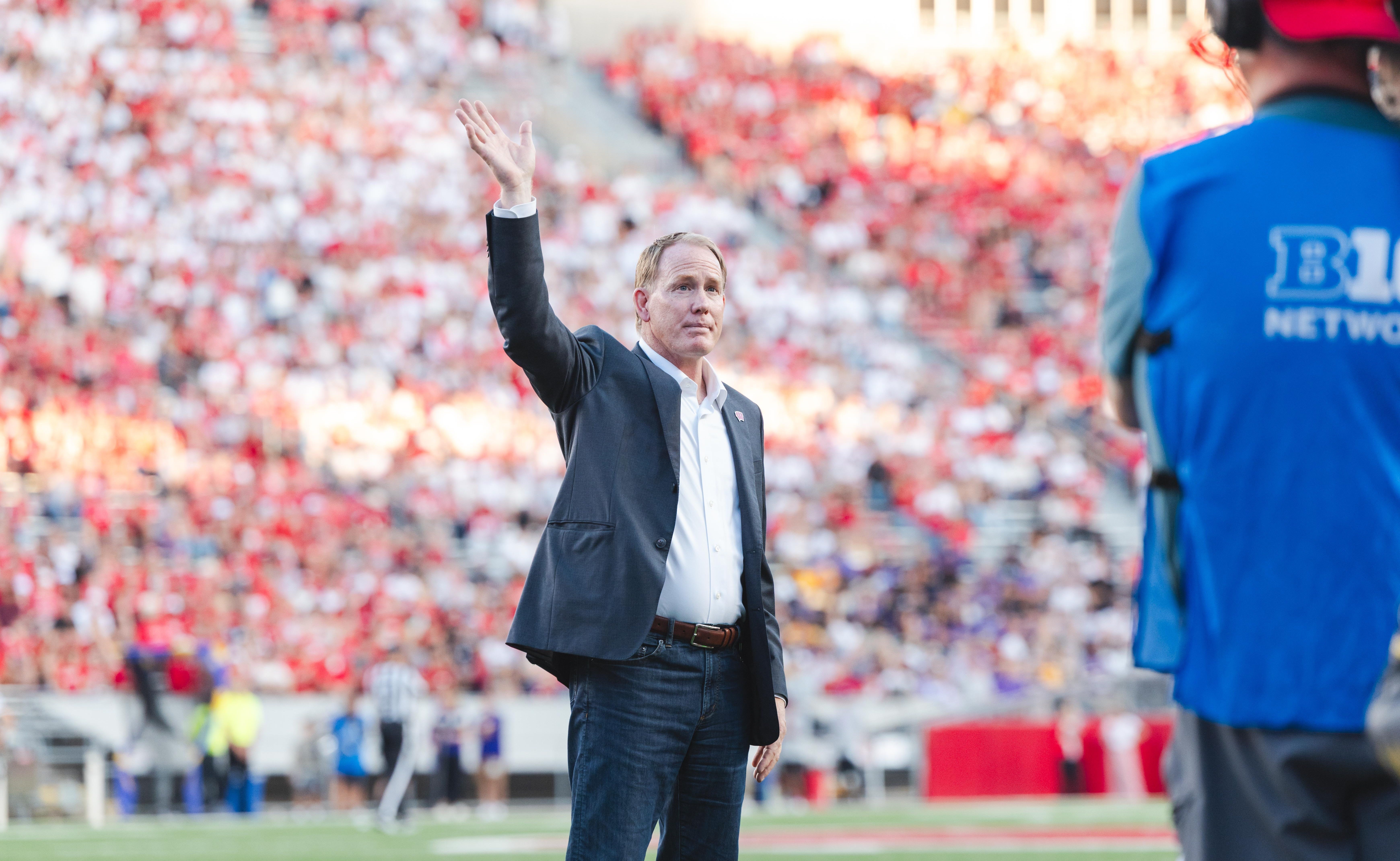
Shawn Eichorst returned to the University of Wisconsin this summer without pretending he already had all the answers.
The Badgers’ new athletic director said from the beginning that his first priority would be to listen, look, and learn before determining where the department needed to go next. A couple of months into that process, Eichorst believes one thing has become increasingly clear.
This place still means a lot to so many people.
“Reaffirmed that this place is special. The people are special. A lot of passion, a lot of pride in everything that we’re doing,” Eichorst said when asked what he’s learned so far during an appearance on Locked On Badgers.
“I’ve been away for about 15 years. And so coming back and settling in and doing a lot of listening to student-athletes, coaches, ticket holders, stakeholders, campus leadership, state leadership.”
Eichorst was appointed Wisconsin’s athletic director in July after spending eight years at the University of Texas, most recently as deputy athletic director and chief operating officer. It is also a homecoming. The Lone Rock (Wis.) native previously worked in Wisconsin Athletics from 2006-11 and eventually became deputy athletic director under Barry Alvarez.
His early approach in Madison has centered heavily on relationships with coaches.
Eichorst describes himself as a “head coach centered administrator,” a philosophy that was shaped by decades spent around leaders ranging from Alvarez and Bo Ryan to Lou Holtz, Steve Spurrier and others.
“It’s about putting a leader of a program in a position to be successful by providing them the resources that they need, and then kind of taking a step back,” Eichorst explained. “They are the ones that are out there on the front lines. They’re identifying, they’re recruiting, they’re developing, they’re retaining.”
That philosophy is particularly relevant with Wisconsin football and Luke Fickell, whose program is one of the most important pieces of the athletic department and serves as a primary financial engine across all sports.
Eichorst described their communication as “open” and “passionate” while he continues getting to know Fickell, his staff and the players.
“There’s a lot of passion there, certainly very detail-oriented, and very disciplined,” Eichorst said of Fickell. “I am really enjoying getting to know him, his staff, and the support staff and the student-athletes. I’ve only been here a couple of months, so I’m still getting my feet on the ground.”
Eichorst later added that he wants to have an open relationship with every one of the coaches at Wisconsin, and that Fickell is “very important to everything that we’re doing.”
That support does not mean Eichorst intends to lead every program the same way. One of his biggest takeaways from working around successful coaches is that there is no singular model or method of doing things.
“What I’ve fundamentally taken is that you can do it differently, right?” Eichorst said. “But the most successful ones do it in a way that fits who they are.”
That same appreciation extends to Greg Gard.
Eichorst knew Gard well from his previous stint in Madison, when he served as the sport administrator for men’s basketball. Since taking over as Wisconsin’s head coach, Gard has gone 237-128 overall and 131-83 in Big Ten play, with two conference titles and two Big Ten Coach of the Year awards on his résumé.
“I’m really fortunate that he’s our basketball coach and the way in which he thinks about it and goes about it,” Eichorst said of Gard. “He embraces challenges. He embraces change and evolution and all the things I think that great coaches do.”
Eichorst will eventually face larger department-wide questions, from resources to facilities and the fan experience. He even left the door slightly cracked when asked about the possibility of Wisconsin someday restoring baseball, though he made clear that is not currently a priority.
“You never want to say never,” Eichorst said, “but the possibilities of that, what I want to do is make sure we’re taking care of the programs we currently have, which we have room to improve on, both from a scholarship perspective and a resource perspective in some other areas. We have some work to do relative to the programs we currently have.”
For now, Eichorst’s first-year plan remains intentionally simple: keep listening, deepen relationships throughout the department and determine what Wisconsin’s coaches need to compete at the highest level.
“I’ve met with all of our head coaches on multiple occasions from an individual perspective, and I will continue to do that on a weekly basis,” Eichorst said. “It takes time to build authentic, genuine relationships.
“You’ve got to put in the time, and you have to put in the time away from what’s going on too, right? It’s not just about what’s going on here.”
A few months into the job, that process is still beginning. But Eichorst’s early message has been consistent. Understand the people first. Then give them what they need to succeed in this new collegiate landscape.
We appreciate you taking the time to read our work at BadgerNotes.com. Your support means the world to us and has helped us become a leading independent source for Wisconsin Badgers coverage.
You can also follow Site Publisher Dillon Graff at @DillonGraff on X.