

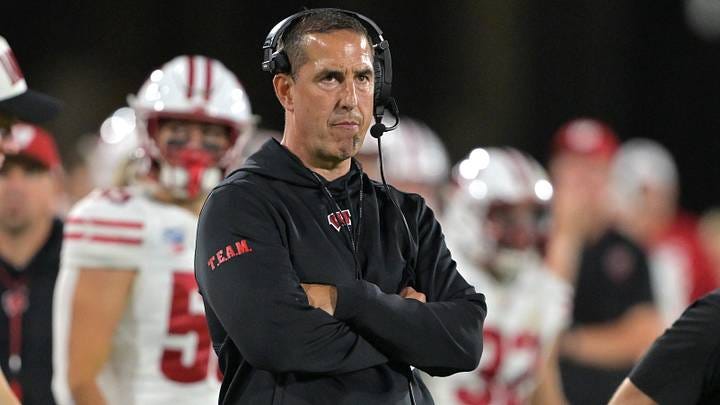
The University of Wisconsin football program has some offensive questions to answer, and Luke Fickell knows the answers won’t be easy.
Coming off a 17-7 road loss to No. 12 UCLA, the Badgers are 4-2 overall and 2-1 in Big Ten play. Their four-game winning streak came to an end in Pasadena, where Wisconsin managed just 214 yards of total offense and struggled to sustain drives.
The Badgers now return home to face No. 16 USC, another opponent that can create problems for a team still searching for offensive consistency.
At Fickell’s press conference, he addressed Wisconsin’s offensive line changes, the need to get its running backs more involved, and the challenge ahead for his defense.
Here are three takeaways from Fickell’s comments.
Wisconsin needs to find a better balance in its running game
One of the more interesting developments from Wisconsin’s loss to UCLA was how heavily the Badgers relied on quarterback Colton Joseph to generate offense.
Joseph carried the ball 18 times for 71 yards and Wisconsin’s only touchdown. Meanwhile, running backs Abu Sama III and Darrion Dupree combined for just 12 carries and 54 yards.
Sama averaged 5.7 yards per carry for 34 yards, while Dupree finished with 20 yards on six carries. For an offense that wants to establish a physical running game, that distribution raises some questions.
Fickell acknowledged that Wisconsin needs to get its backs more involved, but he also pointed to the limited offensive opportunities against UCLA.
“Sometimes it’s hard when you’re playing a multiple of guys. And so to have somebody get into a rhythm is one of those things,” Fickell told reporters. “It’s hard to maybe have a chance to make some plays if you don’t get the ball in your hand. You know, for us this past week, we were limited a little bit.
“They possessed the ball a hell of a lot more... so that goes back to complimentary football of giving us greater opportunities to have the ball to make sure we can move it around a little bit better.”
The Badgers ran just 49 offensive plays compared to UCLA’s 71, with the Bruins controlling possession for more than 37 minutes. That makes establishing a rhythm difficult, particularly when Joseph’s ability to keep the football on designed reads naturally takes opportunities away from the running backs.
“If you’re scoring, if the ball’s moving, if you’re possessing the ball, I think there’s a lot of things you don’t look at as glaring to you,” Fickell said.
Joseph’s rushing ability is undoubtedly an important part of Wisconsin’s offense. But finding a better balance between his carries and those of Sama and Dupree could make the unit more sustainable, especially if the passing game continues to struggle.
Wisconsin continues searching for its best five offensive linemen
Wisconsin’s offensive line has become something of a moving target, with injuries and inconsistent performances forcing the coaching staff to shuffle personnel.
Against UCLA, Stylz Blackmon moved from right guard to center in place of Austin Kawecki, who suffered a broken hand. PJ Wilkins took over at right guard after previously playing left tackle and later switching to right tackle, while Emerson Mandell remained at right tackle after kicking out.
Blackmon’s emergence as a versatile option has been one of the more encouraging developments.
“I think it starts with whatever we’ve asked him to do, he’s done,” Fickell said. “He didn’t start game one, he was rolling. And then after game one, you’re like, wow, he didn’t bat an eye at the situation and how he had to play against a top-tier team in a big venue... so we moved him over there in the bye week, and he didn’t bat an eye at it and handled it really well.”
Blackmon had limited experience snapping the football before the staff moved him to center during the bye week, but Fickell praised how quickly he adapted.
“He’s just a guy that’s been incredibly versatile and everything we’ve asked him to do, he’s been able to do,” Fickell said.
Wilkins’ situation is more complicated.
He’s been used at three offensive line positions this season, and his inconsistency has made it hard to find a permanent home. The staff keeps giving him opportunities, but his performance hasn’t consistently justified the shuffling required to keep him in the lineup.
Against UCLA, Wilkins finished with a season-worst 25.1 pass-blocking grade, according to PFF. He surrendered three pressures and was credited with allowing a sack. Through 307 offensive snaps this season, Wilkins has allowed a team-high 13 pressures and committed four penalties.
Fickell explained that the decision to start Blackmon at center and Wilkins at guard came down to identifying the strongest available combination.
“Through all the things we’ve done, we just felt like that was the best five,” Fickell said.
The challenge is determining whether that combination can provide some stability as Kawecki works toward returning.
“We’ve got to find a way to make sure we’ve got the best five up front in particular every week,” Fickell said.
USC’s passing attack presents another significant challenge
Wisconsin’s defense had been one of the biggest reasons for optimism during its four-game winning streak, but coach Bob Chesney and UCLA exposed some weaknesses that USC is well-equipped to challenge.
The Bruins threw for 264 yards, converted 13-of-20 third downs and repeatedly extended drives through the passing game. Now the Badgers face USC quarterback Jayden Maiava, whose production and ability to extend plays present another difficult matchup for Wisconsin.
Fickell was particularly complimentary of Maiava’s connection with his receivers and the challenges created by USC’s offensive scheme. The Trojans QB1 has thrown for 2,045 yards and 18 touchdowns against just three interceptions while completing 67.9% of his passes this season.
“I mean, they have thrown the ball exceptionally well, and I don’t know that that would surprise you,” Fickell said.
What makes USC dangerous, however, isn’t exclusively its passing game. Fickell emphasized that the Trojans’ counter-heavy rushing attack forces defenses to remain disciplined rather than simply focusing on getting pressure against the quarterback.
“I think that they’re unique in their run game. It’s not like you can fall asleep on the run game,” Fickell said.
Maiava’s ability to move within the pocket while keeping his eyes downfield also complicates matters for a Wisconsin defense that struggled to generate consistent pressure against UCLA.
“His [Maiava’s] connection with the wideouts and his ability to move in the pocket, his ability to even create, not maybe run as much when he creates, but always keep his eyes down the field,” Fickell said. “He’s got a lot of trust in the wideouts, and for a good reason.”
The Badgers have already shown they can compete with quality opponents this season. But the UCLA loss reinforced how quickly things can unravel when they struggle to get off the field defensively, allow explosive plays, and can’t generate enough offense to compensate.
USC will provide another opportunity to see whether Wisconsin can make the necessary adjustments.
We appreciate you taking the time to read our work at BadgerNotes.com. Your support means the world to us and has helped us become a leading independent source for Wisconsin Badgers coverage.
You can also follow Site Publisher Dillon Graff at @DillonGraff on X.