

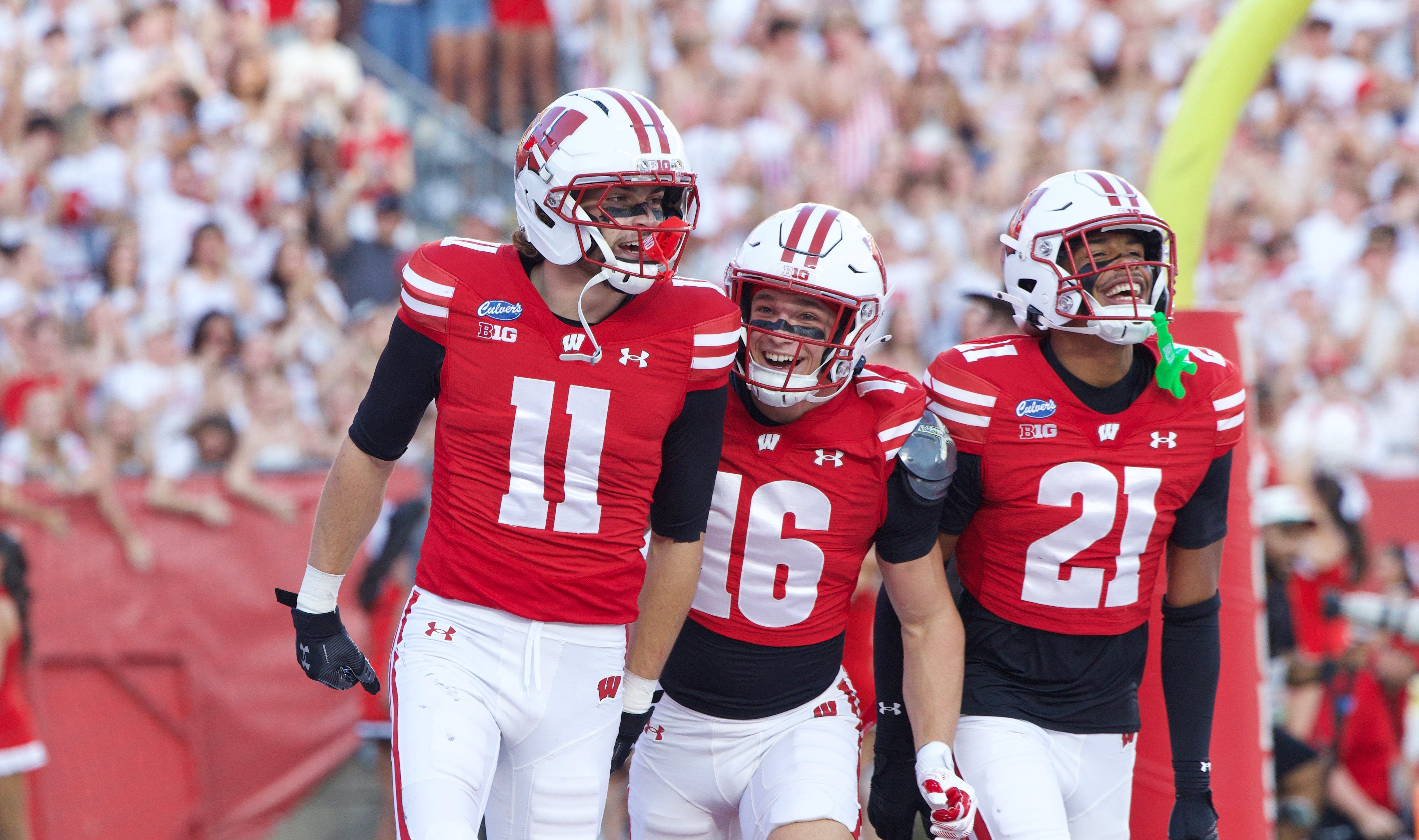
The University of Wisconsin football program got what it needed Saturday night.
A win.
Whether the Badgers got everything they wanted out of it is another question.
Wisconsin scored 17 points in the opening seven-plus minutes against Western Illinois, beginning with Abu Sama III ripping off a 72-yard touchdown on the Badgers’ first offensive snap. Carson Van Dinter later blocked a punt and recovered it for another touchdown. The Badgers appeared well on their way to turning the night into exactly the kind of rout everyone expected.
Then things got a little less convincing.
Wisconsin scored just six points over the remainder of the first half and led 23-6 at halftime before eventually pulling away for a 36-9 win. The Badgers finished with 406 total yards, including 233 on the ground, 173 passing, and averaged 7.7 yards per play. Western Illinois finished with 302 yards and held the ball for nearly 35 minutes.
There was plenty for Luke Fickell to like about Wisconsin’s response coming off the 41-13 loss to Notre Dame. There was also enough uneven football in between the fast start and comfortable finish to keep anyone from declaring all of the Badgers’ problems solved.
Here are three takeaways from Fickell’s postgame media availability.
Wisconsin’s fast start was encouraging. Sustaining it wasn’t as easy
Fickell spent the week talking about maturity and how Wisconsin would respond after getting punched in the face against Notre Dame.
He got the response he wanted immediately.
“Well, the big emphasis for me and for us to start this thing was how are we going to come out of the gates,” Fickell said. “Coming off of a week last week where obviously it would be a disappointing loss and a little bit of a shorter week, a little bit of a new, get into the rhythm of some things. So it was like, hey, we’ve got to have the maturity to come out of these gates with the same energy, the same fire that we did last week.”
Wisconsin did exactly that.
Sama went 72 yards for a touchdown on Wisconsin’s opening possession. Gavin Lahm added a 30-yard field goal, and Van Dinter’s blocked punt touchdown made it 17-0 with 7:54 remaining in the first quarter.
Fickell’s concern was what happened afterward.
“You get out 16 to nothing, and the first thing I think about is, oh no, this is, you know, do you let up,” Fickell said. “You know that sometimes the emotion right away is not what’s best for sustaining things, and maybe I jinxed myself that that’s maybe what happened a little bit.”
Wisconsin’s offense managed just 63 yards in the second quarter, including five rushing yards, while Western Illinois possessed the ball for more than nine minutes.
That gave Fickell another version of the same lesson he took from Notre Dame.
“I think that’s what our guys are going to learn,” Fickell said. “Our ability to sustain emotionally is going to be really important. If there’s one thing that I believe happened to us last week, it was emotionally; the second half took a toll on us.
“And so the focus was, how do we handle that? Well, maybe the toll of the first six minutes emotionally, where you get so high and you aren’t able to sustain that, maybe took a toll on us too. And all these things are where I think we just got to grow from.”
The circumstances were obviously different Saturday. So was the result.
But Wisconsin is still searching for the same thing that Fickell has been talking about since the offseason: making its best football sustainable rather than something that appears in stretches. Unfortunately, that’s hardly a new problem to solve for this program under Fickell.
Wisconsin’s passing game remains a work in progress
Wisconsin found its running game against Western Illinois.
Sama finished with 107 rushing yards on just eight carries, while the Badgers piled up 233 as a team and averaged 7.5 yards per attempt. Darrion Dupree added a 28-yard touchdown in the third quarter on a run up the gut and would finish with 38 rushing yards on the night. USC transfer Bryan Jackson also saw his first meaningful workload, playing 17 offensive snaps, per PFF, and carrying the ball 10 times for 40 yards.
The passing game wasn’t nearly as consistent.
Colton Joseph finished 12-of-22 for 173 yards and one touchdown. Wisconsin’s offense eventually generated some explosive passes, including a 51-yard completion to Tyrell Henry and a 33-yard touchdown to Chris Brooks Jr. late in the fourth quarter. Still, Fickell acknowledged that the Badgers weren’t as sharp throwing the football as he wanted.
“I don’t think that we’re probably as satisfied with the way we threw the football, in particular in the middle of that second third quarter,” Fickell said.
There was some context.
Joseph entered the game still feeling the effects of the hit he took against Notre Dame, according to Fickell, which limited some of what Wisconsin asked him to do during the week.
“You know, he was a little dinged up from last weekend,” Fickell said. “Obviously nothing was ever really said; you know, he wasn’t able and ready to go on Tuesday. He was still a little bit sore from a shot he took.”
Still, Fickell knows Wisconsin can’t allow that to become a limitation moving forward.
“I think all in all, we know we’re going to have to start a little bit better,” Fickell admitted. “I mean, throwing the football in particular, we’ve got to start a little bit better. We’ve got to be able to sustain some things. We’ve got to be a little bit sharper when it comes to throwing the football.”
That’s probably the most important offensive takeaway from Saturday.
Wisconsin can beat Western Illinois without consistently threatening defenses through the air. That becomes a much more difficult proposition once Big Ten play begins. At the same time, the Badgers probably didn’t lean nearly enough on the ground game for a team that has spent so much time talking about building its offensive identity around it.
Special teams are becoming a legitimate weapon
Two games into the season, special teams have been one of Wisconsin’s most consistent strengths.
Liam Danitz got a hand on a Notre Dame punt in Week 1 and nearly did it again in Week 2. Van Dinter went one step further Saturday, blocking a Western Illinois punt and recovering it for a touchdown, while also contributing a pass breakup on defense.
The blocked punt wasn’t necessarily something Wisconsin entered the game expecting to exploit, either.
“To be honest with you, after the first punt rush, he [Van Dinter] made an adjustment,” Fickell said. “He and Coach Lig [Bob Ligashesky] made an adjustment on the side to let him go. And he was pretty adamant about saying, I can get there. And he was right. And so he made an adjustment. He was able to make the play. He was able to finish the play.”
Tyrell Henry had a career night as a pass catcher, hauling in four passes for 91 yards, and also returned a punt 18 yards, while tailback Nate Palmer totaled 126 yards on four kickoff returns, including a long of 42.
Then there was Lahm.
The fifth-year senior, who was a high school teammate of Van Dinter, connected on field goals from 30, 49, and 51 yards, giving Wisconsin another weapon that could matter considerably once the margins become smaller. Lahm’s lone blemish came on a missed extra point.
“Gavin is a weapon,” Fickell said. “He made — I know that what last one was 51. I don’t know what the other ones were. I mean, he can hit them from a bit deeper than that. But what I love is that he didn’t try to overswing.”
Punter Sean West didn’t get much work, but he remains a field-tilter in his own right. West punted just twice against Western Illinois, averaging 46.5 yards per attempt with a long of 54, while placing one inside the 20.
That’s something Wisconsin can feel legitimately good about through two weeks.
The bigger questions remain elsewhere.
Wisconsin did what it was supposed to do against Western Illinois and improved to 1-1. The Badgers ran the football considerably better, created a handful of explosive plays, and once again got meaningful contributions from their special teams.
They also went through stretches where the offense lost its rhythm and allowed an FCS opponent to control the time of possession.
Nobody needed Saturday to prove Wisconsin could beat Western Illinois. What mattered was whether the Badgers could begin putting more of the football team they’ve spent months talking about on film.
There were signs of it.
There are still plenty of reasons to wait before believing it will last.
We appreciate you taking the time to read our work at BadgerNotes.com. Your support means the world to us and has helped us become a leading independent source for Wisconsin Badgers coverage.
You can also follow Site Publisher Dillon Graff at @DillonGraff on X.
If Colton was dinged up, why were there so many QB keepers up the middle? Wouldn't a naked bootleg or two be much safer? Also, since the WUI QB liked to roll to his right on many of his passes, why didn't UW emphasize rushing from our left side instead of the right side?