

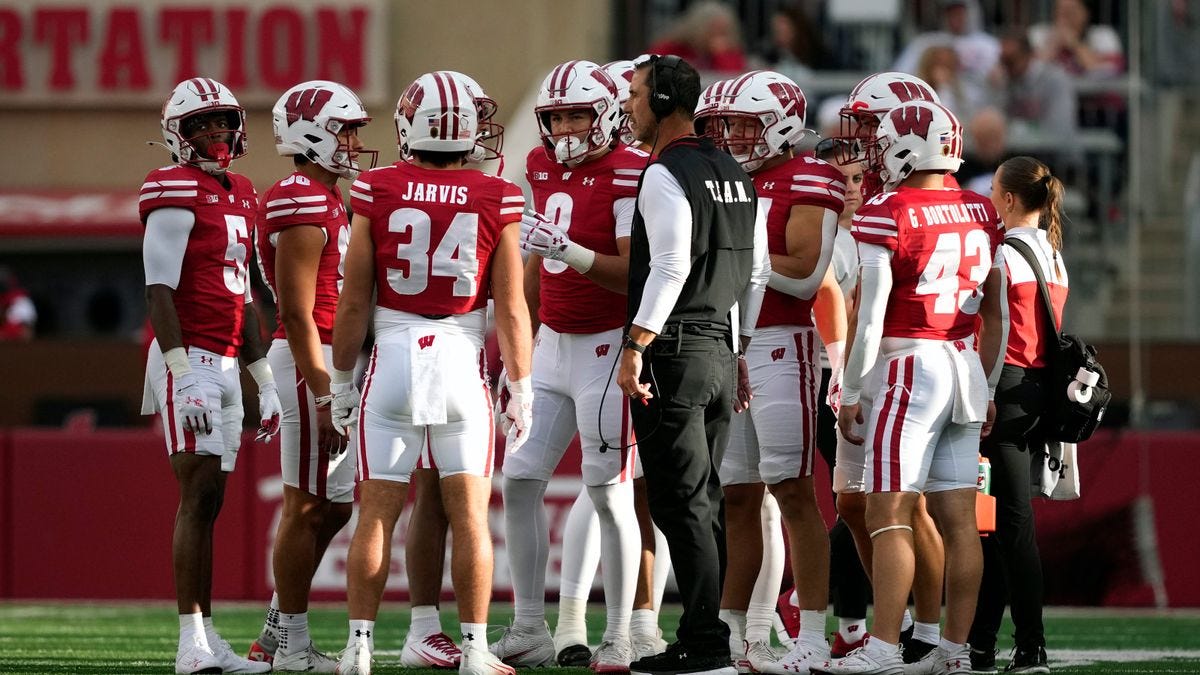
Luke Fickell has spent much of the offseason acknowledging that the Wisconsin football program has not met the standard he inherited or the expectations that followed his arrival.
Now entering Year 4, the question is no longer whether the Badgers understand what has gone wrong. It is whether they are finally close to becoming the football program Fickell believed he was building.
“I think we’re a hell of a lot closer than we have been,” Fickell said at Big Ten Media Days.
That answer reflects the confidence Wisconsin has tried to project throughout the offseason. That’s all well and good, but it also comes after three years of decline, consecutive losing seasons for the first time since the early 1990s, and a roster that required significant reconstruction.
Fickell has taken ownership of a tenure that has produced a 17-21 overall record, a 10-17 mark in Big Ten play, and a 2-11 record against AP Top 25 opponents. He has promised changes, adjusted his offensive approach, and acknowledged that Wisconsin must become tougher, more consistent, and better equipped to compete in the modern Big Ten.
The administration, corporate partners, and NIL donors have also provided the program with the financial support needed to operate more competitively in recruiting and roster retention. That removes one of the obstacles Wisconsin faced during the earlier stages of Fickell’s tenure.
The remaining question is whether those financial investments and changes will finally produce a team that resembles his original vision. Fickell believes the answer begins with the Badgers’ leadership.
“There’s a different vibe within our program, and I think it has so much to do with leadership,” Fickell said. “How good are we? Where will we be? We’ve got a lot of new faces that have come in here, but the great thing is they’ve come in to be a part of us.”
That distinction matters for a roster featuring more than 40 newcomers between transfer additions and incoming freshmen.
Wisconsin has leaned heavily on the transfer portal to repair weaknesses, increase competition and create more depth at several key positions. But Fickell’s larger challenge is ensuring that those additions strengthen the program’s identity rather than forcing it to start over from scratch.
“That’s where I would say we’re a hell of a lot closer to what I envisioned and what a lot of people envisioned the University of Wisconsin football program and team would look like, because it’s about toughness,” Fickell said.
“It’s about leadership. It’s about making people become us, whether they’re from here or they’re coming into here.”
That still falls short of the “championship-level expectations” Wisconsin sold to the fanbase when Fickell arrived — but it sounds closer to a recognizable identity than the program has been at any point during his tenure.
Now, that identity must become visible on Saturdays. The Badgers have reached the point where it can no longer be measured by offseason coach-speak, roster construction or confidence in things we can’t see.
Fickell also acknowledged that the league Wisconsin is trying to climb has improved around it.
“Every team has gotten a hell of a lot better,” Fickell said. “If there’s one thing I could say about this league over the last three years, it’s that even where the top of the league was three years ago to where the top of the league is now, and everybody in between, they’ve increased who they are and how they’ve done things.”
That context makes Wisconsin’s task more difficult. That said, it does not lower the standard, especially after prominent donor Ted Kellner acknowledged the program had been operating in the bottom third of spending and made clear that level of investment would change.
Fickell believes the combination of young, emerging talent, veteran leadership, and greater organizational stability has placed the Badgers in a different position as they enter a make-or-break Year 4.
“Because of that combination of the youth and the leadership and some of the veterans, their willingness to sustain and push through this journey, we’re just in a much different place than we have been over the last three years,” Fickell said.
For much of last season, Fickell looked like a coach who was running out of time. As the losses mounted, “Fire Fickell” chants echoed through Camp Randall, a public sign of how far confidence in the program had fallen. When his former boss gave him the choice to “find an escape route” or recommit to fixing what had gone wrong, Fickell chose to stay.
That choice now defines 2026.
Chris McIntosh will not be around to see the football decision he made through to its conclusion. Fickell will. He believes Wisconsin is closer to the program he envisioned, but belief is no longer enough. This season is his opportunity to prove that staying was more than stubbornness and that the program he chose to keep fighting for can still be turned around.
We appreciate you taking the time to read our work at BadgerNotes.com. Your support means the world to us and has helped us become a leading independent source for Wisconsin Badgers coverage.
You can also follow Site Publisher Dillon Graff at @DillonGraff on X.
@Dillon, The only source of $25,000,000 is a reporter for The Athletic. After that reporter wrote that in an article about LF and the 2026 Badgers, it's been taken as gospel by the 608 media. The New York Times reporter has probably never even been to Madison. "Sources" is fake news' favorite term in fake news articles. I wouldn't hold onto the number 25,000,000 as a stand alone. I'd use "unverified $25,000,000 as written in an article by a NY Times reporter". Remember UW Madison has to report data and cannot bury $25,000,000 somewhere. The Form 990 for 2025 shows no where near $25 million. PS: I hope I'm wrong but I know 608 land. There are no secrets in Dane County.
@Dillon.....Does anyone really know whether $25,000,000 is a real number or not ?; Does anyone really know if Ted Kellner (Bless his heart !) came up with real money as all the media quotes are "he said we need more $" ? The 608 lemmings are taking that as a real amount of money with that number tied "to people who know". Who are the people who know ? 608 is not known for its secrecy. There has to be one bartender, probably at a country club, who knows the real number. Let's find her/him. Until someone identifies a source I'm cynical and doubtful.