

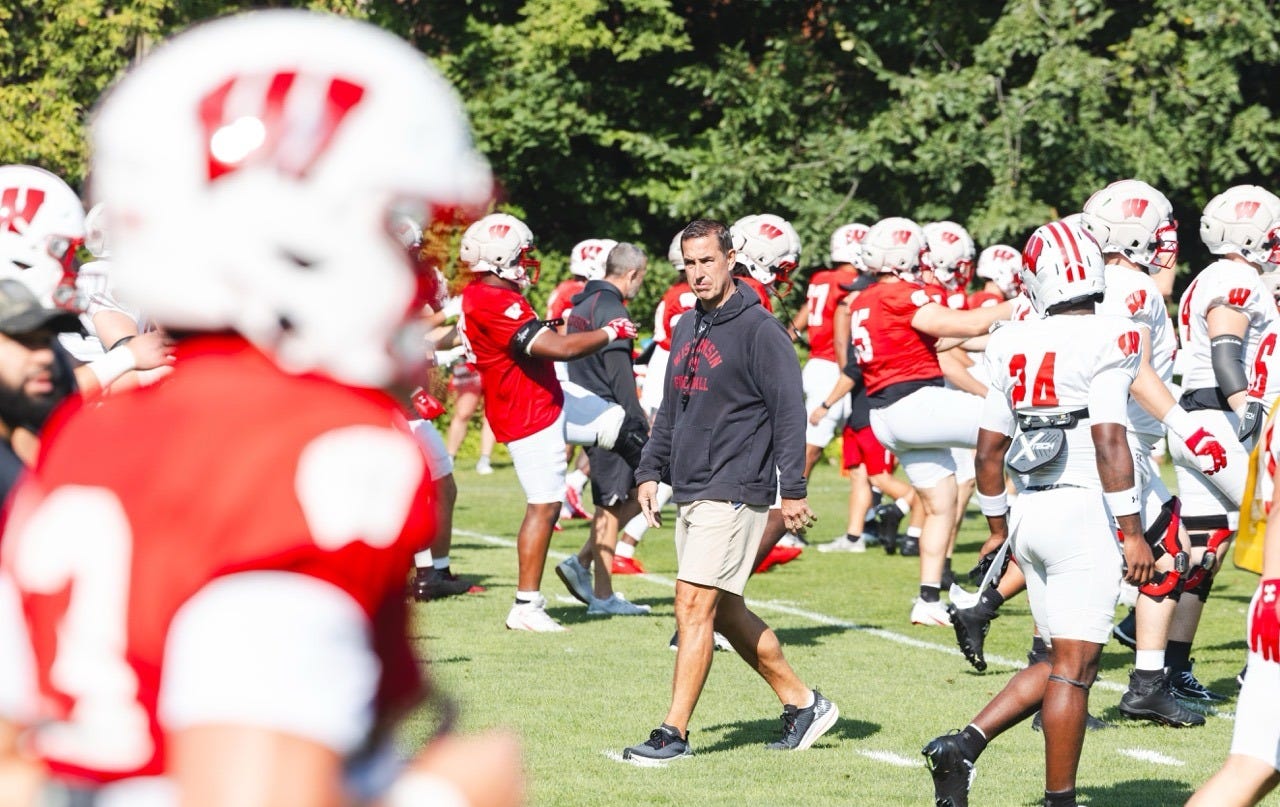
The Wisconsin football team has officially reached the end of the portion of fall camp open to the media.
Luke Fickell’s final availability of training camp came after the Badgers held a scrimmage that provided extended opportunities for several players and gave the coaching staff another chance to evaluate where things stand before preparations shift toward No. 4 Notre Dame.
Fickell isn’t pretending Wisconsin has everything figured out.
In fact, one of his biggest questions entering camp remains one of his biggest concerns coming out of it. But the Badgers’ defensive front has given him more confidence than he had a few weeks ago, increased depth is beginning to show up across the roster, and Fickell believes the overall balance of this team might ultimately become one of its strengths.
Here were the biggest takeaways from Fickell’s final media availability of fall camp.
Wisconsin’s defensive front answered one of Fickell’s biggest questions
Fickell entered fall camp uncertain about what Wisconsin would have up front defensively.
He’s leaving it feeling considerably different.
“I think the strength of the team is balance,” Fickell said. “Even going into fall camp, I was a little bit like, okay, how good can we be up front on the defensive side of the ball?”
The answer has been encouraging enough that Fickell now believes Wisconsin could have as many as nine guys capable of contributing.
That matters for a defense that wants to remain physical without asking the same handful of players to carry an unsustainable workload. It also gives defensive coordinator Mike Tressel more flexibility to keep players fresh and potentially wear opponents down over four quarters.
“I’m not saying it’s a complete strength just yet, but I think that our ability to play with nine guys up there is going to give us the chance to, I think, wear some people down,” Fickell said.
The interior defensive line has been particularly encouraging.
Fickell doesn’t necessarily expect that group to produce the kind of statistics that attract much attention nationally. What has impressed him is its depth, physicality and leadership.
“I think it’s a really solid group,” Fickell said. “I think it’s got some depth. I think it’s got some heart. I think it’s got some different leadership than maybe even we’ve had.”
That’s a meaningful development considering Fickell viewed the rebuilt defensive front as a legitimate question mark when camp began.
Now, it’s one of the areas he feels best about.
The offensive line remains Wisconsin’s biggest question coming out of camp
Not everything became clearer over the past several weeks.
Wisconsin’s offensive line, led by position coach Eric Mateos, remains unsettled, largely because injuries have prevented the Badgers from consistently getting their preferred group on the field.
Kevin Heywood and Emerson Mandell were again among the players held out of team work during the final open practice, leaving Wisconsin with decisions to make before the opener.
“I still think offensive line-wise, with having some guys that haven’t practiced as much, it’s probably where we gotta, these next eight days are gonna be really telling for us,” Fickell said.
The concern isn’t simply identifying five starters.
Offensive line play depends heavily on continuity, communication and developing chemistry between players who have to operate together on virtually every snap. Injuries have forced Wisconsin to rotate players and prevented that process from happening as naturally as Fickell would have liked.
“The hardest position is on the O-line,” Fickell said. “We’ve got to kind of figure some of those things out, and then we’ve got to make some decisions on health and what we can push and what we need to be smart with, too.”
Wisconsin at least has familiarity working in its favor with Heywood and Mandell.
Fickell has coached both for more than two years and believes that knowledge makes it easier to determine how aggressively Wisconsin needs to push them before the season. He joked that both would have participated in the scrimmage if the staff had allowed it.
“You love the guys that you got to protect from themselves,” Fickell said. “But we’ve also got to be smart about that too.”
How healthy Wisconsin gets up front, and how quickly the eventual starting five develops cohesion, could become one of the most important developments before Notre Dame. PJ Wilkins, Colin Cubberly and Austin Kawecki appear set in their starting roles, while the competition at right guard remains unsettled. Lucas Simmons, meanwhile, has stepped in at right tackle with Heywood sidelined, giving the Badgers another option.
Fickell believes Wisconsin finally has more usable depth
Perhaps the biggest difference Fickell sees on this roster isn’t necessarily in any one position.
It’s the number of players Wisconsin’s staff believes it can use.
That showed up during the scrimmage, where injuries and planned absences created opportunities for players further down the depth chart. It has also changed how Fickell is thinking about special teams.
Wisconsin has historically leaned on starters such as Matt Jung, Cooper Catalano and Mason Posa to handle significant special teams responsibilities. Fickell isn’t convinced that will be necessary this season.
“I just feel like we’re in a different spot with some depth,” Fickell said. “Right now, saying, hey, well, I don’t know that we have to play those guys on multiple special teams or even maybe even be a starter right now on a special team.”
That doesn’t mean the decisions have been made.
Younger players such as Donovan Dunmore still have to prove that Fickell can trust them with meaningful special-teams assignments once the games count. But having legitimate options is different from simply filling spots out of necessity.
Fickell sees that depth elsewhere, too.
Grant Stec has developed into one of Wisconsin’s most dependable and versatile tight ends. Shamar Rigby has worked his way back from an injury that limited him for much of camp and showed Fickell encouraging signs during the scrimmage. Darrion Dupree handled an increased workload at running back and demonstrated progress toward becoming someone the Badgers can rely on in all three phases of the position.
Fickell believes that depth contributes to what he repeatedly described as the roster’s improved “balance.”
“I would say the biggest thing is the balance,” Fickell said. “The thing I feel like we’ve got is that there’s a different nature to that complementary football and the balance to what it is that we do offensively, defensively, but even so within the entire program of the leadership.”
That last part remains important to Fickell.
He was encouraged by the way Wisconsin competed during its final open practice, particularly after the staff backed off some of the physicality in the preceding days. Even players unable to participate remained engaged and helped push teammates through the scrimmage.
Fickell doesn’t want that responsibility falling exclusively on a few established leaders.
“Leadership never rests,” Fickell said. “It’s a consistent thing that you got to be every single day.”
Fall camp is effectively over from the outside looking in. Wisconsin will now begin narrowing rotations, making decisions on injured players and determining exactly what it wants to carry into Week 1 preparation.
There are still questions, particularly along the offensive line. And after three consecutive seasons of declining results, anything Wisconsin believes it accomplished during August ultimately has to survive contact with an actual opponent. But Fickell leaves camp believing this roster has more balance, more usable depth, and fewer glaring weaknesses than the one he coached a year ago.
Now comes the part that actually determines whether any of it matters.
We appreciate you taking the time to read our work at BadgerNotes.com. Your support means the world to us and has helped us become a leading independent source for Wisconsin Badgers coverage.
You can also follow Site Publisher Dillon Graff at @DillonGraff on X.