

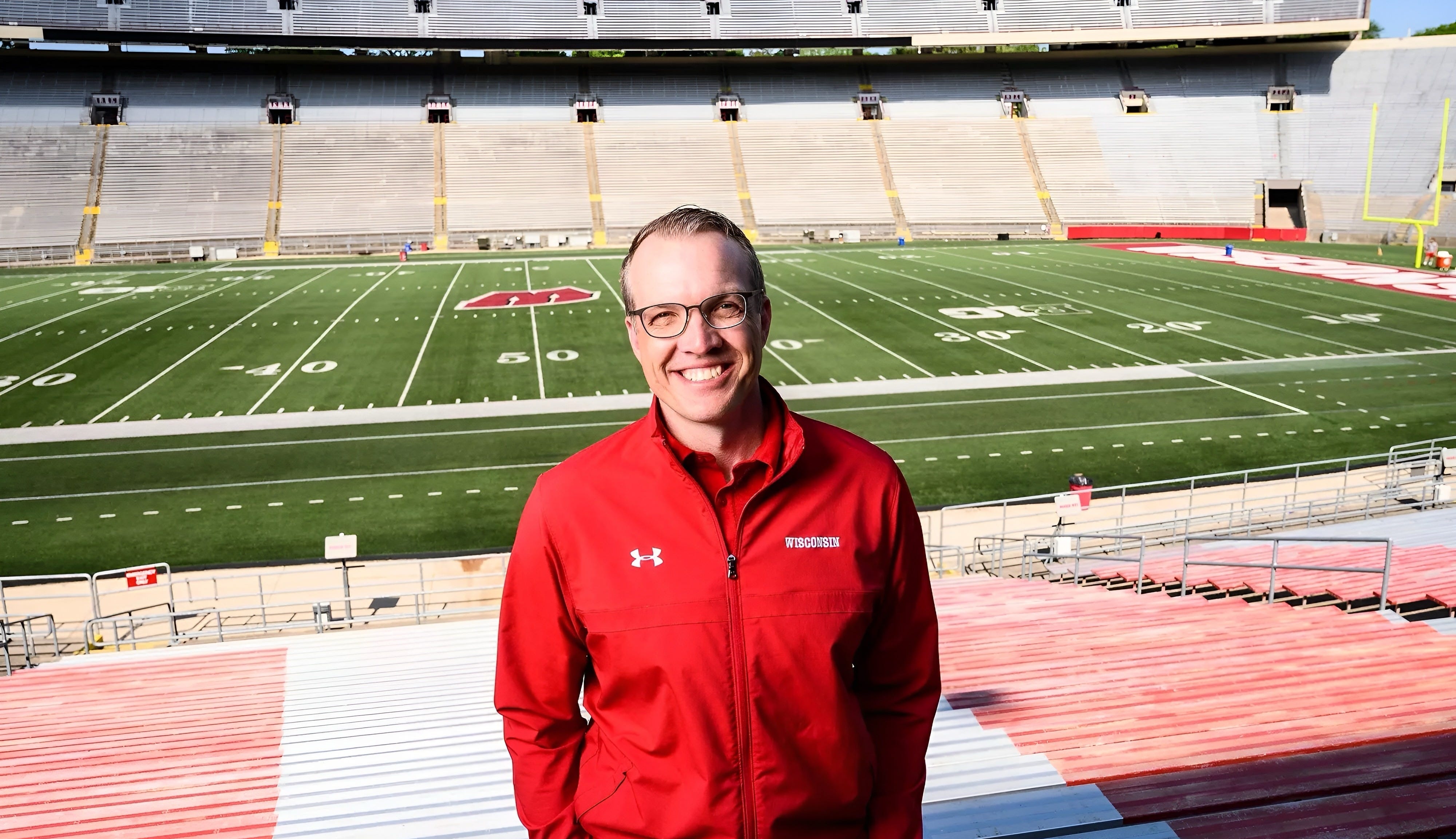
The University of Wisconsin will soon be in the market for a new athletic director.
With Chris McIntosh reportedly stepping aside to take a role as Deputy Commissioner for Strategy within the Big Ten, Wisconsin is now staring down a leadership transition at a time when the athletic department can least afford uncertainty.
With Chancellor Jennifer Mnookin already on her way out and broader uncertainty across the university system, Wisconsin now faces the task of replacing two of its most important decision-makers in the middle of one of the most volatile eras in college sports history.
In the meantime, deputy athletic director and football general manager Marcus Sedberry is expected to step in as interim athletic director, while Eric Wilcots, set to become interim chancellor following Mnookin’s departure, will help oversee the hiring process moving forward.
McIntosh, who took over for Barry Alvarez in 2021, framed his departure with appreciation when speaking to Sports Business Journal.
“To be able to work for the University of Wisconsin and certainly for the last five years as athletic director, to be able to pour everything I had into transitioning Wisconsin into a changing world, it’s just been an honor,” McIntosh said.
“I’ve said along the way that the best thing about Wisconsin is the people. I’ve been surrounded by the best people and people who care about, first and foremost, our student athletes and about the university. They’ve just given everything to making Wisconsin the best it can be.”
And while that sentiment reflects the pride of a former player turned administrator, evaluating his tenure is more complicated.
There were real successes. The Badgers captured four NCAA championships during McIntosh’s time at the helm, with volleyball breaking through in 2021 and women’s hockey continuing its dominance with national titles in 2023, 2025, and 2026. Those programs didn’t just sustain excellence — they reinforced Wisconsin’s identity as one of the nation’s premier all-around athletic departments.
But the conversation around McIntosh’s legacy will almost certainly begin and end with football.
His defining decision came when he moved on from head coach Paul Chryst midseason in 2022, passing over Jim Leonhard for the job and hiring Luke Fickell away from Cincinnati. It was bold. It was aggressive. And it was meant to signal that Wisconsin was ready to evolve.
Instead, the results have been uneven at best. Even if the hire itself made sense at the time, the program wasn’t funded properly from the start. It took way too long to adjust, and that falls on the athletic director.
Fickell holds a 17–21 overall record and is 10–17 in Big Ten play through three seasons, with the program coming off back-to-back losing campaigns, including a 4–8 finish in 2025. Attendance at Camp Randall has dipped. Fickell is firmly on the hot seat, the fanbase hasn’t exactly rallied behind him, and his buyout still sits north of $25 million.
That matters because the next athletic director won’t be walking into a blank slate. They’ll inherit a high-stakes decision already in motion, one that may soon require another course correction.
At the same time, they’ll be tasked with navigating an NIL landscape that Wisconsin was slow to fully embrace. While recent efforts, including a legislative push that secured $14.6 million annually in public funding for NIL-related initiatives, show a program trying to catch up, the perception is that the department spent too much time reacting rather than leading.
In many ways, the push to get the football program back on track has led to an overcorrection. A significant share of resources is now being funneled toward football because it drives the department’s financial engine.
That reality has left programs like men’s basketball in a position where they’re still expected to compete at a high level despite operating with an NIL budget that sits in the bottom third of the Big Ten.
That’s the challenge ahead.
The next athletic director must be both steady and forward-thinking. Someone who understands that success in today’s college athletics isn’t just about hiring the right coaches, but about funding them, supporting them, and positioning them to win in an increasingly professionalized environment. It needs to be someone who can also raise the resources necessary to field rosters capable of truly competing in the Big Ten.
There is, however, a foundation to build on.
Wisconsin still boasts elite programs in volleyball under Kelly Sheffield, women’s hockey led by Mark Johnson, and men’s hockey under Mike Hastings, along with a men’s basketball program that has maintained national relevance under Greg Gard. The infrastructure is there.
The expectations are clear. But so is the pressure.
Because this isn’t the same job that Pat Richter held when he helped pull the department out of financial instability in the 1990s. It’s not even the same one Barry Alvarez handed off to McIntosh in 2021. The rules have changed. The stakes have risen.
And now, the next person in that chair will be asked to navigate all of it while determining the department’s future, which still drives everything.
We appreciate you taking the time to read our work at BadgerNotes.com. Your support means the world to us and has helped us become a leading independent source for Wisconsin Badgers coverage.
You can also follow Site Publisher Dillon Graff at @DillonGraff on X.
Good riddance. Lets get someone in there who knows the current landscape of college athletics something McIntosh has failed to grasp until this off season with football. Sounds like Mens basketball could use a larger injection too. Hastings has been his best hire but that was after sticking with Granato way too long.