


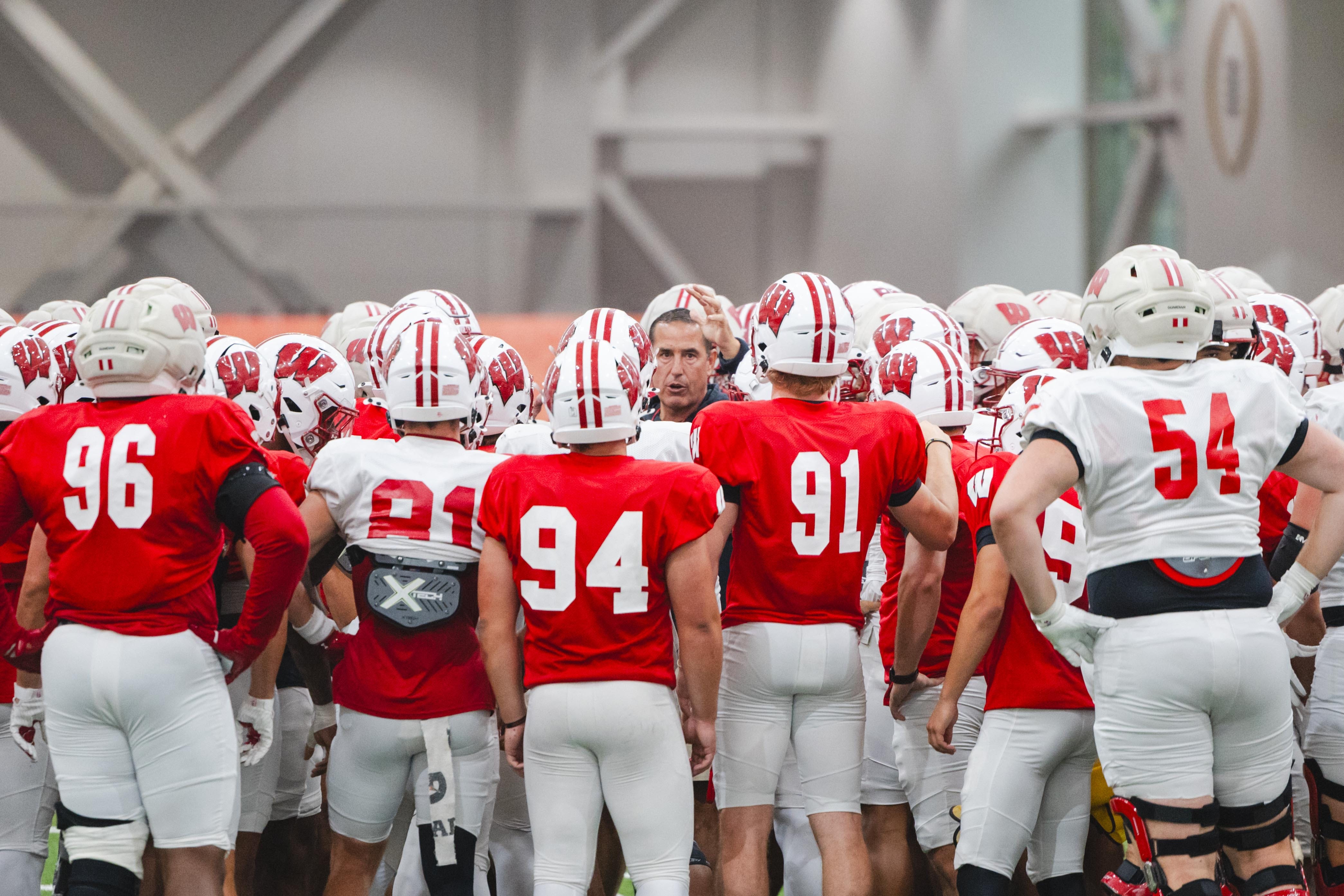
There’s only so much we can actually learn about a college football team before the games begin. But after an offseason spent listening to the Wisconsin football coaches and players, studying the roster, reviewing the numbers, and evaluating what we know from previous seasons, we’ve developed a much clearer idea of what this team could be in 2026.
Some of these predictions will inevitably be wrong. That’s part of making judgments before we have real games to evaluate.
But with fall camp now closed and Week 1 just around the corner, it’s time to put those expectations on the record. For our preseason roundtable, the BadgerNotes staff weighed in on what we expect from Wisconsin’s offense, defense, and, ultimately, where the Badgers will finish in 2026.
How good will Wisconsin’s offense be in 2026?
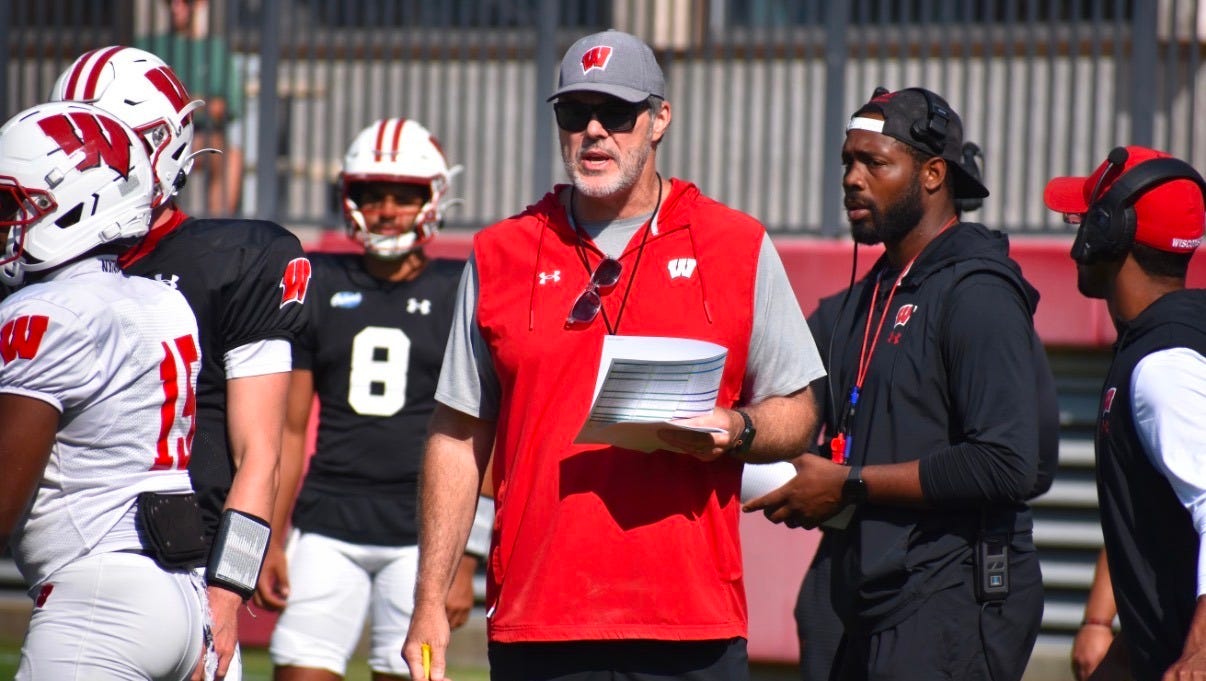
Dillon: I feel considerably better about Wisconsin’s offense than I did a year ago.
That doesn’t mean I’m ready to call it good.
Colton Joseph changes the equation because of what he can do with his legs. He gives Wisconsin a legitimate running threat at quarterback, can extend plays when protection breaks down, and should force defenses to account for one more player in the run game. That alone should raise the floor of an offense that finished near the bottom of college football last season.
The Badgers also have more options around him. Abu Sama III and Darrion Dupree give Wisconsin a backfield it feels good about, with Bryan Jackson and Nate Palmer providing additional depth if healthy. The tight end room looks solid and versatile, and the receiver room has enough different pieces that Wisconsin shouldn’t have to rely on one player to carry the passing game.
If injuries strike at quarterback, Deuce Adams and Ryan Hopkins also give the staff backups with enough mobility that the offense shouldn’t have to completely reinvent itself.
That’s all encouraging.
What I’m not willing to do is take those improvements and automatically project Wisconsin into becoming a dynamic offense.
We’re talking about a unit that averaged 12.8 points and 253.1 yards per game last season. That lack of production doesn’t disappear because the roster looks better on paper. There are still legitimate questions about the passing game, and the biggest concern remains up front.
Wisconsin has spent much of fall camp without Kevin Heywood and Emerson Mandell involved in team work. PJ Wilkins, Colin Cubberly and Austin Kawecki appear settled into starting roles, but the right side remains more fluid, with Lucas Simmons working at right tackle and several players getting opportunities at right guard. Maybe everyone gets healthy, and the group comes together quickly. That’s certainly possible.
But offensive line play depends so heavily on continuity that I’m hesitant to assume it will immediately become a strength after spending the month of August constantly shuffling pieces.
That matters because I think Wisconsin’s best version offensively is still going to be built around running the football, controlling the clock, and keeping Joseph out of obvious passing situations.
Joseph doesn’t need to become an elite Big Ten passer for this offense to take a significant step. He needs to protect the football, make enough throws when defenses force him to, and stay healthy enough for his legs to remain a central part of what Jeff Grimes wants to do. If the offensive line can consistently move bodies and the running backs hold up, Wisconsin should be considerably more functional.
I just think there’s a big difference between functional and explosive.
Nothing we’ve seen during Luke Fickell’s first three seasons suggests Wisconsin deserves the benefit of the doubt offensively yet. The personnel looks better. The scheme should fit the roster better. There are more players the staff can reasonably trust.
That’s enough for me to believe Wisconsin can go from one of the worst offenses in the entire country to a competent one.
Anything beyond that, especially projecting a strong passing attack and a consistently explosive offense, feels like something Wisconsin still has to prove rather than something I’m willing to assume before Week 1.
Christian: After watching a handful of practices during fall camp, I have a much better idea about how I feel about this team heading into the season than I did three weeks ago.
First, the offense is still clearly a work in progress. Every position looks drastically different than it did a year ago. When that happens, it takes a bit for everyone to gel together. The offense looked overwhelmed at times in practice, but you could also chalk some of that up to injuries.
The Badgers were without their starting right guard and tackle, Emerson Mandell and Kevin Heywood, for most or all of camp. On top of that, running backs Bryan Jackson and Juju Pope missed a good amount of practice time with injuries.
But there were glimpses of what the offense could be. They busted a few runs with gaping holes along the line, or connected on a long pass from time to time. It gives you a little hope that as the season progresses, this side of the ball can move the ball and put up some points.
Charlie: I’ve said this a few times inside Bucky’s Burrow already, but this offense lives or dies on how well Colton Joseph runs the football. The last few years we’ve been one-dimensional. Unable to throw it, and barely able to run it either. That’s how we ended up with one of the worst statistical offenses of any Power Four team since the turn of the century.
Joseph’s legs bring a dimension Badger fans haven’t seen since Russell Wilson. And the coaching staff has a track record here. New offensive line coach Eric Mateos came from a system in which Taylen Green ran for 777 yards and eight touchdowns. Jeff Grimes at Kansas? 439 yards rushing and six scores from Jalon Daniels. Fickell’s playoff team at Cincinnati? 592 yards and 12 touchdowns from Desmond Ridder. CoJo is the perfect prototype for this scheme.
The question is whether his game translates from the Sun Belt to the Big Ten. He carried it more than 13 times a game last season, and I’d expect something close to double digits again, especially in the games that matter.
The bigger question is whether this team can move the ball through the air. There are no proven threats at receiver, and that room worries me. Tyrell Henry and a few of the tight ends feel like sleepers who could carry more of the passing game than people expect.
On the ground, outside of CoJo, I love the backs we brought in, Sama especially. And I think Darrion Dupree ends up with a bigger role than most are anticipating. If the quarterback and offensive line stay healthy, this offense is good enough to get the job done. That’s a big if.
How good will Wisconsin’s defense be in 2026?
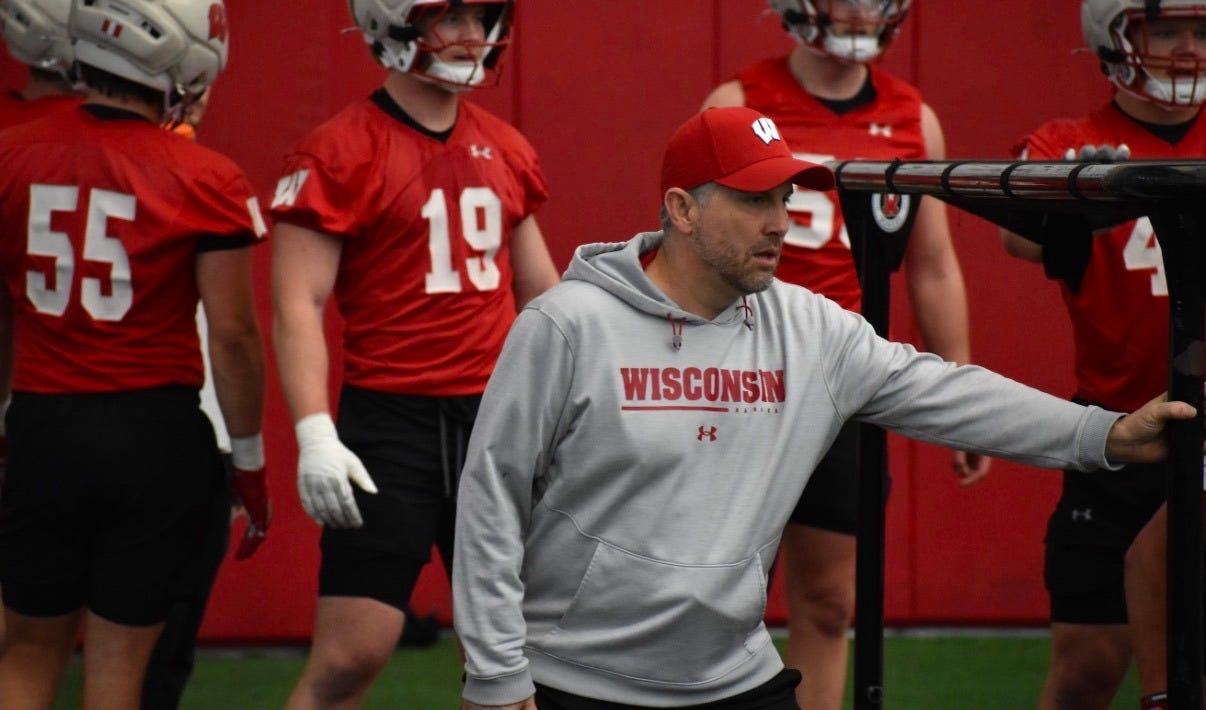
Dillon: It goes without saying that Wisconsin invested heavily in rebuilding this roster during the offseason, and there’s nowhere I’m more interested in seeing the payoff than on the Badgers’ defense.
This is still a unit returning only three starters from a 4-8 team: Mason Posa, Cooper Catalano, and Matt Jung. But that number doesn’t tell the whole story. Wisconsin retained important pieces such as Charles Perkins and Sebastian Cheeks, then used the transfer portal to completely remake several areas of the defense and, more importantly, to stack the depth chart with players it believes can actually play and be trusted.
That’s probably what I like most about this group.
There aren’t many places where Wisconsin looks like it will be forced to survive with one or two options. This staff wants to rotate players and match their personnel to the opponent. The Badgers have different body types and skill sets off the edge, with Cheeks looking ready to take another big step. And behind all of it are Posa and Catalano, two players I already trust to make plays and set the tone in the middle of the defense.
The secondary is where I’m most interested to see whether the offseason investment pays off.
Wisconsin was too one-dimensional defensively a year ago. The Badgers could stop the run, but too often couldn’t hold up when teams attacked them through the air. They’ve essentially rebuilt the cornerback room around Javan Robinson, Jai’Mier Scott and Bryce West, with Eric Fletcher and Cai Bates providing additional options. The staff clearly feels better about its ability to play man coverage and hold up on the perimeter.
If that’s real, it changes quite a bit.
A secondary capable of surviving on its own gives Mike Tressel more freedom with everything happening in front of it. Pair that with what I expect to remain a strong run defense and enough depth along the defensive front to keep bodies fresh, and I have a hard time seeing this defense being anything worse than really good.
Whether it can become great probably comes down to takeaways.
Wisconsin created just six last season, the fewest in the country, and that’s been a recurring problem for Tressel’s defenses in Madison. The staff has made attacking the football a major emphasis throughout the offseason. Now somebody has to actually turn those opportunities into possessions when the games count.
I’m not sure how many All-Conference players this Wisconsin defense will ultimately have, but I don’t think it needs a ton of them to be effective. If a few emerge, though, that could significantly raise the ceiling of this unit.
Maybe Cheeks becomes a stud pass rusher. Maybe Marvin Burks Jr., Javan Robinson, or another member of the secondary becomes a difference-maker. Maybe Posa and Catalano build on what they showed as freshmen and establish themselves as stalwarts in the middle of the defense. With a deep defensive line keeping blockers occupied and creating opportunities for everyone behind it, there should be enough talent for playmakers to emerge.
The larger question is whether Tressel can put all of it together.
There have been shortcomings along the way during his first three seasons, but Wisconsin also appears to have a much clearer understanding of what it wants to be defensively. Tressel has now had another offseason to recruit and deploy players who fit that vision.
I’m considerably more willing to give this side of the ball the benefit of the doubt.
I think Wisconsin will have a really good defense (top 30 or better). If the rebuilt secondary holds up, the pass rush becomes disruptive, and the Badgers finally start taking the football away, great isn’t out of the question.
Christian: Defensively, I came away very impressed. The staff did a nice job of bringing in some veterans to mix with the young talent on the roster. The depth at key positions like defensive line and edge is impressive, and this is one of the fastest and most athletic secondaries I’ve seen at Wisconsin in quite a while.
They are aggressive and physical, with an edge to them. Even if the offense can’t get things going (again) this season, the defense will be enjoyable to watch.
I think this unit will give the Badgers a shot any given week, buying time for the offense to get going.
Charlie: I have high expectations for this defense and think it will be Fickell’s best at Wisconsin. After Mike Tressel’s first season as defensive coordinator, I was skeptical, but he’s proven himself since then, both with last year’s unit and with the recruiting job he’s done in finding talent.
Mason Posa and Cooper Catalano anchor things at linebacker after breakout freshman seasons. They swarm the football and should help Wisconsin field one of the better run defenses in the country. Interior transfers Hammond Russell and Junior Poyser will eat up blocks and let those two run free.
The question marks are the pass rush and the secondary. Wisconsin’s rush turned it up late last season, but much of that talent is gone.
Sebastian Cheeks returns, and I’m high on him. I think he could be a top five player on this team. They’ll need someone else to step up opposite him, and I expect Nick Clayton to claim that spot at some point. Justus Boone/Tyrese Fearbry are older guys who could also make an impact.
I’m far more confident in this secondary than last year’s. It’s a more talented and physical group of transfers than fans are used to seeing at the position. I think not only the starters, but the depth of this defense is what makes it special. Young guys all over, like Cairo Skanes, Jai’mier Scott, and Jon Jon Kamara, could all break out.
If the pass rush can generate consistent pressure, this defense has a chance to be one of the best in the Big Ten.
Wisconsin football 2026 record predictions
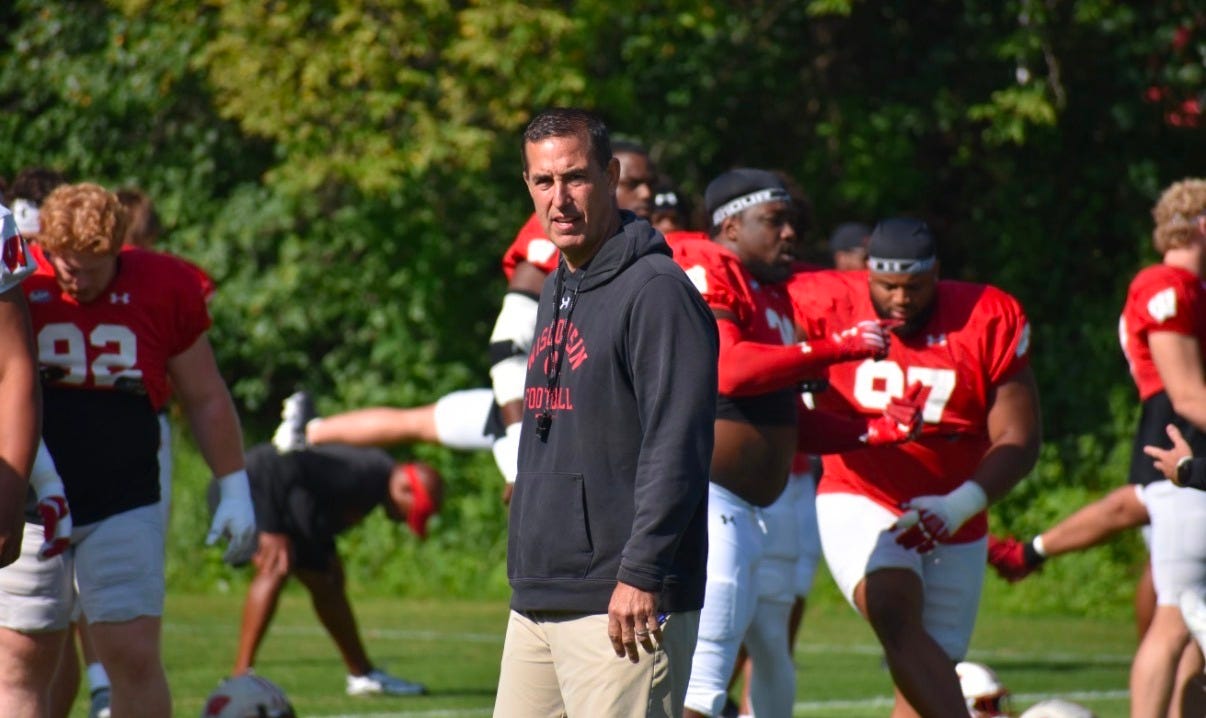
Dillon: You can count me among those who believe Wisconsin is headed in a better direction. The program invested significantly more money in the roster, and I think the staff legitimately feels better about its depth, competition, and the number of playable options at its disposal.
But after three years of declining results, I’m not willing to give Luke Fickell and this staff the benefit of the doubt until they earn it.
I have Wisconsin losing to Notre Dame before beating Western Illinois and Eastern Michigan. The stretch from Penn State through Iowa is where I think we’ll really learn where this program stands. Right now, I have losses at Penn State, UCLA, and Iowa, and a home loss to USC. Michigan State is closer to a toss-up for me, but I’m leaning toward a loss because they often play down to opponents. I have Wisconsin finishing with wins over Rutgers, Maryland, Purdue, and Minnesota to reclaim the Axe.
That puts me at 6-6, with 7-5 probably the highest I’m willing to go entering the season if the Badgers beat Michigan State or UCLA.
Wisconsin should return to a bowl game after a two-year absence, but given the resources poured into this roster, I view that as the absolute floor rather than something worth celebrating. I’d love to be wrong and find out that additional resources were what Fickell needed to turn this around. But after three disappointing years, I need to see some evidence that they’re finally making tangible progress before I buy anything more.
Christian: If I had to make a prediction right now for the 2026 Wisconsin football team, I would have them going 8-4. They are headed in the right direction, and with a favorable schedule, I think they will be bowl-bound again after missing out in back-to-back seasons.
I think Notre Dame is an incredibly difficult game to open the season with so many new players on the team. Going against one of the toughest defenses in all of college football is going to be one hell of a challenge for Jeff Grimes and the Badgers’ offense.
I think losses to Penn State, USC, and one more game, maybe Iowa or Michigan State, could be in the cards. But an 8-4 record with a win over Minnesota (and potentially Iowa) and a return to a bowl game will save Fickell’s job and give him a chance to continue building this program in the right direction in 2027.
Charlie: I have the Badgers finishing 7-5, struggling again against Minnesota and Iowa, with Luke Fickell ending the year back on the hot seat and plenty of people in the fanbase doubting whether he can build anything significant at Wisconsin. Ultimately, Fickell gets another year.
Colton Joseph returns for his senior season, and a strong homegrown 2027 recruiting class comes in. With another manageable schedule in 2028, that becomes the real deciding year.
We appreciate you taking the time to read our work at BadgerNotes.com. Your support means the world to us and has helped us become a leading independent source for Wisconsin Badgers coverage.
I think the biggest question will be if they can move it through the air if teams stop the run